Warehouse & Storage Pest Prevention in Vancouver & Fraser Valley
Phantom Pest Control’s warehouse and storage pest prevention program puts warehouses, distribution centres, 3PL buildings and self-storage facilities in Vancouver, BC and the Fraser Valley on a schedule of visits. Each visit services numbered stations, traps and stored-product monitors, checks the doors pests use, and ends with a written report.
Visits
On a schedule set for your site
Each visit
Service area
What Warehouse and Storage Pest Prevention Covers
Warehouse and storage pest prevention is built to catch pests early, while there is one mouse at a dock door or a few moths in one aisle, rather than after stock is damaged. Stations, traps and monitors stay in place between visits, each with a number on the site’s device map, and every visit counts them, checks the doors and writes the result down.
SQF’s code for storage and distribution sites uses the same name, a pest prevention program, and asks for more than a contractor’s visits: trained site staff inspect for pest activity on a regular basis too, and records of every inspection are kept. The program’s device map, counts and reports give that file its contractor side, and food-grade sites keep them as their audit file. The pests themselves, B.C.’s bait rules and the first walk-through of a warehouse are on our warehouse pest control page.
Refrigerated and freezer buildings have their own page, cold storage pest control, and cold stores that hold food have our food facility pest prevention program. A site that only needs monitoring has our pest monitoring program, Pest Watch, and a site that only needs rodent work has the rodent maintenance program.
Every truck at a dock and every tenant at a unit opens a way in, and a worn door bottom leaves one after the door shuts.
In commercial buildings, mice often come in on packaged goods or delivery vehicles, the University of California’s IPM program notes.
The Canadian Grain Commission says the Indianmeal moth’s life cycle continues year round in heated buildings.
HealthLinkBC lists cleaning unused buildings among the activities that raise the risk of hantavirus from deer mice.
Damaged packaging, chew marks and webbing are among the signs CFIA’s guidance has monitoring look for.
The Canadian Conservation Institute notes that mice can nest in stored fabric, and rodents damage anything they can chew or gather for nesting.
What the Devices Watch For
Rodents and the insects that live in stored goods are what the devices watch for. Each row notes what matters for monitoring and links the page that covers the pest in full.

They seldom go more than about 9 metres (30 feet) from their nest and food, the University of California’s IPM program says, so traps sit close together where mice are active.
HealthLinkBC names the deer mouse as the hantavirus carrier in Canada; house mice and rats aren’t known to spread it.

Their traps draw adult males and won’t catch beetles, the University of California’s IPM program says, so moth and beetle monitors are separate devices.

Cast larval skins are the clearest sign of them, the Canadian Grain Commission says, and the larvae get into packaged food.
Larvae burrow into packages and can bore through cardboard; the adults live about 25 days and can chew the structures around the stock, the Canadian Grain Commission and University of Florida extension note.
They have wings but don’t fly, NC State Extension notes, and TG 27, the U.S. military’s stored-product monitoring guide, finds them with food-oil lures and glue boards rather than a sex lure.
Clothes moths can damage wool, carpets and upholstery and are common in rodent and bird nests, the Canadian Grain Commission says; B.C.’s guide finds the varied carpet beetle more abundant on the coast.
Photograph the insect, the packaging or the droppings, and add the photos to your estimate request.
What Each Season Means for a Storage Building
Some pressure follows the weather and some doesn’t. The bars show months taken from the source named in each row; the three rows under the chart hold in any month.
Each bar turns the season its source names into calendar months: B.C.’s rodent guide, Phantom’s rodent control page and the U.S. military’s TG 27 guide.
B.C.’s rodent guide for homeowners asks for inspections at least twice a year, ideally in spring and fall.
TG 27 runs its warehouse insect traps from at least April through October in temperate climates.
TG 27 notes that insects may move into a building from the surrounding area as the season changes in fall.
Phantom’s rodent control page notes that rodents look for food, shelter and warmth inside, especially in the colder or wet seasons.
Any month
TG 27 recommends year-round monitoring where warehouses are heated, with traps or lures changed more often.
Silverfish leave ragged holes in paper and booklice graze damp surfaces, the Canadian Conservation Institute notes; both point to damp storage.
The Canadian Grain Commission says the black carpet beetle can develop from as low as 2 °C, so a cold unit isn’t off-season for it.
Where a Prevention Visit Checks, Stop by Stop
A visit covers the outside, the docks, the warehouse floor, and the self-storage doors, corridors and office. The letters match the drawing.
- AStations on the walls
Locked stations against the outside walls of both buildings, each opened, serviced and counted by its number.
- BBins & compactor
The stations nearest the bins and compactor, checked and counted like the rest.
- CDocks and leveller gaps
Door seals, door bottoms and the gaps beside levellers, with gaps up to a toonie sealed on the visit.
- DReturns cage
Monitors where returned and damaged stock waits before it goes back into the racking.
- ERacking monitors
Pheromone and sticky monitors in the racking, and traps along the walls, each with its number.
- FStaff room
Traps where staff eat and keep food, checked and counted each visit.
- GDrive-up unit doors
The bottoms of the drive-up unit doors, where a worn edge leaves a gap at the slab.
- HIndoor corridors
Traps along the corridors between the units, each on the map.
- IStorage office
Traps in the office, checked and counted with the rest.
What Your Team Does Between Visits, and What the Technician Does
Staff and tenants see the building every day, so a few habits catch problems between visits. Devices, pesticides and sealing stay with the technician.
Your team
Note what was seen, where and when on one sheet; SQF’s storage code asks the sites it certifies to record and trend sightings.
A sign at the office asking tenants to report droppings, gnaw marks or insects, with the unit number.
Unit rules that keep food and pet food out leave rodents and stored-product insects less to find.
The technician
Opened, serviced and counted by number every visit.
Checked every visit, with follow-up wherever moths or beetles show.
Checked every visit: gaps up to a toonie sealed then, larger openings quoted as exclusion work.
Written after every visit, with the counts set against earlier visits.
What to Expect on Each Prevention Visit
The free site inspection sets the program up, and every visit after it runs the same way.
The first walk-through covers the outside, the docks, the floor and any unit rows, and the quote is built from what it finds.
Stations outside and traps inside get a number on the device map, with monitors in the racking, returns and damaged-goods areas.
Each visit opens every device, services it and records its count against its number.
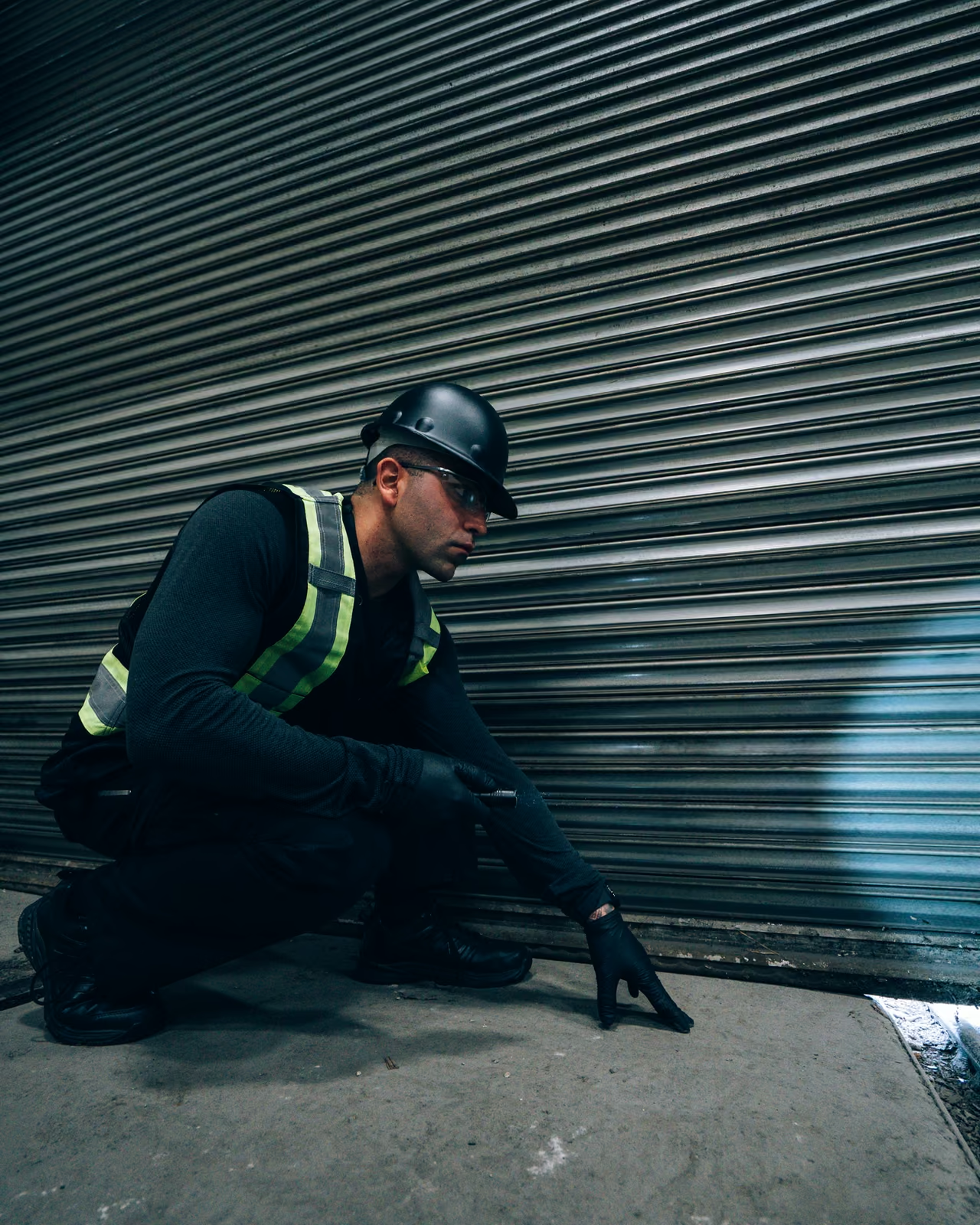
Seals, door bottoms and leveller gaps are checked; toonie-size gaps are sealed and larger openings quoted.
A written report closes every visit, with the counts set beside earlier visits.
The regular maintenance page lists every scheduled program, including monitoring-only and rodent-only visits.
What to Have Ready for the First Visit
Six things that help the first visit set the program up. Phantom’s preparation sheets for treatments are on our client forms page.
It helps the first visit place and number the devices, so mark the docks, doors and any unit rows.
Food, textiles, paper or mixed goods: what’s stored decides where monitors go and what the stations may hold.
If the site is SQF, BRCGS or AIB audited, send the clauses your auditor checks.
SQF asks contractors to report to a responsible person on arriving and after the work, so name that person.
How the technician reaches the corridors, drive-up rows and office, and which hours suit tenants.
If you have them, they show where activity was before the first visit.
After Each Visit: Counts, Trends and the Report
What you receive after each visit, and what it shows.
The report
Written after every visit.
Counts by number
Each station, trap and monitor, against its number on the map.
The trend
Each count beside earlier visits, so a rise stands out.
Door repairs
Toonie-size gaps sealed on the visit; larger openings quoted as exclusion work.
The audit file
For food-grade sites: the map, reports, trend summaries and corrective-action notes.
The visit report is yours to keep. Separately, section 35 of B.C.’s Integrated Pest Management Regulation has the licensee record each pesticide use, and section 83 keeps those records for 3 years.
Call or text 604-771-0404 about a sighting, a chewed carton or a new gap.
What a Moth in a Pheromone Trap Tells You
A moth in a pheromone trap shows that one species, or a close relative, is present and roughly where, not how many there are. Many stored-product lures copy the scent a female uses to draw males of her own species. TG 27, the U.S. military’s monitoring guide for food warehouses, reads each trap against its own history, because no standard number turns a catch into an infestation level.
Read against that trap’s own history; a single catch can be a stray.
Follow-up goes to the stock and packaging around that number.
TG 27 often traces a catch that size to an infested pallet.
Dermestid larvae count sooner: more than two in a week.
TG 27’s rough guide: one or two insects a week at scattered traps is likely incidental, two to five caught regularly at the same trap probably mean a small infestation, and ten or more points to an active one, often from an infested pallet brought in. Dermestid larvae, warehouse beetle larvae among them, count sooner: more than two in a week is a probable infestation. That is why every visit records counts by trap number, and why follow-up goes to the trap that changed. TG 27 was written for U.S. Department of Defense food warehouses, so its numbers are a guide, not a B.C. rule.
Placement and lures change what a trap shows. TG 27 keeps insect traps at least 30 feet (about 9 metres) from exterior doors and open windows, so they read the stock rather than the yard; beetle traps sit low and Indianmeal moth traps hang higher. Lures wear out too: its tables give a moth lure about 3 months and cigarette and warehouse beetle lures 4 weeks. Rodent traps go the other way: CFIA’s guidance allows them next to exterior doors and in storage areas.
Why Choose Phantom for Warehouse and Storage Prevention
Who does the work, what every visit counts, and what stays in your file.
Owner’s experience
15+ years of pest control experience serving British Columbia
Credentials
Fully licensed, insured and certified
Each visit
Stations, traps and monitors counted by number
Larger openings
Reports
A written report after every visit
EXCELLENT Based on 830 reviews
 Posted on Google

 Ashley WoodWe were having some problems with mice at our home so we contacted Phantom and Darcey came and resolved the issues quickly. Darcey was friendly, great with our dog and made sure we understood everything he was doing and what to expect. Happy to report no more mice! Thank you, Darcey!Posted on Google
 Michelle HerrExcellent pest control service! The team was professional, friendly, and knowledgeable. They arrived on time, explained the treatment process clearly, and made sure everything was taken care of. Their attention to detail and commitment to customer satisfaction were impressive. I really appreciate their prompt service and effective results. Highly recommend them to anyone looking for reliable and professional pest control services!Posted on Google
 Nasib AbdulMark was great and he did a great job and was very knowledgeable.Posted on Google
 HenryDarcey provided exceptional support in resolving our pest concerns. He was punctual, highly knowledgeable, and professional throughout the process. We have been trying to deal with these issues for quite some time without any luck but thankfully the matter is now resolved. We appreciate the dedication he demonstrated and will be sure to reach out should we require his services again.Posted on Google
 Jacqueline BruceI want to let you know that June did an amazing job on our house for the moths. He was really friendly, patient, professional and conscientious. I wasn't fully ready for the treatment when he arrived and he managed to move some clients so he could return later. He explained a lot about the treatment and the moths' habits which really helped with other areas that he wasn't even treating. He kindly helped me moved some things to barricade the area from pets. I would get Phantom back and highly recommend them.Posted on Google
 Fraser HannayDarcey was amazing at helping us deal with a wasp nest. Friendly, knowledgeable and on time! Thank you!Posted on Google
 JanetWe hired Phantom Pest Control to eliminate a wasp nest inside our house and the service was great. Information on the phone when I first called to book an appointment was clear and we got an appointment quickly. Juan, the specialist who arrived to do the job, fully explained the process, did the work, and explained what to watch in the outside chance additional work might be needed. We are happy with the job and were glad to have Juan as our technician.Posted on Google
 Jenny WuWe received exceptional service from Joy. She was both professional and knowledgeable, explaining the service thoroughly.Posted on Google
 Sean AbbottThey showed up on time, early actually. Mark was very professional and explained how the cockroaches work. He was personable and efficient, and hygienic with how he worked (wearing protective boot covers and gloves). I was impressed and would definely call again if needed.
Warehouse and Storage Pest Prevention Across Vancouver & Fraser Valley
The program serves warehouses, distribution centres and self-storage facilities in the communities below, Annacis Island included. Every name opens its local page.
Vancouver & North Shore
Burnaby & Tri-Cities
Richmond & Delta
Fraser Valley
Related Services for Warehouses and Storage Sites
The sector page, the one-time services and the cold storage page that sit beside this program.
Our warehouse and distribution centre page: the pests, B.C.’s bait rules and the first walk-through.
For moths and beetles already in stored goods: the signs, where they hide and professional treatment for businesses.
For rats or mice already living inside, the treatment comes first and this program can follow.
Refrigerated and freezer warehouses and their docks have their own page.
Warehouse and Storage Pest Prevention FAQs
Visit frequency, device maps, non-food sites, self-storage, rising counts, what isn’t covered, hours, droppings in a unit, traps and bait, and cost, one question at a time.
Prefer to talk?
Who decides how often the visits happen?
Your site does, with us. The schedule is set for each building after the free site inspection, so no visit count is published. Audit schemes work the same way: SQF’s storage and distribution code leaves it to the site’s own documented program to outline how often pest status is checked, and CFIA’s guidance asks a food business’s program to state a frequency and to check traps and stations more often when an infestation shows.
What is a numbered device map?
A floor plan with every station, trap and monitor marked and numbered, so each count belongs to one spot. SQF’s storage code asks for each device’s identification, location, number and type on the site map, temporary devices included. On this program the counts are recorded against those numbers at every visit, and that is how a rise at one trap shows up in the report.
Does the program cover warehouses that don’t store food?
Yes. Ambient warehouses, distribution centres and 3PL buildings get the same visit whatever they hold, and the audit file of maps, reports, trend summaries and corrective-action notes is kept for food-grade sites. Stock without food still has pests of its own: B.C.’s home and garden pest guide lists paper sizing, bookbinding and starched fabrics among the things silverfish feed on.
Do you look after self-storage facilities?
Yes. A self-storage site gets the same numbered stations, traps, door checks and written reports as a warehouse, laid out around its rows of units, so the manager can see from one visit to the next which part of the property is busy. Renters have their own guides on our blog: storage unit pest control tips, rodent-proofing your storage and protecting furniture in storage from mice.
What happens when a visit finds the counts going up?
Follow-up goes to the spot where the count changed. For moths or beetles, the technician checks the stock and packaging around that monitor. Gaps found on the door check are sealed if they’re toonie-size or quoted if larger, and the report sets the rise beside earlier visits. Rats or mice already living inside are a job for rodent control.
Which pests aren’t part of the program?
Birds, flies, wasps and cockroaches. Netting and spikes go up through bird control and are kept up by the bird deterrent maintenance program; flies have one-time fly control and the fly prevention program; other insects are treated through their own pest pages. This program watches for rodents and the insects that live in stored goods, and checks the doors they use.
Can a visit be booked outside business hours?
Yes, when it’s pre-arranged. Office and Service Hours: Monday to Friday, 9 AM to 5 PM, and we’re open 24/7 for pre-arranged commercial services, so a visit can be set before the doors open to tenants or between shifts. Tell us on the estimate call which hours keep the docks and corridors clear.
A tenant found mouse droppings in a unit. What now?
Don’t sweep or vacuum them. HealthLinkBC’s hantavirus file says to put on a well-fitting filter mask, rubber gloves and goggles, ventilate any enclosed area for 30 minutes before you start, soak the droppings with disinfectant for 10 minutes, then wipe them up with a paper towel and double-bag them. Our hantavirus post covers the cleanup in full. Ask the tenant to give the office the unit number, so the next visit checks the corridor traps and outside stations nearest it.
Why are traps used inside instead of bait?
Because bait and stored goods don’t mix. SQF’s storage code says poison rodenticide bait shall not be used inside product storage areas, and CFIA’s guidance has old bait removed from stations so it doesn’t become infested itself. In its carpet beetle advice, B.C.’s home and garden pest guide says to use traps instead of bait, so no dead rodents are left for beetles to breed in. Our warehouse page explains B.C.’s rules for rodent bait.
How much does the program cost?
It depends on the site, so no figure is published. The building’s size, its doors and devices, and the visit schedule shape the quote that follows the free site inspection. An opening too large to seal on a visit is priced separately as exclusion work.
Book a Free Site Inspection
Tell us about the building, what it stores and anything staff or tenants have seen, and we’ll set up the walk-through.
The free site inspection comes first, and the quote for your building follows it.