Transportation Pest Control in Vancouver & Fraser Valley
Phantom Pest Control provides transportation pest control across Vancouver, BC and the Fraser Valley for truck and courier terminals, fleet garages, bus and transit depots, rail yards and airports, and for the vehicles that run from them. Programs cover rodents, pest birds, and cockroaches and bed bugs inside buses, cabs and trailers, with a written report after every commercial visit.
Site type
Terminals, depots, rail yards, airports
Common pests
Where they get in
Service area
Why Terminals, Depots and Yards Draw Pests
Shelter that keeps moving and food that keeps arriving. Parked trailers and buses give rodents dark, warm cover, dock doors open for every load, and crews eat at every shift change, so pests get in from the yard and ride in with the vehicles.
Part of the region’s bed bug pressure comes from people and goods moving through major transit hubs, and every bus, cab and trailer that comes back to the yard can carry something in with it. That is why pest control for vehicles is part of a transportation program, alongside the buildings they return to.
Our rodent control and bird control pages cover those pest groups in depth. Buildings where freight is stored or sorted have our warehouse and distribution program, and a refrigerated warehouse where reefers unload is part of our cold storage program. Every other industry we serve has its card on our commercial pest control page.
A parked trailer or bus is dark, sheltered and warm after a run, which is what rats and mice look for.
Dock and bay doors stand open through loading, and a worn seal leaves a gap once they close.
Driver rooms, lunch tables and cabs collect food and wrappers, which draws mice, cockroaches and wasps.
Engine bays, shop panels and parts shelves put wiring and insulation where gnawing rodents can get at them.
Fuel island canopies, dock lights and hangar rafters give pigeons and starlings dry ledges above the traffic.
Uncovered garbage beside the driver room and the wash bay draws wasps, flies and rats.
Pests Found at Terminals, Depots and Yards
The pests that turn up between the gate and the wash bay, each linked to its full page.

They move into parked trailers, buses and engine bays and gnaw wiring, hoses and insulation.
North America’s main hantavirus carrier, so droppings in a trailer or cab that has sat closed need care before anyone cleans.

They roost on canopies, dock lights and hangar rafters, and their droppings make walkways and loading docks slippery.

Heated driver rooms and bus interiors give them food, water and warmth, and they ride in with deliveries.

They travel in bags and on clothing, and a sleeper berth gives them the sleeping area they prefer.

Nests go up in trailer skirting, parked equipment and canopy frames between late spring and early fall.

Garbage and drains around the wash bay and the driver room breed them through spring and summer.
Send up to 3 photos or a short video with your estimate request, and we’ll look at them before the yard walk.
When Pests Peak at a Terminal or Depot
Pest birds, cockroaches and bed bugs carry on in every season, so the chart follows the pests that move with the weather: wasps in the yard, flies at the bins, ants in the warm months and rodents once the rain sets in.
The bars translate the season stated on each Phantom pest page into months, and pests with no stated season are listed below the chart.
Late spring through early fall, while nests grow in skirting, canopy frames and parked equipment.
Not seasonal
Pest birds stay here through every season, so a canopy or rafter can be roosted in any month.
A heated driver room or bus interior keeps them breeding whatever the weather in the yard.
They move with passengers and drivers, so traffic through the fleet matters more than the calendar.
Where Pests Get Into a Fleet Depot
The walk follows how pests reach each part of a depot: from the fence and the parked fleet, through the dock doors and the shop, to the canopy, the driver room, the bins and the wash bay.
- AFence line
Planted edges and drainage along the fence give rats a route in, so perimeter stations sit along it.
- BParked trailers & buses
A unit parked for days is dark and sheltered; mice nest in engine bays, cabs and under the floor.
- CDock doors
Doors open for each load, and a worn seal or a gap at the track lets rodents in once they close.
- DTruck shop & parts room
Warm bays, stored parts, rags and cardboard give rodents cover beside wiring worth gnawing.
- EFuel island canopy
Pigeons and starlings roost on the canopy frame and lights, and droppings fall on the islands below.
- FDock lights & roof edge
Lights over the dock doors and the roof edge are dry ledges, and nests there drop debris at the doors.
- GDriver room & dispatch
Fridges, vending machines and food left in cabs draw mice and cockroaches.
- HBins & recycling
Open bins draw wasps, flies and rats to the corner of the yard where trucks turn.
- IWash bay & drains
Drains and standing water breed flies and give cockroaches the moisture they need.
How Drivers and Yard Crews Can Prevent Pests Between Visits
Prevention between visits starts with daily habits that keep food, shelter and gaps from building up across the yard and the fleet. Anything involving a pesticide, bait, a bird’s nest or a bird deterrent is a technician’s job.
Your crew can
Food, wrappers and cups come out of every cab and bus at the end of the run, and lids stay on the bins.
Bay doors come down between loads, and a worn seal or a new gap is reported with the door number.
Note droppings, gnawed wiring or bites with the unit or bay number and the date, and don’t sweep or vacuum droppings; the FAQ on droppings below gives the wet cleanup method.
Needs a technician
B.C.’s Integrated Pest Management Act requires a licence to provide a pesticide service (section 4), so whoever you hire to treat vehicles, shops and crew rooms must hold one.
Bait goes only into locked, tamper-resistant stations that a technician places and numbers; the bait rules below explain where the strongest baits are allowed.
Cockroach and bed bug work inside buses, cabs, sleeper berths and rail cars; for bed bugs, a K9 search first shows which units need it.
Netting and spikes go where pigeons and starlings roost, and nest work stays within the federal and B.C. bird rules.
How a Transportation Pest Control Program Works
Five steps from the first yard walk to a program that runs on your dispatch schedule.
From the gate and fence line through the docks, shop, canopy, driver room and wash bay, noting where food, shelter and gaps meet.
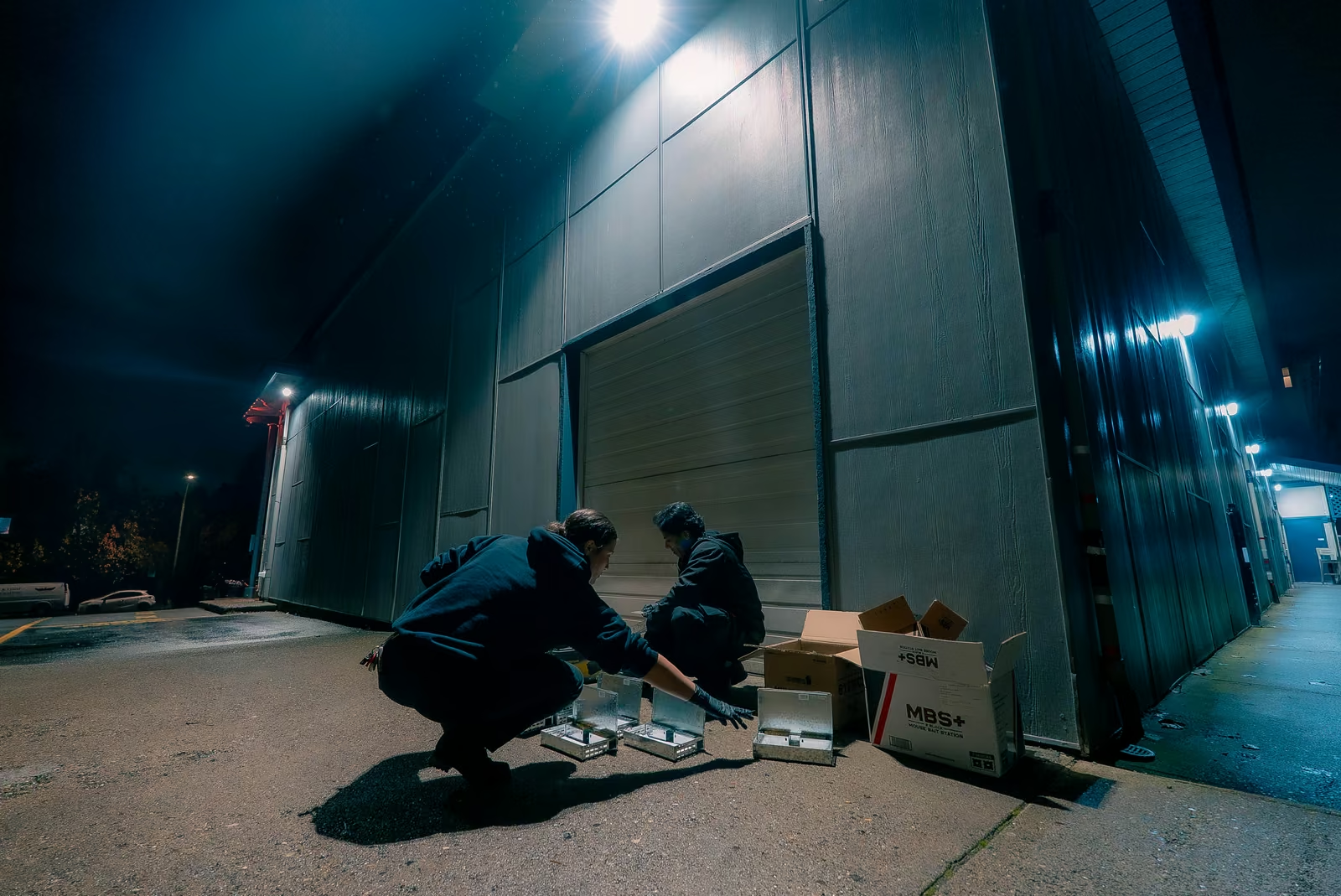
Locked bait stations go along the buildings and the fence, traps go inside, and each one is numbered on the device map.
Small gaps are sealed, larger openings are quoted as exclusion work, and netting or spikes go where pest birds roost.
A K9 search shows which buses, cabs or trailers carry bed bugs, and treated units go back in service once the re-entry time has passed.
Every visit ends with a written report, and the plan shifts with the seasons and the sightings your drivers log.
Our regular maintenance program books recurring visits, each with its own documentation, for sites that need ongoing control.
Before the First Yard Walk
Six things that let the first walk start from what your drivers and yard staff already know. Rodent, cockroach, bed bug and K9 visits each have a preparation sheet on our client forms page.
A site plan or aerial photo with bay and building numbers lets one walk cover the gate, the fleet, the shop and the crew rooms.
Tell us how gate check-in works, which PPE the yard requires, whether an escort is needed airside or in a rail yard, and who will meet the technician.
Note the pest, the unit or bay and the date: droppings in a trailer, bites reported on a route, birds over the fuel island.
A coin laid beside droppings gives scale in a photo; attach it to your estimate request.
The K9 checklist asks that no household cleaners or disinfectants be used for at least 24 hours before the search; in a fleet, that means the vehicles and rooms being searched.
Tell us which buses, cabs or trailers can be out of service for a treatment, and when, so the visit fits your dispatch.
After the Yard Walk: What Happens Next
What follows the first walk. The visit schedule is agreed with your fleet or facility manager.
Yard walk
The first visit maps the yard, the buildings and the fleet, and your quote is based on what it turns up.
Entry points
Toonie-sized and smaller gaps are sealed during the rodent program; a dock door that no longer closes tight, or any bigger opening, is quoted as exclusion work.
Device map
Every station and trap carries a number that matches the site’s device map.
Service reports
Each visit ends with a written service report for your maintenance or safety records.
Fleet checks
Vehicle treatments and K9 checks are booked around your runs, and the program changes with the seasons.
If a station sits in a truck’s turning path, call us rather than moving it, so it isn’t crushed or lost.
A short log at dispatch, with what was seen, which unit or bay, and when, points the next visit at the problem.
Where B.C. Still Allows the Strongest Rat Baits at a Transport Site
Only at sites on the province’s essential-service list. Section 81 of B.C.’s Integrated Pest Management Regulation lets a licensed applicator use a second-generation anticoagulant rodenticide (SGAR) only at an essential service location. For transport, Schedule 6 names rail facilities, airplane hangars, commercial or industrial shipping (ports, passenger and commercial terminals, shipyards) and food transportation facilities. Truck terminals, bus depots and fleet garages aren’t named, so a licensed applicator has to confirm a site qualifies before using one.
Where rats run along the walls and the door tracks meet the slab.
Outside the driver room door, by the bins and gaps under the skirting.
Where the yard meets planted edges or drainage, farther out from the buildings.
Near the cable entries and doors that lead to warm, stored supplies.
Where an SGAR is allowed, it comes with limits. Section 81 of the Integrated Pest Management Regulation has the licensee confirm rodents or recent activity first, use one only after practical alternatives have been tried and haven’t worked, ask whether an SGAR was used at the site in the past year, follow a rodent management plan in the form the province sets, and stop at 35 consecutive days or 120 days in a year. Any station that holds rodenticide bait, SGAR or not, carries a lid label with the word Poison or its symbol, a contact’s name and phone number, and the active ingredient or registration number.
Baits other than SGARs remain available, and a Phantom program keeps them in locked stations. Health Canada’s bait station rules put outdoor, above-ground bait that children, pets or wildlife could reach in locked, tamper-resistant stations, kept within 15 m of a structure or within 100 m along a fence when fastened down. The province restricted the strongest baits to essential services over concerns about owls and other wildlife, so a Phantom program leans on traps, sealing and the numbered device map, and the full program is on our rodent control page.
Why Choose Phantom for Your Terminal or Depot
Who does the work, what you receive in writing after each visit, and how the devices in your yard are tracked.
Experience
15+ years of pest control experience serving British Columbia
Credentials
Fully licensed, insured and certified
Reporting
A written report left after each commercial visit
Scheduling
Open 24/7 for pre-arranged commercial services
Bed bug detection
EXCELLENT Based on 830 reviews
 Posted on Google

 Ashley WoodWe were having some problems with mice at our home so we contacted Phantom and Darcey came and resolved the issues quickly. Darcey was friendly, great with our dog and made sure we understood everything he was doing and what to expect. Happy to report no more mice! Thank you, Darcey!Posted on Google
 Michelle HerrExcellent pest control service! The team was professional, friendly, and knowledgeable. They arrived on time, explained the treatment process clearly, and made sure everything was taken care of. Their attention to detail and commitment to customer satisfaction were impressive. I really appreciate their prompt service and effective results. Highly recommend them to anyone looking for reliable and professional pest control services!Posted on Google
 Nasib AbdulMark was great and he did a great job and was very knowledgeable.Posted on Google
 HenryDarcey provided exceptional support in resolving our pest concerns. He was punctual, highly knowledgeable, and professional throughout the process. We have been trying to deal with these issues for quite some time without any luck but thankfully the matter is now resolved. We appreciate the dedication he demonstrated and will be sure to reach out should we require his services again.Posted on Google
 Jacqueline BruceI want to let you know that June did an amazing job on our house for the moths. He was really friendly, patient, professional and conscientious. I wasn't fully ready for the treatment when he arrived and he managed to move some clients so he could return later. He explained a lot about the treatment and the moths' habits which really helped with other areas that he wasn't even treating. He kindly helped me moved some things to barricade the area from pets. I would get Phantom back and highly recommend them.Posted on Google
 Fraser HannayDarcey was amazing at helping us deal with a wasp nest. Friendly, knowledgeable and on time! Thank you!Posted on Google
 JanetWe hired Phantom Pest Control to eliminate a wasp nest inside our house and the service was great. Information on the phone when I first called to book an appointment was clear and we got an appointment quickly. Juan, the specialist who arrived to do the job, fully explained the process, did the work, and explained what to watch in the outside chance additional work might be needed. We are happy with the job and were glad to have Juan as our technician.Posted on Google
 Jenny WuWe received exceptional service from Joy. She was both professional and knowledgeable, explaining the service thoroughly.Posted on Google
 Sean AbbottThey showed up on time, early actually. Mark was very professional and explained how the cockroaches work. He was personable and efficient, and hygienic with how he worked (wearing protective boot covers and gloves). I was impressed and would definely call again if needed.
Transportation Pest Control Across Vancouver & Fraser Valley
Our transportation program covers terminals, depots, yards and airports across the Lower Mainland, the Fraser Valley and Sea-to-Sky. Each city name links to our local page there.
Vancouver & North Shore
Burnaby & Tri-Cities
Richmond & Delta
Fraser Valley
Related Services for Terminals, Depots and Fleets
Services that can run alongside a transportation or fleet pest control program.
Locked stations, traps and exclusion for rats and mice around shops, docks and parked fleets.
Netting, spikes and deterrents for pigeons and starlings on canopies, docks and hangars.
Treatment for buses, cabs, sleeper berths and crew rooms, with follow-up inspections where needed.
Trained dogs search vehicles and rooms to show which units need treatment.
Transportation Pest Control FAQs
Mice in parked units, droppings in a cab, bed bugs on buses, re-entry, night work, birds and cost, one question at a time.
Prefer to talk?
Which parked trucks and buses do mice choose?
The ones that sit. Phantom’s guide to rats and mice in vehicles says vehicles left unused, or parked near shrubs or garbage, are the likeliest to be chosen. In a fleet, that points the first checks at spare units, trailers parked for the season and anything parked beside the bins.
What are the signs of rodents in a fleet vehicle?
Droppings, chewing and a smell. Look for droppings on floor mats, in the trunk, on the engine cover or around the battery, and for chewed wiring, hoses, foam or upholstery. Phantom’s vehicle guide says to call a mechanic for chewed wires or hoses, a nest in the air intake or engine bay, a new warning light or a smell through the vents, and pest control when more than one vehicle is affected.
What should drivers do about mouse droppings in a cab or trailer?
Don’t sweep or vacuum them dry. Phantom’s post on hantavirus explains that people are infected mainly by breathing in contaminated particles, and that dry sweeping and standard vacuuming put those particles into the air. Take the unit out of service. For a small, contained spot, our vehicle guide gives the Public Health Agency of Canada’s wet method: air the unit out, wear gloves and a fit-tested N95 respirator, soak the droppings with a Health Canada approved disinfectant or 1 part bleach to 9 parts water for 10 minutes (or the contact time on the product’s label), then wipe them up and double-bag them. Anything larger is a job for a technician.
Can bed bugs live on buses or in sleeper berths?
Yes. Health Canada says bed bugs are easily moved on infested objects and prefer places where they can hide and feed regularly, like sleeping areas, which describes a sleeper berth. They can live from several weeks to up to a year and a half without feeding, so parking a bus won’t starve them out. A K9 search shows which units carry an infestation before treatment is planned.
When can drivers use a treated bus or cab again?
Once the re-entry time has passed. Our cockroach and bed bug preparation sheets ask everyone to stay out for at least 6 to 8 hours after treatment, and 24 hours for pets, children under 2, nursing mothers and people with respiratory conditions; the bed bug sheet adds pregnant women and people with weakened immune systems. Where WorkSafeBC applies, section 6.89 of its OHS Regulation has the employer keep workers out of a treated area until the restricted entry interval ends: the time on the label, or 24 or 48 hours if the label gives none, and section 6.91 exempts some small spot and crack-and-crevice treatments. Airlines, airports, courier services, and railways, trucks and buses that cross provincial or international borders are federally regulated, so the Canada Labour Code sets their workplace rules instead.
Can you treat vehicles between runs or at night?
Yes, when it’s booked ahead. Our service is open 24/7 for pre-arranged commercial services, and the office takes bookings Monday to Friday, 9 AM to 5 PM, so a unit can be treated between runs or while it’s parked for the night. The re-entry time is built into the plan.
Who handles birds on runways and aprons?
The airport operator. Under sections 302.302 and 302.305 of the Canadian Aviation Regulations, the operator of an airport the rules cover, such as one in a built-up area or with a waste disposal facility within 15 km, must keep an airport wildlife management plan and review it every two years. Birds on runways and aprons belong to that plan; our bird work stays with the buildings: terminal canopies, cargo sheds and hangar rafters.
Can pigeon and starling nests be removed from a hangar?
Yes. Rock pigeons, European starlings and house sparrows aren’t covered by the federal Migratory Birds Convention Act (ECCC’s list leaves them out), and B.C.’s Designation and Exemption Regulation exempts their nests and eggs from section 34 of the Wildlife Act. Protected birds are different: a migratory bird’s nest can’t be disturbed while it holds a live bird or a viable egg, and the Wildlife Act protects some nests even when empty, such as eagle, osprey and heron nests. ECCC’s general nesting period here runs from late March to mid-August.
How often should a terminal or depot be serviced?
That is set after the first walk, from what it finds. Phantom’s Rodent Program sheet says many clients opt for ongoing preventative maintenance, monthly, bi-monthly or quarterly, and our regular maintenance program books those visits and adjusts them with the seasons.
How much does transportation pest control cost?
It depends on the yard, the buildings, the number of devices and how many vehicles need work, so the price follows a site inspection. For commercial clients that inspection is complimentary, and the written quote prices the whole program for your fleet and site, including any K9 vehicle inspections.
Book a Yard Walk
Tell us about the site, the fleet and what your drivers have seen, and we’ll plan the first walk around your dispatch schedule.
Commercial site inspections are complimentary; the quote is written after the walk.