Rodent Control in Vancouver, BC
Phantom Pest Control provides rat and mouse control, removal and extermination in Vancouver, BC and across the Lower Mainland and Fraser Valley, for houses, condos, rental suites and businesses. Our three-visit rodent program inspects your home inside and out, sets traps where rodents travel and seals small gaps up to the size of a toonie, with larger openings quoted as exclusion work.
- Fully licensed, insured and certified
- Read our Google reviews
- Program $495–$650 + GST 3 visits for a house; $395–$495 + GST for a condo, apartment or townhouse
- Inspection From $125 + GST $150 + GST for a house; +$50 for an attic or crawl space, waived if you book the service the same day
- Visits 3 within 90 days Traps inside and small gaps sealed, as the rodent program preparation sheet explains
- Area 24 communities From Squamish to Abbotsford
How to Tell a Rat From a Mouse
Rodent identification starts with size and droppings. B.C.’s guidance puts a house mouse at 15 to 17 cm from nose to tail tip, with large ears and droppings about 6 mm long. Norway and roof rats reach 30 to 45 cm, with droppings 10 to 20 mm long. A Norway rat has small ears and a blunt nose.
Norway rat Rattus norvegicus
Heavy-bodied, 30 to 45 cm from nose to tail tip, with a blunt nose, small ears and a tail shorter than its head and body. In a year of trapping in Vancouver’s Downtown Eastside, UBC researchers found 94.5% of the rats were Norway rats.
Roof rat Rattus rattus
Slimmer and an agile climber, 33 to 43 cm long, with a pointed nose, large ears and a tail longer than its head and body. It often nests in ceilings and attics, B.C.’s rodent guide notes.
House mouse Mus musculus
Small, 15 to 17 cm including the tail, with a pointed nose, large ears and a nearly hairless tail. Health Canada notes a mouse can squeeze through a crack the size of a dime. Mouse or rat droppings
Illustrations, drawn to one scale with a 5 cm bar. Lengths run from the nose to the tip of the tail.
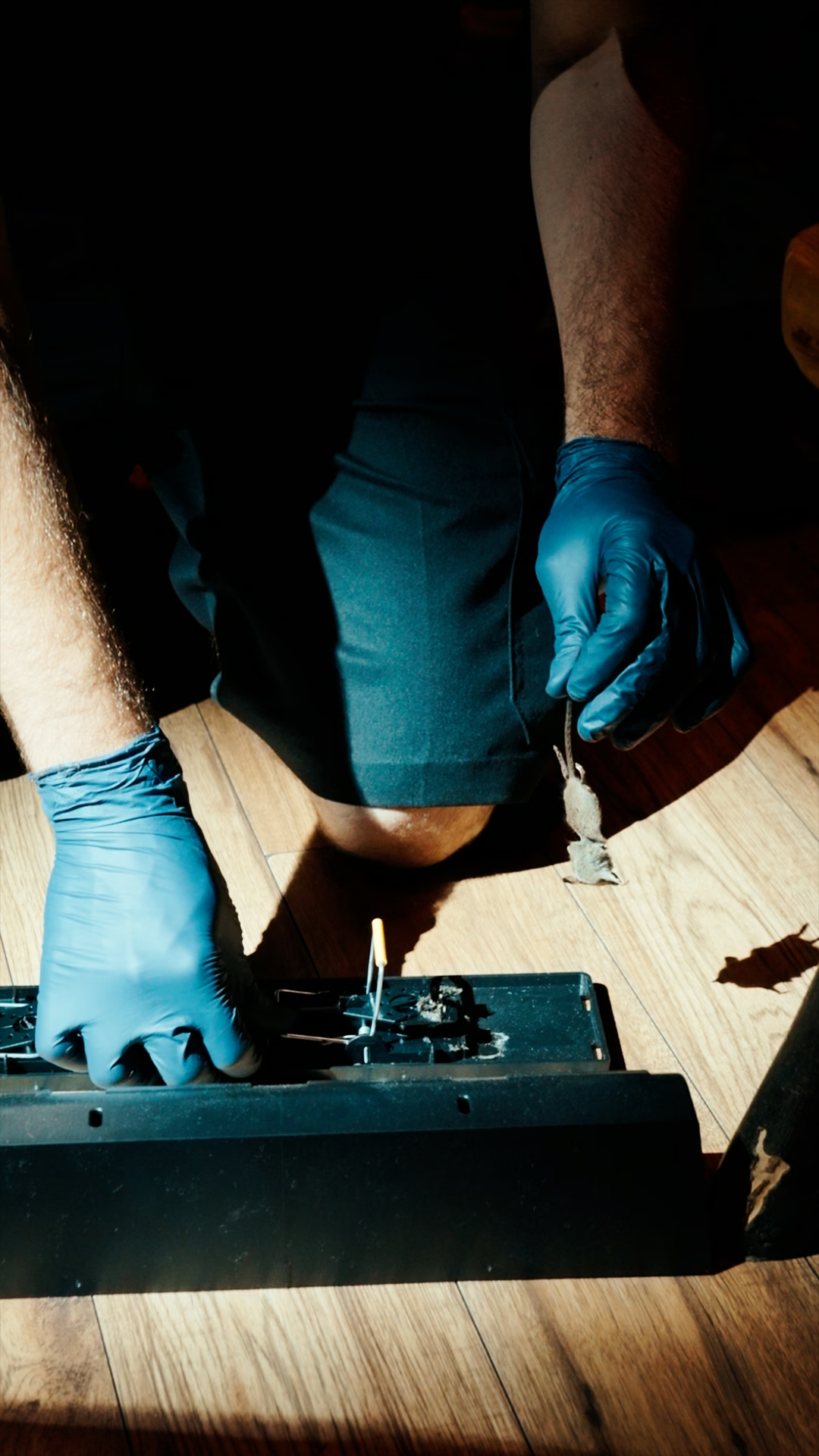
A catch at a trap station
A mouse caught in a snap trap inside a trap station, on a Phantom restaurant job.
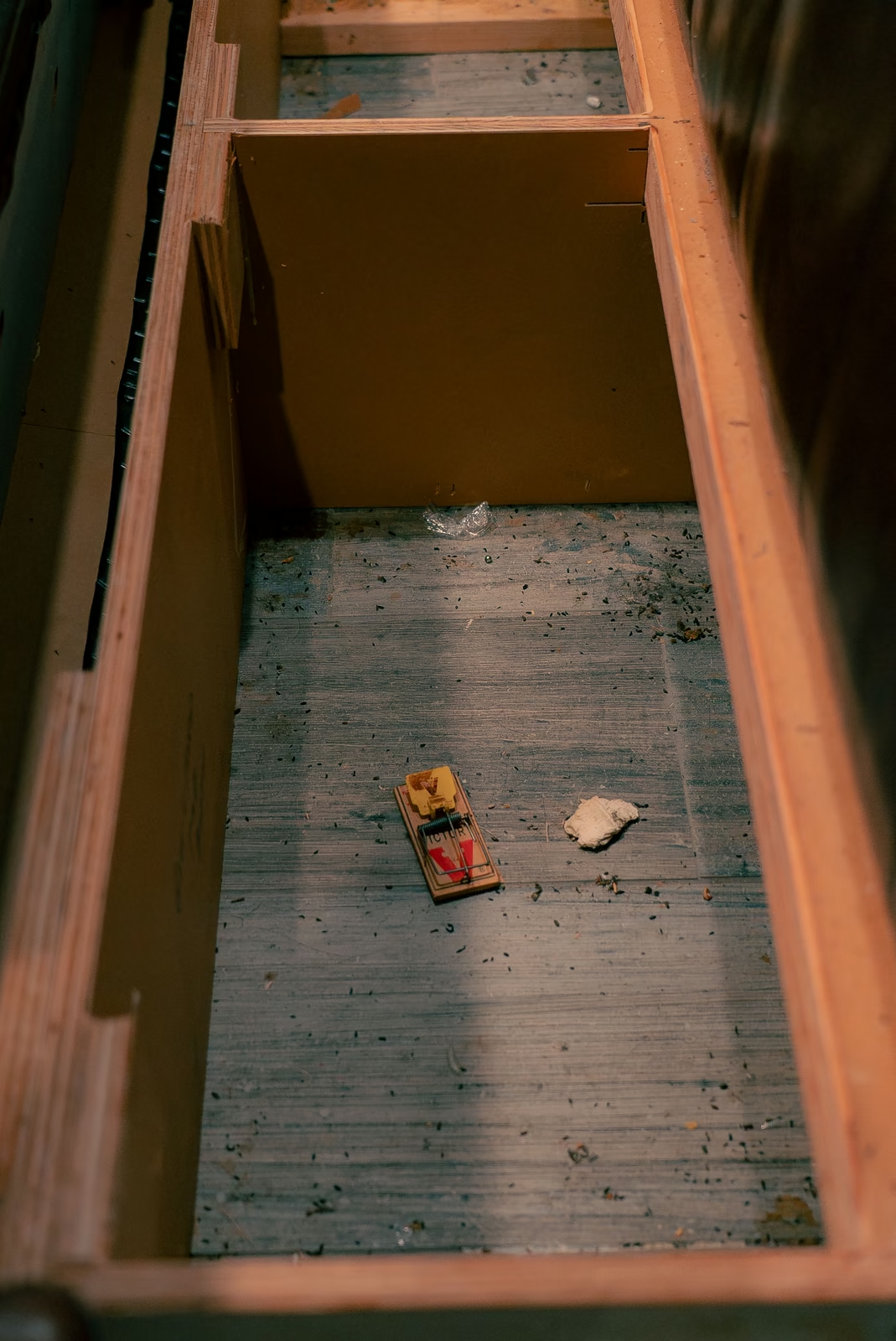
Droppings in a booth base
Rodent droppings across the dusty floor inside a pub booth’s base, beside a baited snap trap.
Easy to Mistake for a House Mouse or Rat
Deer mouse
Brown or grey with a white belly, white feet and a tail that is white underneath, as Health Canada describes it. It may move into buildings near fields and woods in the fall, and in B.C. it is the mouse that carries hantavirus. Hantavirus and what it means for your home
Young rat or adult mouse
A University of California guide notes that very young rats have large heads and feet for their bodies, while an adult mouse’s are much smaller. Droppings help too: how to tell mouse droppings from rat droppings.
Shrew
Not a rodent but a small insectivore, with a long, pointed snout, small eyes and ears hidden in its fur, the Canadian Encyclopedia notes. The University of California guide says shrews turn up around buildings and get mistaken for house mice.
Eastern grey squirrel
B.C. reports it established around Vancouver and in the Fraser Valley, and the Invasive Species Council of B.C. notes it nests in roofs, attics and chimneys and chews wires, eaves and shingles. A bushy tail sets it apart from a roof rat, and squirrels in an attic are a wildlife control job.
Signs of Rats or Mice in Your Home
Droppings are a sure sign. Rats and mice are most active at night, so gnawed food packages, greasy rub marks along walls, shredded nest material and scratching in the walls or ceiling are often the first clues, and Norway rats dig burrows beside foundations. They look for food, shelter and warmth indoors, especially in the colder, wet months.
Points to rats or mice
- Dark droppings along walls, in cupboards or under the sinks
- Gnaw marks on food packages, wood or wiring; B.C. warns gnawed wiring can start a fire
- Greasy rub marks along walls, beams and pipes
- Shredded paper, fabric or insulation gathered into a nest
- Scratching or scurrying in the walls or ceiling at night
- Burrows or holes in the soil beside the foundation
- An ammonia-like smell
- Rodents seen in the daytime, which BCCDC notes can mean a heavy infestation
Not proof on its own
- Old droppings on their own: clean them up the wet way, then watch for fresh ones
- Noise in the attic in the daytime: squirrels nest in attics too
- One sighting in the yard near a compost bin or bird feeder
You can add a photo of the droppings to your estimate request, and read how to spot early rodent activity in spring.
How Rats and Mice Get Into a Vancouver Home
Rats and mice get into Vancouver homes through small entry points: Health Canada notes mice squeeze through cracks as small as a dime and rats through a quarter-sized hole. Roof rats are agile climbers that get into attics and roofs; Norway rats dig burrows and favour damp crawl spaces. B.C. advises sealing every opening bigger than 6 mm.
- A
Roof vents and the roofline
Roof rats live in trees and vines and get into attics and roofs, Health Canada notes, so a vent that has lost its screen is a way in. B.C. advises cutting branches back at least 2 m from the eaves and roof.
- B
Soffits and fascia
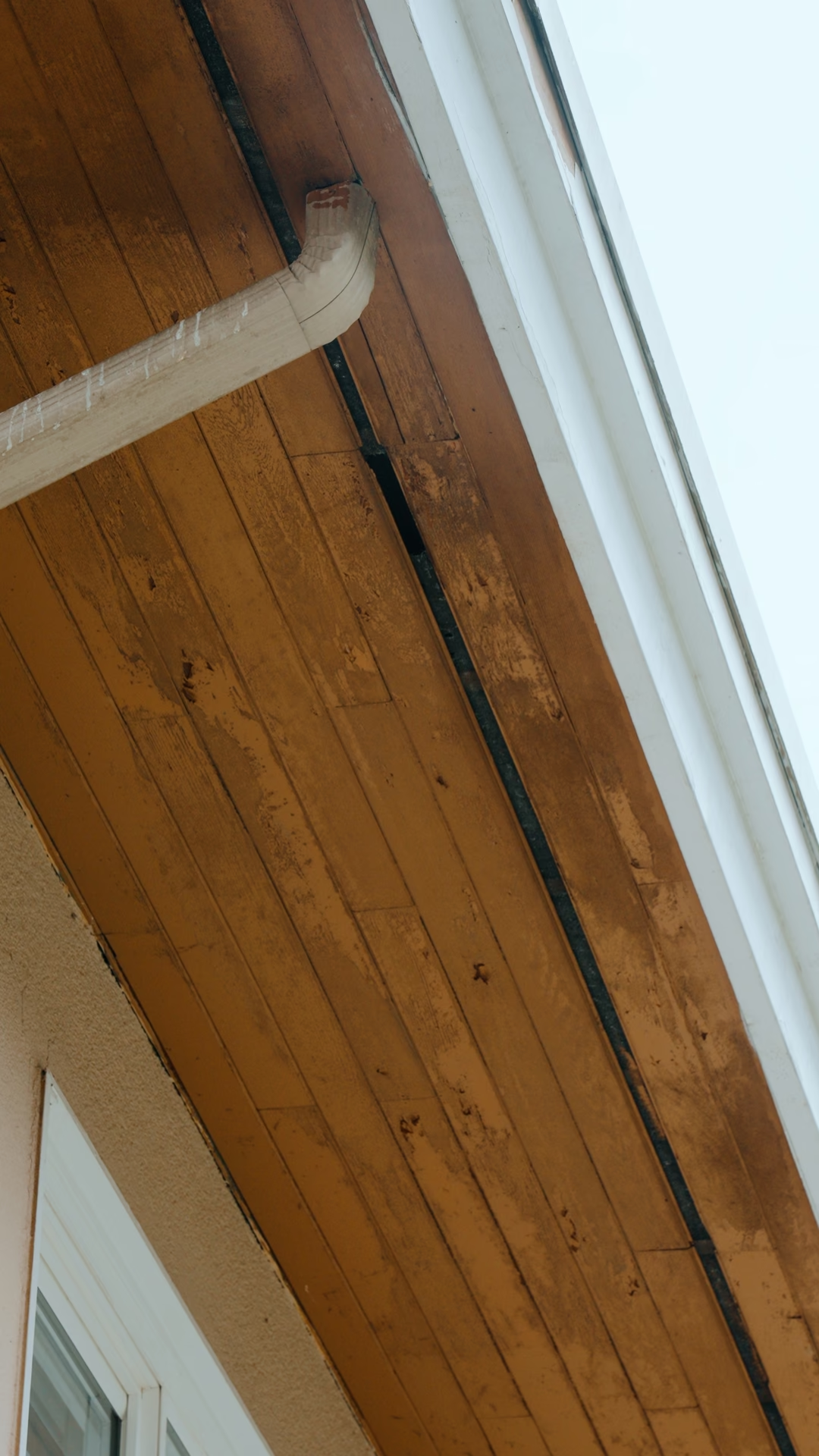
Open seams and holes in a wooden soffit lead straight into the attic. Phantom seals gaps up to the size of a toonie during the program; bigger ones are quoted as exclusion work.
- C
Attic insulation
Roof rats often nest in ceilings and attics, and rodents chew insulation, B.C.’s rodent guide notes. Droppings on the joists and shredded insulation are the signs; checking an attic is a +$50 add-on to the inspection.
- D
Dryer and exhaust vents
A vent flap that doesn’t close is an open pipe into the wall. B.C. advises covering dryer vents, attic vents and soffits with heavy ¼-inch wire mesh.
- E
Under the kitchen sink
Gaps where pipes and wires pass through cabinets and walls are a common way in; B.C.’s guide suggests escutcheon plates around pipes. The preparation sheet asks you to clear under the sinks so they can be checked.
- F
Doors
Worn thresholds under doors let mice in, Health Canada notes, and a quarter-sized hole is enough for a rat. Metal weather stripping or a door sweep made for rodents closes the gap.
- G
Crawl space and foundation
Norway rats favour damp crawl spaces and building edges and dig burrows at ground level. HealthLinkBC advises covering crawl-space vents with 6 mm metal screening; a crawl space is a +$50 add-on to the inspection.
- H
Firewood against the house
A woodpile on the ground beside the foundation shelters rodents; a University of California guide notes Norway rat burrows under woodpiles. B.C. advises storing firewood away from buildings and at least 30 cm off the ground.
An open soffit seam
A long open seam in a wooden soffit beside a downspout: the kind of roofline gap a rodent inspection checks.
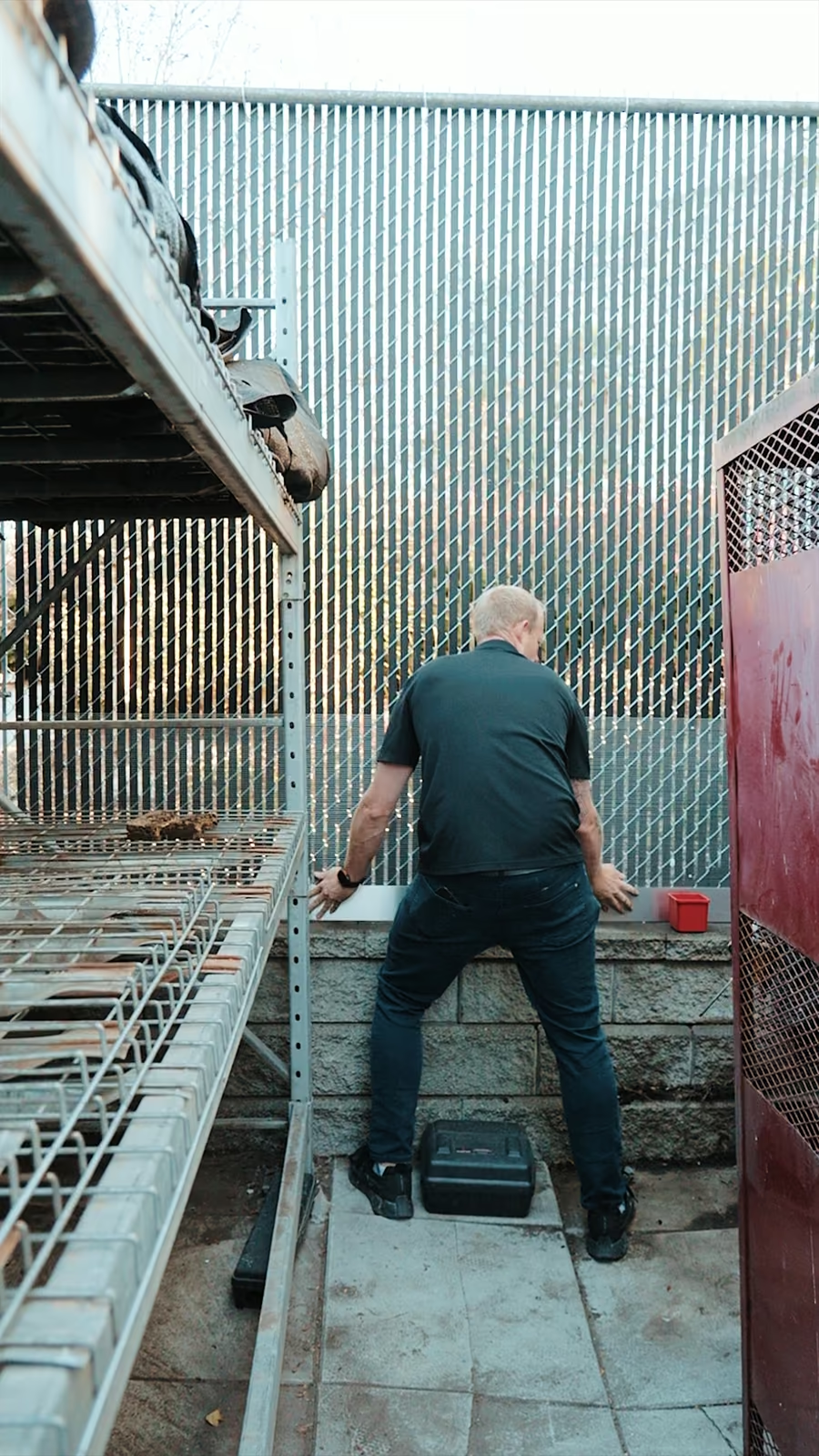
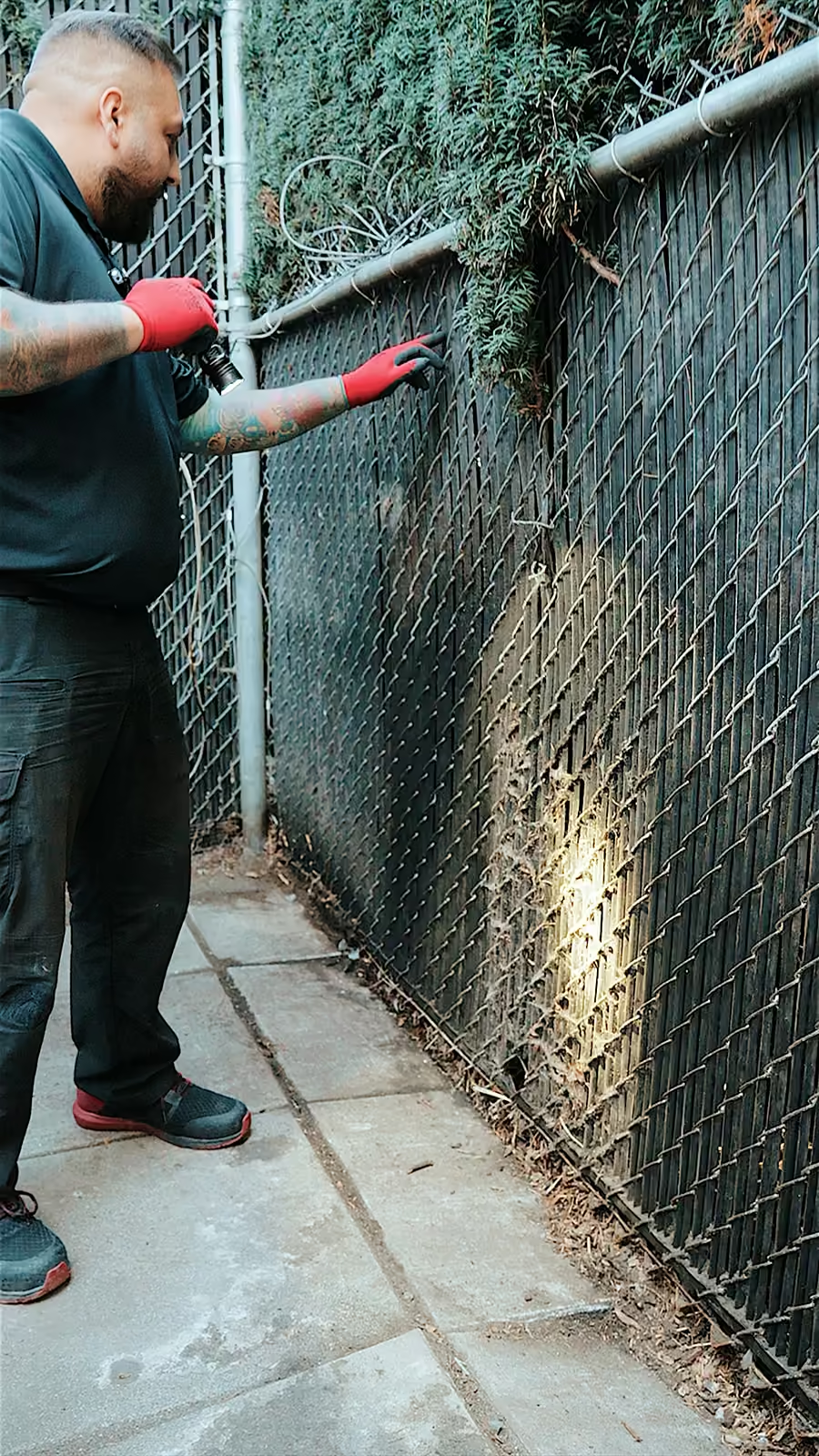
Flashing at a fence base
A technician checks metal flashing fixed along the base of a fence enclosure after sealing it.
Our Rodent Control Process: 3 Visits in 90 Days
The rodent program is three service visits, completed within 90 days of the first: an inspection inside and out, traps where rodents travel and small gaps sealed, then visits that check and reset the traps and finally take them out. A severe infestation can need more visits. Watch the program explained (1:28)
Inspection
A technician checks inside and out: droppings, gnawing and rub marks, the attic opening, and the gaps around pipes, vents, doors and the roofline.
Trapping
Traps go where the droppings and rub marks show rodents travel. The preparation sheet calls it Phantom Mass Trapping.
Sealing small gaps
Gaps up to the size of a toonie are sealed during the visits. Larger openings are quoted as exclusion work, at extra cost.
Follow-up visits
The next visits check the traps, remove catches and reset traps where activity continues. At the end the devices come out, since left behind they attract insects.
How to Prepare for Rodent Control
Before the first visit, declutter, clean behind the kitchen appliances, couches and chairs and under the sinks, and for rats, clear the way to the attic opening and the closet near it. The technician needs weekday access between 9 AM and 5 PM; if a visit can’t go ahead because the home isn’t ready, a $78 fee applies.
Before the first visit
- Declutter the rooms where you’ve seen activity
- Clean behind the kitchen appliances, couches and chairs, and under the sinks
- For rats: clear the way to the attic opening and the closet space near it
- Give access on a weekday between 9 AM and 5 PM
Cleaning up old droppings
- Air the room out for 30 minutes before you start
- Wear rubber gloves, goggles and an N95 mask or better; a painter’s dust mask isn’t enough
- Pour 1 part bleach to 9 parts water over the droppings, without a sprayer, and let it soak for 10 minutes
- Wipe it up with paper towels, then double-bag and seal it for the garbage
- Don’t sweep or vacuum dry droppings, as HealthLinkBC advises
Rodent Control Cost in Vancouver
In Vancouver, Phantom Pest Control’s three-visit rodent program costs $495–$650 + GST for a house and $395–$495 + GST for a condo, apartment or townhouse. Exterior bait stations start at $150 + GST to set up, then $78.75–$95 + GST a visit. Inspections are $150 + GST for a house or $125 + GST for a condo.
Rodent program, 3 visits
- House $495–$650 + GST
- Condo, apartment or townhouse $395–$495 + GST
Exterior bait stations
- Setup From $150 + GST
- Each service visit $78.75–$95 + GST 30 days’ notice to cancel; the final visit is charged.
Estimate and inspection
- Estimate over the phone Free
- Inspection, house $150 + GST
- Inspection, condo, apartment or townhouse $125 + GST
- Attic or crawl space, added to the inspection +$50 Waived if you book the service the same day.
Businesses
Savings
- Two or more services together 15% off
- Seniors 5% off
- Referrals, for both you and the new client $25 off
Prices are in CAD and exclude GST. These are standard prices for homes in Greater Vancouver and the Lower Mainland, and they can change with the size of the property, how severe the infestation is and the treatment it needs.
One Rodent Program or Ongoing Protection
The three-visit rodent program deals with rats or mice in your home now. If they keep coming back, exterior bait stations or the Rodent Maintenance Program keep watch between problems, and exclusion work closes the larger ways in.
Rodent program
- When it fits Rats or mice inside your home now.
- Visits 3 visits within 90 days: traps inside, small gaps sealed.
- Price $495–$650 + GST for a house; $395–$495 + GST for a condo, apartment or townhouse.
- When it fits Rodents that return, or a property you want watched.
- Visits Our Rodent Maintenance Program services locked bait stations outside and sets traps inside when a visit finds activity.
- Price Homes: from $150 + GST to set up, then $78.75–$95 + GST a visit. Businesses: a free site inspection and a quote.
- When it fits Openings larger than a toonie, or rodents getting in again and again.
- Work Openings sealed after the inspection, quoted as exclusion work.
- Re-checks Our pest proofing program re-checks the seals on a schedule.
How to Keep Rats and Mice Out
Seal the ways in and take away food and shelter. B.C.’s guidance says to seal every opening bigger than 6 mm, and PHAC lists wire screening, steel wool, metal flashing and cement for the job. Keep food, bird seed and garbage in hard containers with tight lids, and store firewood off the ground, away from the house.
What helps at home
- Seal openings bigger than 6 mm with wire mesh, steel wool and caulking, metal flashing or cement
- Fit metal weather stripping or a rodent-proof door sweep under doors
- Keep dry food, bird seed and pet food in hard containers with tight lids
- Use garbage and compost bins with tight lids, and keep meat and dairy out of the compost
- Pick up fallen fruit and spilled bird seed
- Cut branches back at least 2 m from the eaves and roof
- Store firewood and lumber away from the house, at least 30 cm off the ground
- Read the full guide to keeping mice out of your home
DIY or a Rodent Exterminator: What Each Can Do
Snap traps
What it does Catch mice and rats where they run; B.C.’s rodenticide guide puts snap or electronic traps first.
Where it falls short Placement and size decide it: traps away from droppings and runways catch little, and Health Canada notes a rat trap is too large to kill a mouse.
Glue boards
What it does Catch mice along walls.
Where it falls short B.C.’s guidance says glue traps may cause significant stress and suffering, and they can catch birds, small wildlife and pets.
Store-bought poison
What it does Kills rodents that eat enough of it.
Where it falls short HealthLinkBC warns poisons can accidentally harm pets, wild animals or children, and B.C. restricts the strongest ones (see the FAQ below).
Ultrasonic repellers
What it does Make a sound people can’t hear.
Where it falls short They may work at first, but rodents get used to the sound, B.C.’s guidance notes.
For trap types and where to set them, read how to catch mice.
Why Vancouver Homes Call Phantom for Rodents
Phantom Pest Control publishes its rodent prices and its preparation sheet, and is fully licensed, insured and certified. It has serviced 29,000+ locations across the Lower Mainland and Fraser Valley from 2019 to 2026.
- Our owner 15+ years of pest control experience serving British Columbia
- Since 2019 29,000+ locations serviced from 2019 to 2026
- Credentials Fully licensed, insured and certified Licensed under B.C.’s pest control regulations
- Area 24 communities From Squamish to Abbotsford
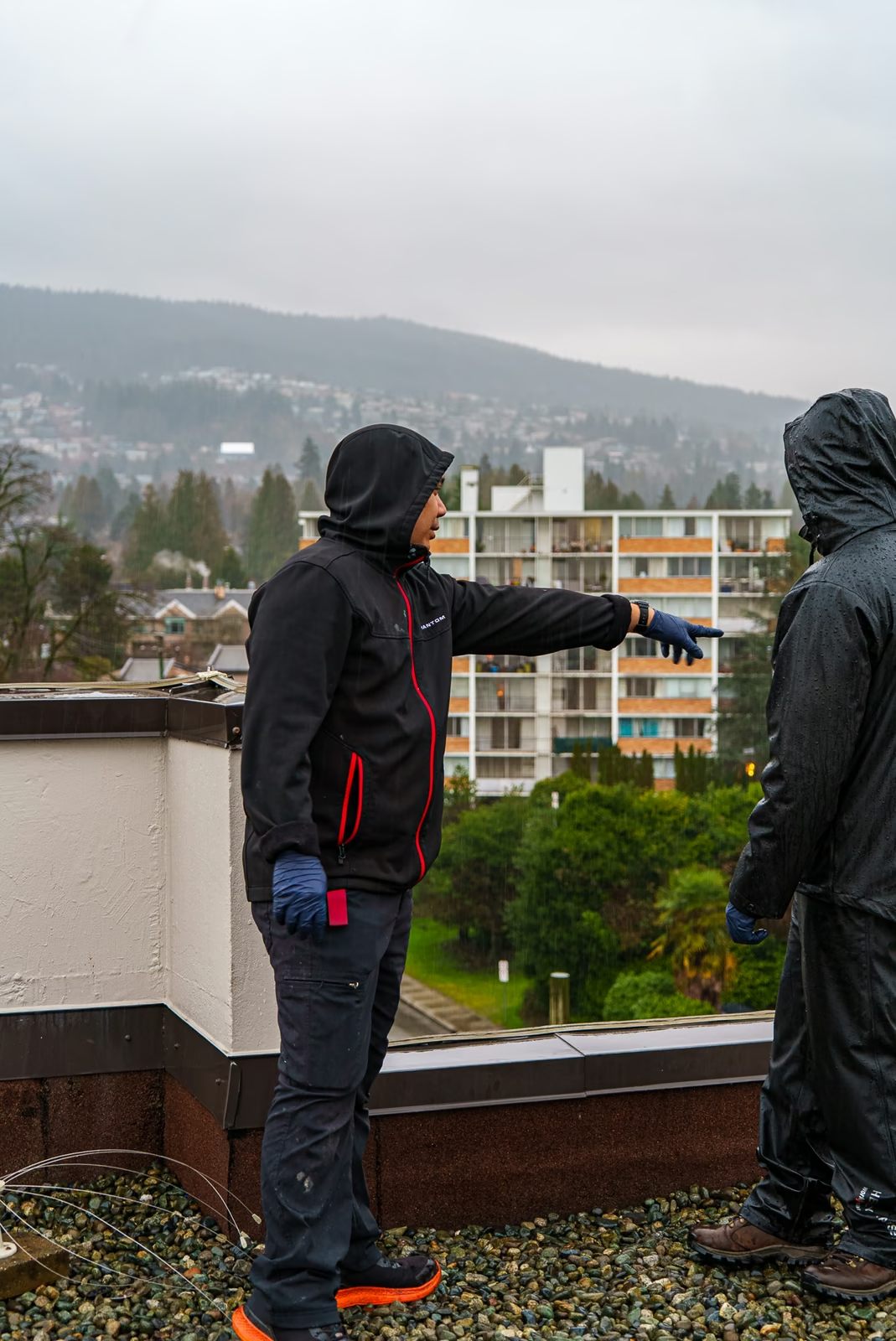
On the roof
Checking an apartment building’s roof in West Vancouver, in the rain, on a rodent job.
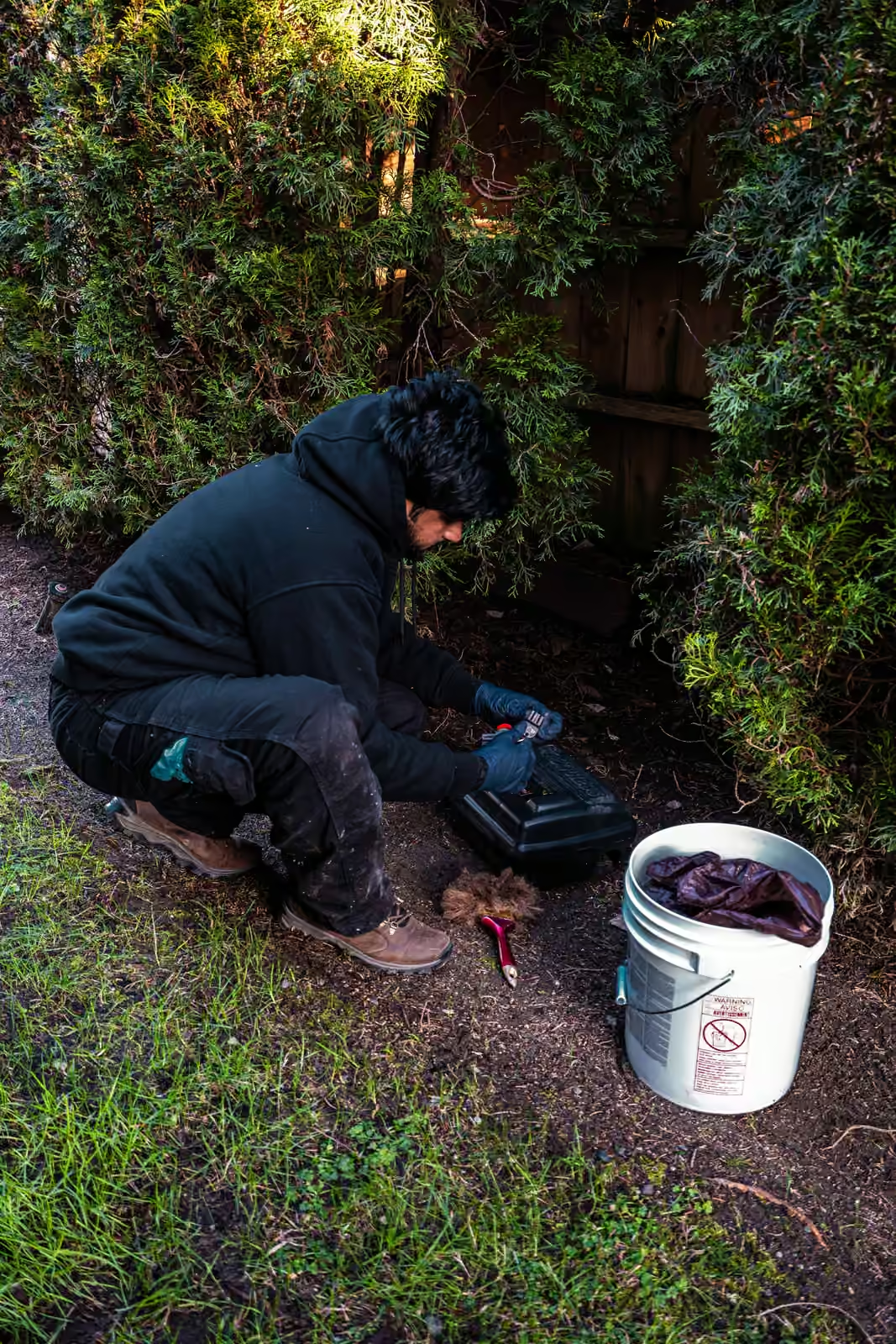
Exterior bait stations
Servicing a locked bait station under a cedar hedge at a townhouse complex.
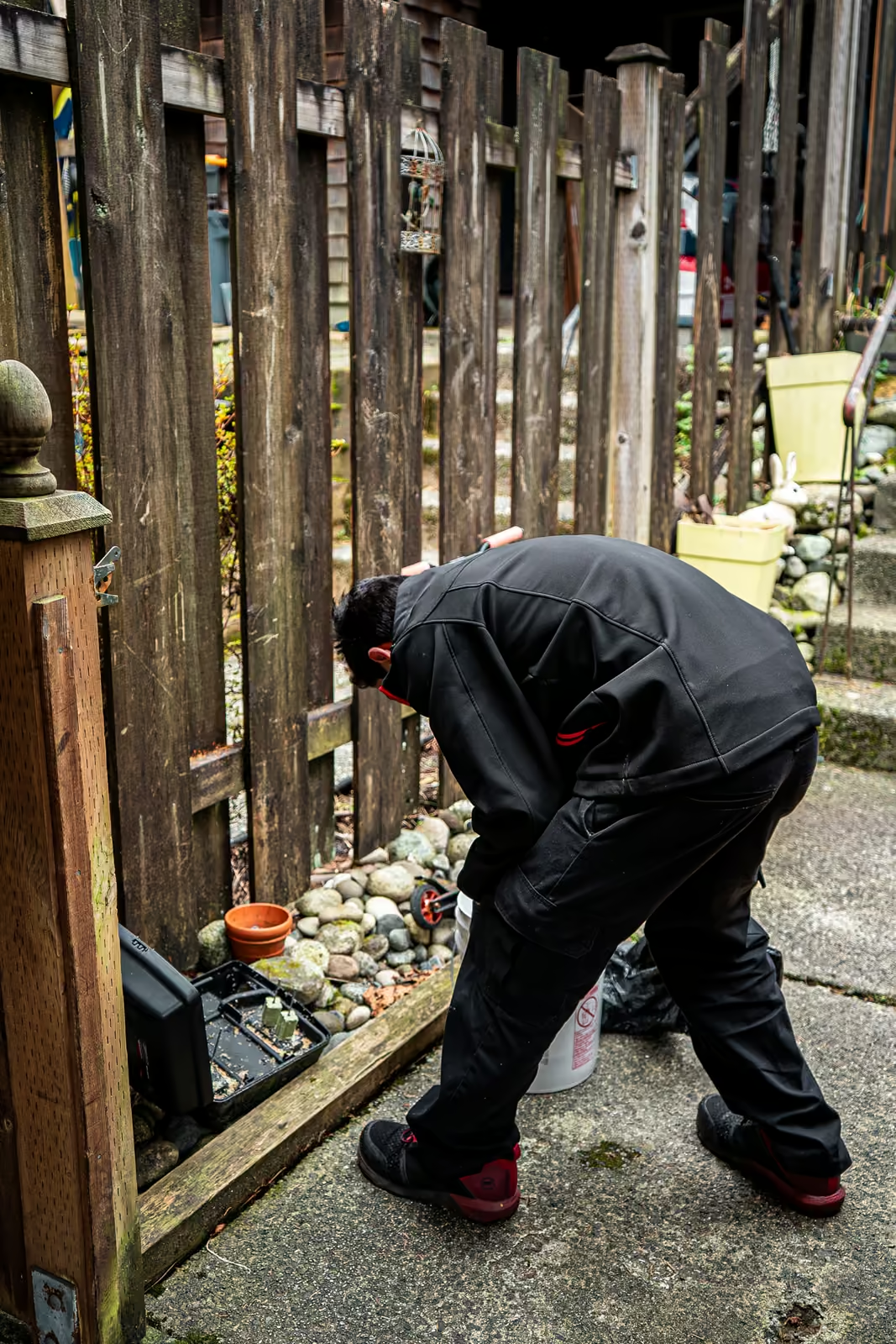
Along the fence line
Checking a station beside a wood fence on a townhouse service visit.
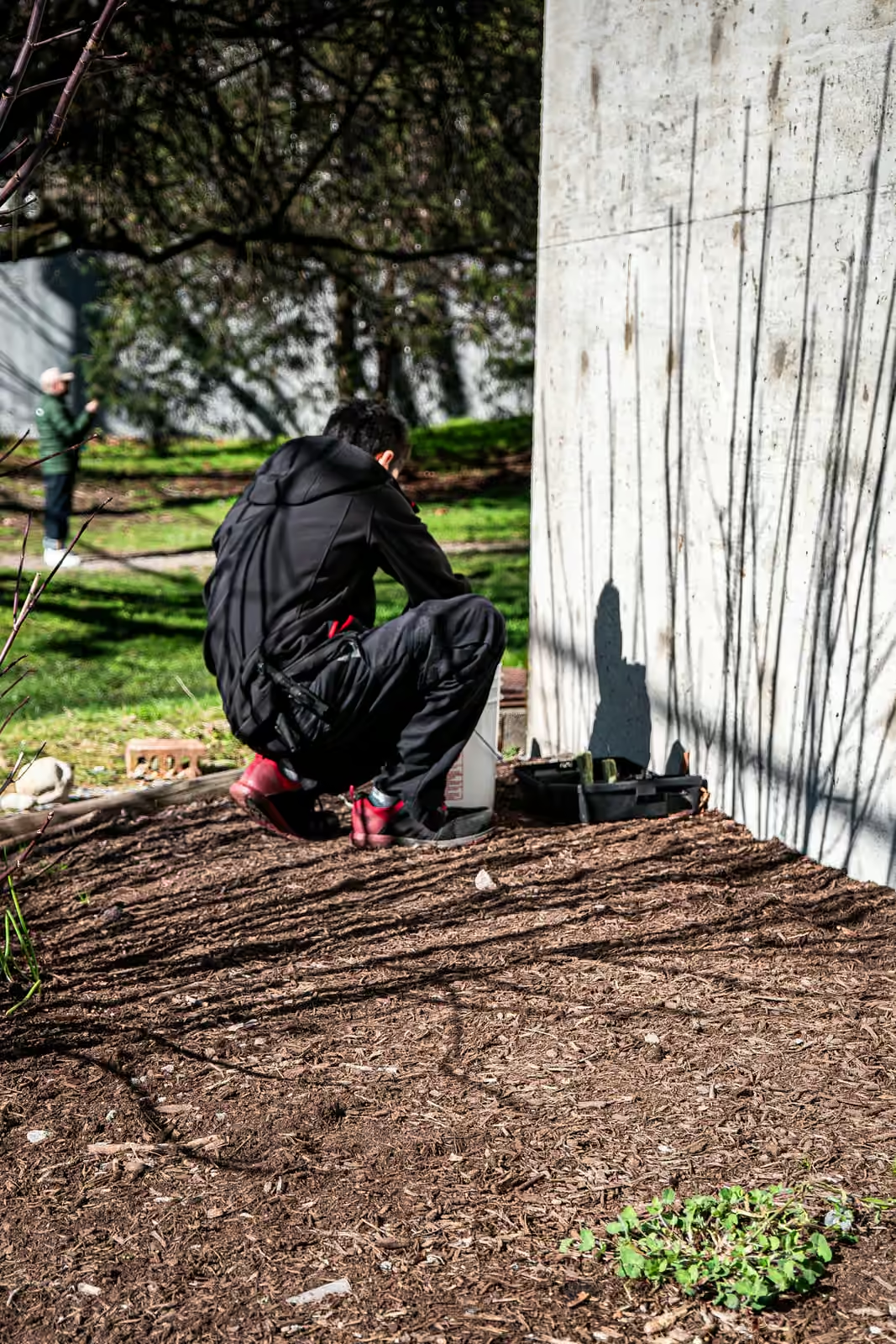
At the foundation
Servicing a station on a mulch bed at the foot of a building wall.
A full crew
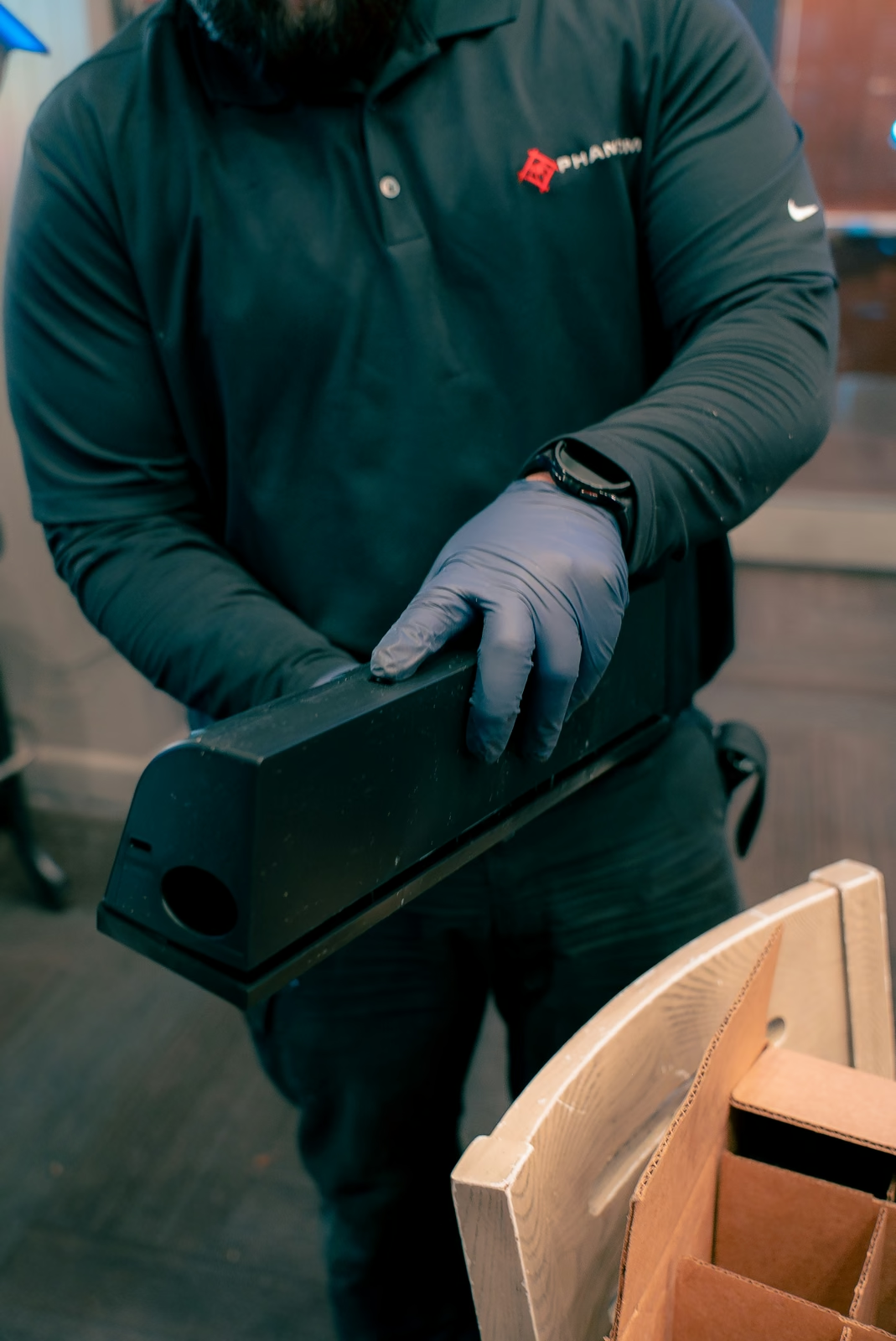
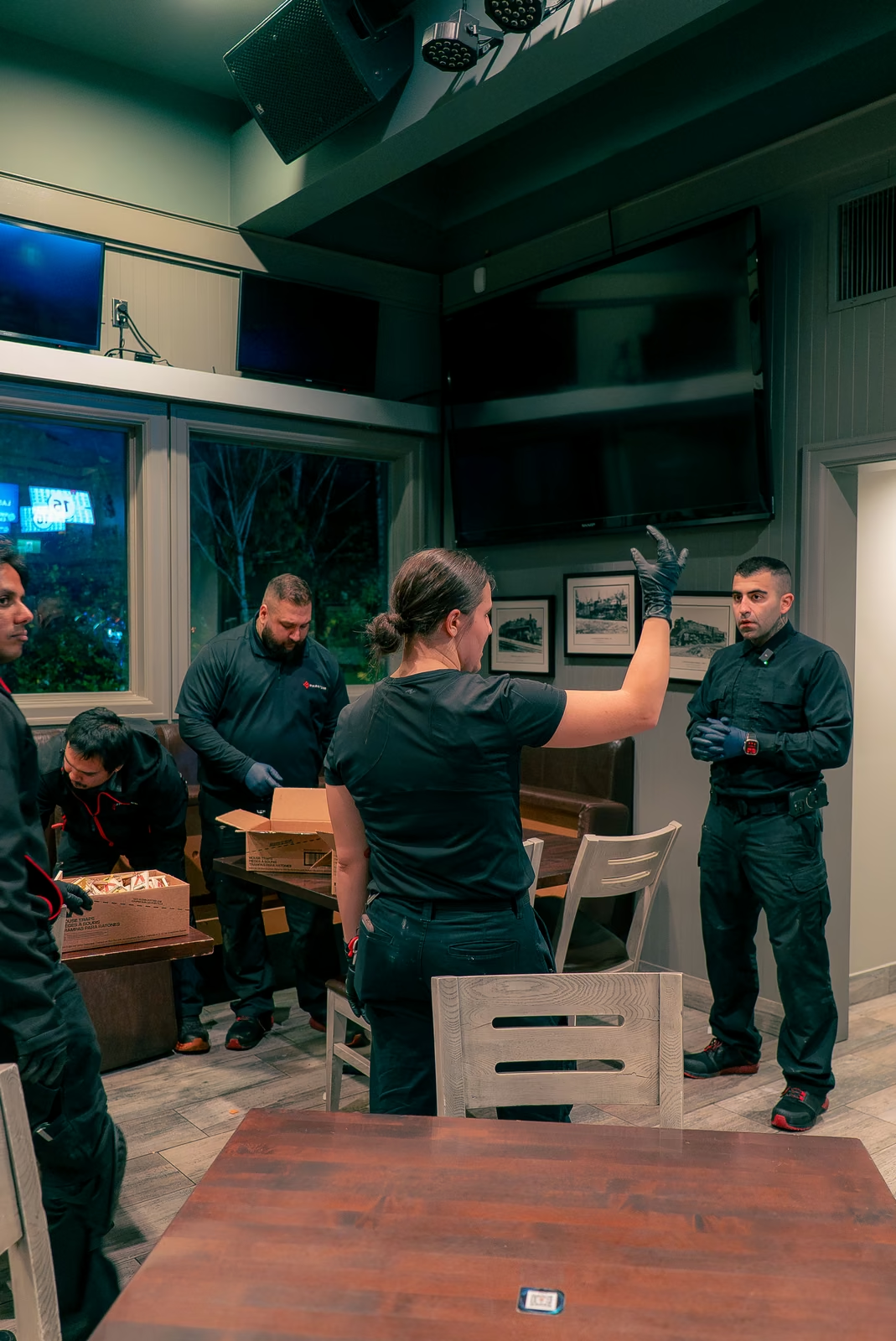
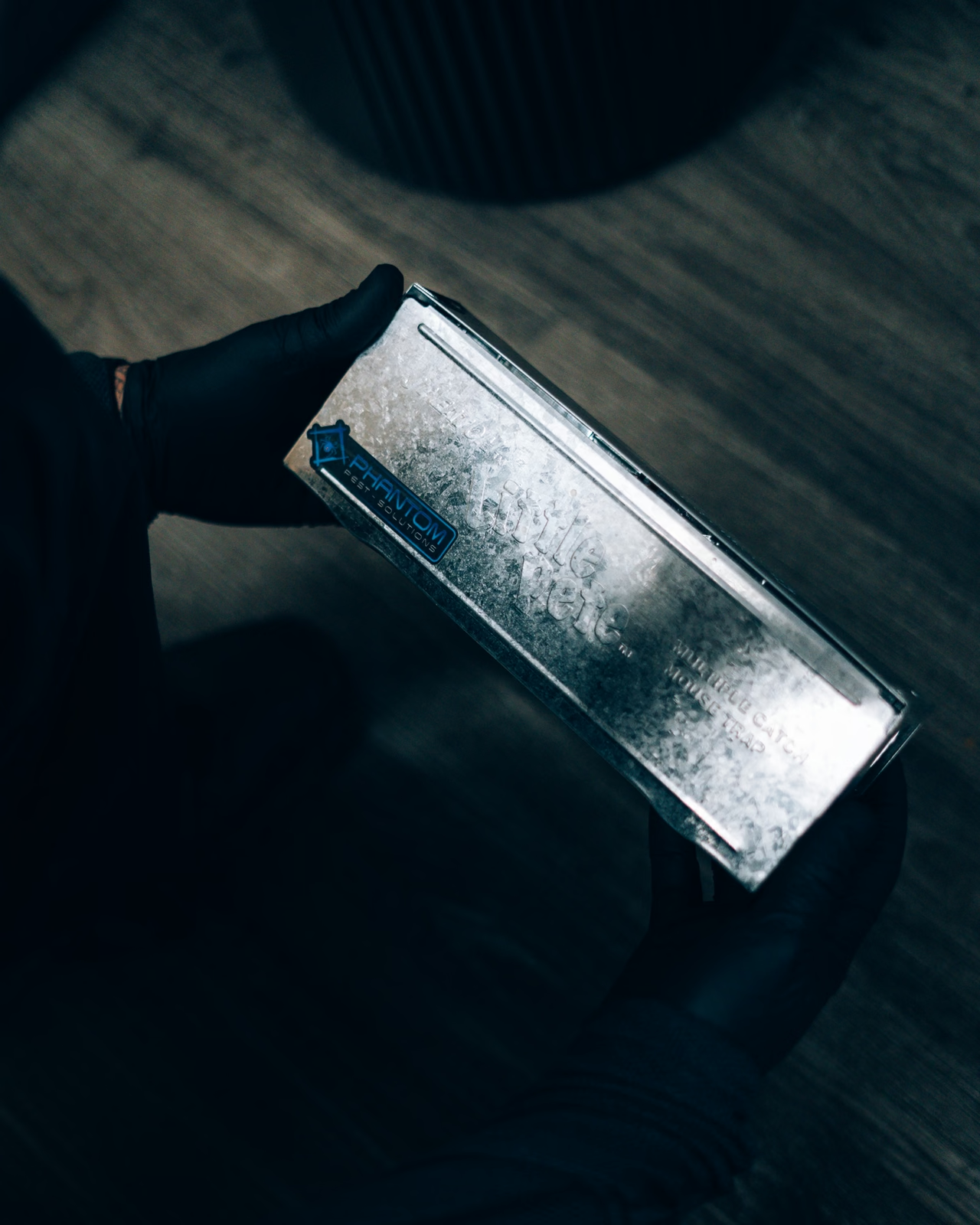
A crew unpacking mouse traps on the tables of a Surrey pub before trapping the dining room.
Stocking up
Unpacking new bait stations at the truck between jobs.
Getting stations ready
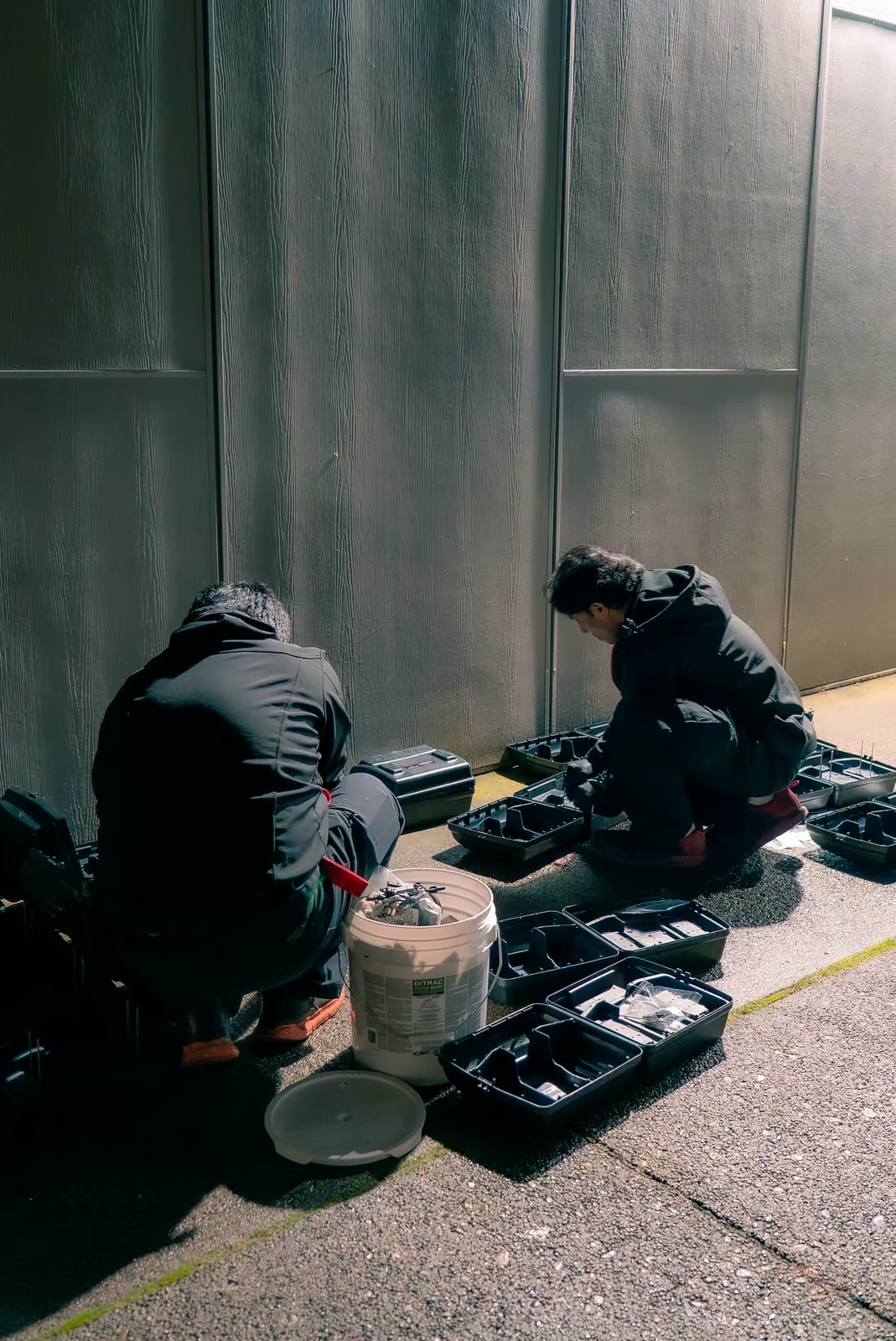
Two technicians open bait stations beside a building before placing them.
Out of sight
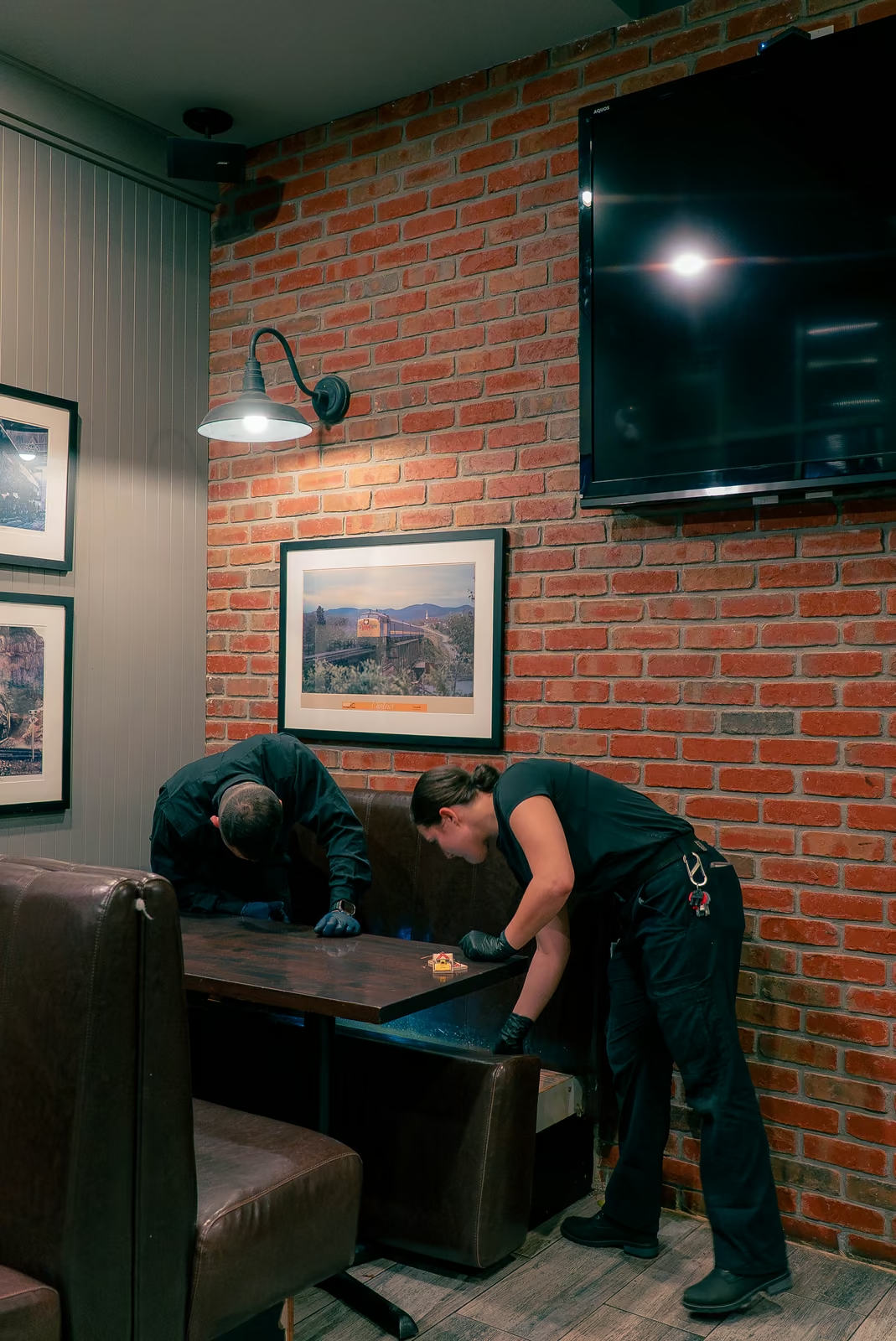
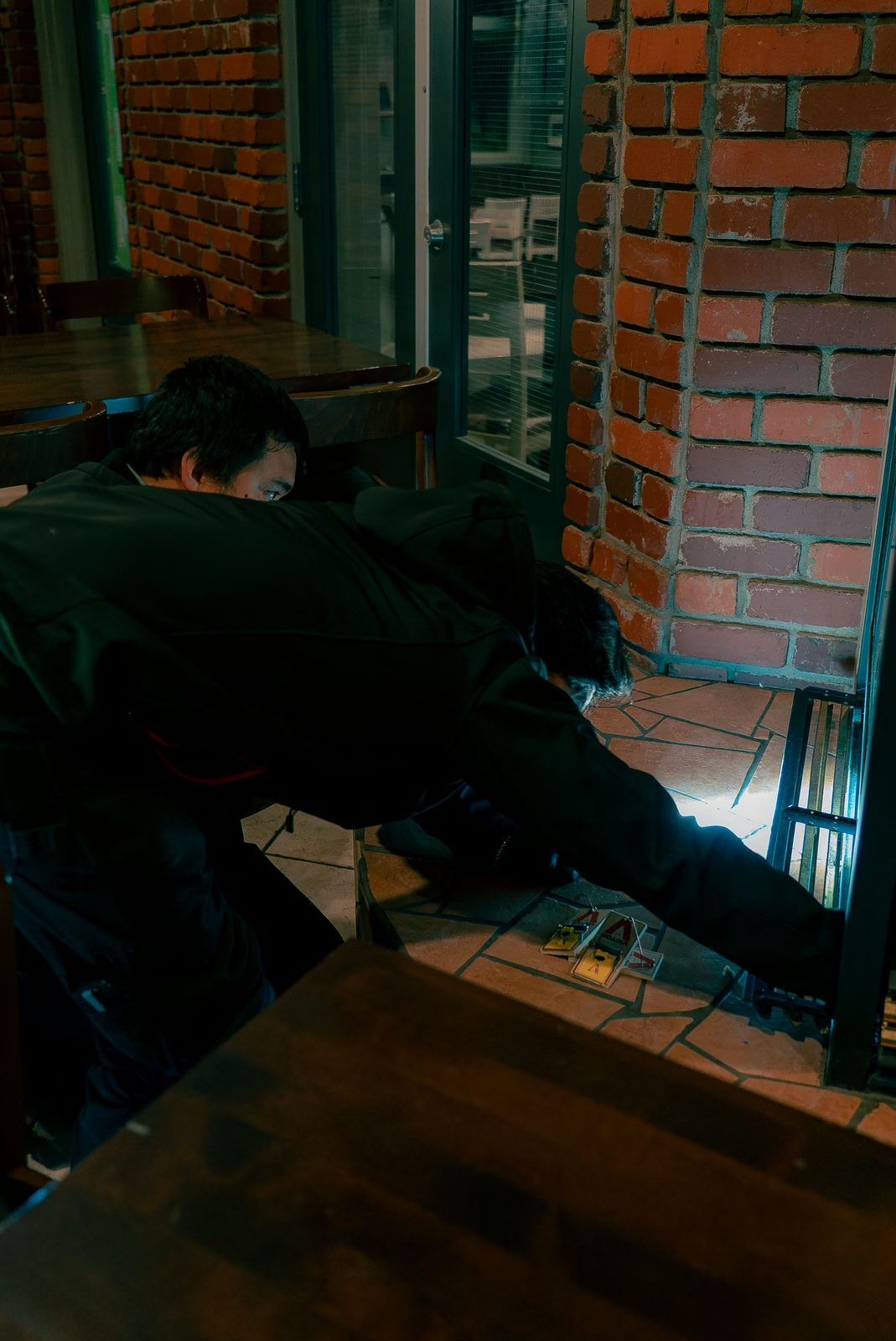
Reaching behind a metal grate in a pub to set a snap trap where it won’t be disturbed.
Rodent Control Across Vancouver & the Fraser Valley
Phantom handles rats and mice in 24 communities with a local service page, from Squamish to Abbotsford. Several cities have their own rodent rules, listed below. Not on the list? Tell us your city in the form, or call the office.
Vancouver, the North Shore and Squamish
Burnaby, the Tri-Cities and Ridge Meadows
Richmond and Delta
Surrey, Langley and Abbotsford
Local rodent rules
- Richmond: Bylaw 6989 bars storing material or letting food build up so it shelters or feeds rodents, with a $100 ticket. The City’s 24-hour rodent line is 604-276-4316.
- North Vancouver: the City’s Rodent Control Bylaw 5899 bars conditions that shelter or feed rodents, with a $200 bylaw notice, and the District’s Bylaw 6040 sets the same rule. The City lists Vancouver Coastal Health, 604-983-6700, for rodents.
- Delta, Ladner and Tsawwassen: Bylaw 8066 bars a rodent infestation or conditions that feed or shelter rodents, with a $300 bylaw notice. Bylaw Enforcement takes reports at 604-946-3340.
- Coquitlam: the Wildlife and Vector Control Bylaw counts rats and mice as vectors and bars attracting them, with a $150 bylaw notice. The City advises calling a licensed pest control company.
- New Westminster: Rental Units Bylaw 6926 requires rental properties to be kept free of mice and rats, with a $200 bylaw notice. Bylaw Enforcement answers at 604-527-4657.
- Port Moody: the Vector Control Bylaw bars conditions that attract vectors, with a warning first, then tickets of $75 to $150. The City suggests a company that avoids or limits rodenticides.
- Port Coquitlam: the Vector Control Bylaw bars a rat or mouse nuisance. The City’s Vector Control staff answer at 604.927.7932.
- West Vancouver and Lions Bay: the North Shore Black Bear Society and the Village advise removing rodent bait boxes, which bears break open, so tell us before booking exterior bait stations there.
Rodent Control FAQs
Prefer to talk?
604-771-0404Can mice in my house give me hantavirus?
House mice aren’t known to spread it. HealthLinkBC says that in Canada the virus has been found only in the deer mouse, and that house mice, roof rats and Norway rats aren’t known to spread it. Only a couple of people in B.C. report it each year. Because you can’t easily tell which rodent left the droppings, clean them up wet and never by sweeping or vacuuming. Hantavirus and what it means for your home
Is rat poison still legal in B.C.?
Some of it. Since January 21, 2023, B.C. allows the strongest rat poisons, second-generation anticoagulants (SGARs), only at essential-service sites, not at homes. First-generation baits are still sold, but the province’s guide keeps them as a short-term last resort and puts snap or electronic traps first. Phantom’s program inside your home is built on traps, and exterior bait stations are a separate service. B.C.’s rodenticide rules
Will dead rodents smell in my walls?
Poison makes it more likely. HealthLinkBC warns that poisoned rodents can crawl away and die where their bodies are hard to find, leaving an unpleasant smell. Phantom’s program inside your home is built on traps, which hold the catch where it can be found and removed on the next visit.
Will rats come back after the program?
They can, if the ways in stay open. Rodents cross property lines, B.C.’s guidance notes, and the province’s rodenticide guide for residents calls an integrated pest management program focused on prevention the only long-term solution to managing rodents. The program seals gaps up to the size of a toonie, larger openings are quoted as exclusion work, and the Rodent Maintenance Program keeps watch on properties where rodents return. Rodent Maintenance Program
Do you handle rats and mice in condos and apartment buildings?
Yes. Rodents cross property lines, B.C.’s guidance notes, so in a strata or rental building the suites and common areas should be checked together. A single suite can book the rodent program at the condo price, $395–$495 + GST, and buildings that need ongoing visits can use our multi-unit pest control program, which schedules the work across the building.
I rent. Is my landlord responsible for rodent control?
It depends on your city. B.C.’s Residential Tenancy Branch says local standards-of-maintenance bylaws decide whether the landlord handles rodents; New Westminster’s rental bylaw, for one, requires rental properties to be kept free of mice and rats. Under the Residential Tenancy Act, the landlord keeps the property to the legal health and safety standards and the tenant keeps the unit reasonably clean. Phantom also works with strata councils and property managers. Strata and apartment buildings
How to Book Rodent Control
Tell us what you’ve found and where, and the office will call you back. You can add a photo of the droppings to the request. Estimates over the phone are free.
Free estimate request
Prefer to talk?
604-771-0404Office and Service Hours: Monday to Friday, 9 AM to 5 PM.