Food Processing Pest Control in Vancouver & Fraser Valley
Phantom Pest Control provides food processing pest control in Vancouver, BC and the Fraser Valley: inspections inside and out, a numbered map of the traps, bait stations and insect monitors, and a report with photos after every visit. We work in your down-time or sanitation windows, not on running lines.
Facility type
Food processing & packing plants
Common pests
Where they get in
Service area
What Food Safety Rules Expect From Pest Control in a Food Plant
Food premises in B.C. must be kept free of pests, free of the conditions that let them shelter or breed, and protected against their entry, under section 26 of the province’s Food Premises Regulation (FPR). Plants that hold a Canadian Food Inspection Agency (CFIA) licence answer to federal rules too, which require an establishment protected against animals that could contaminate food.
B.C.’s rule sets the result, not the method. The written duties sit in a plant’s procedures, which a health officer approves: food safety procedures that identify critical control points, as a HACCP plan does, and sanitation procedures that list every pesticide used, what it’s for and how it’s stored. For licence holders, the federal Safe Food for Canadians Regulations (SFCR) add an interior that keeps insects, rodents and other vermin out.
Dry ingredients get the same attention as the production floor: see our stored product pest control for businesses, including grain beetle control and Indian meal moth treatment. Other industries are on our commercial pest control page.
Your approved procedures name each pesticide used in the plant, its use and its storage.
Pallets, sacks and cartons can bring stored-product insects and cockroaches in with the shipment.
Worn seals and doors left open are a common way in for rodents, birds and flying insects.
Wet floors and floor drains keep fruit flies and drain flies breeding in any season.
CFIA’s guidance says cats and dogs can’t be used to control pests in food facilities.
B.C. allows its strongest rat baits at food plants only under strict conditions.
Pests We Control in Food Processing Plants
What an inspection of a food processing or food manufacturing plant looks for, each linked to its full service.

The pest we find most often in food plants. Rats and mice get in through gaps in exterior walls and around loading docks.

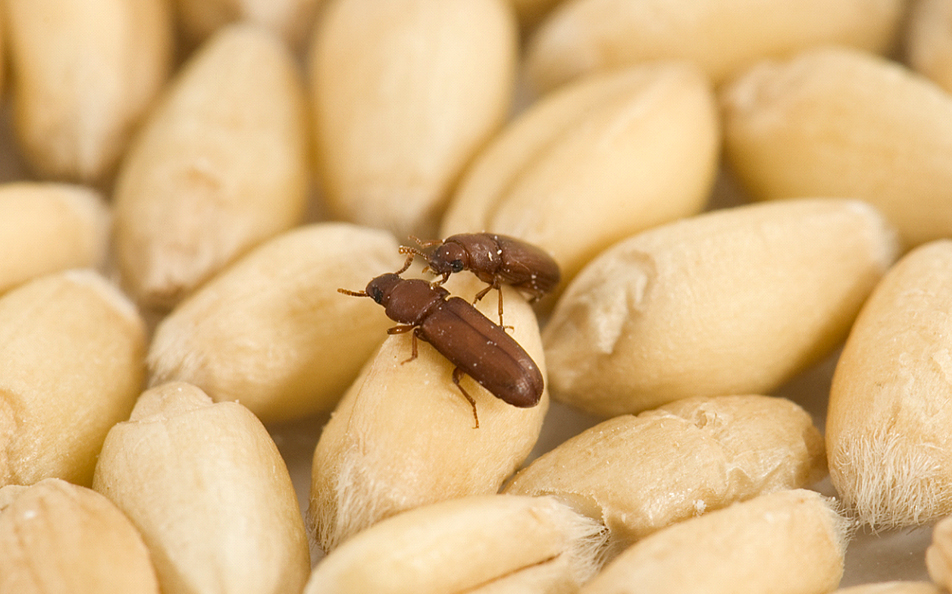
Grain, drugstore and cigarette beetles and flour moths feed on dry ingredients and packaging.

Fruit flies and drain flies breed in drains and food waste; house flies come in through open doors.

They shelter in warm, humid production areas and can arrive in incoming goods and packaging.

Pigeons and gulls roost on ledges, while starlings and sparrows nest in vents and roof voids.

They trail in through cracks and door gaps to spills and moisture, mostly in spring and summer.

Drawn to uncovered bins and sweet residue near docks, from late spring into early fall.
Describe it or send a photo with your estimate request.
When Outdoor Pests Push Into a Food Plant
Inside the plant, stored-product insects and cockroaches can breed in any month. Pressure from outside changes with the seasons, and birds follow Environment and Climate Change Canada’s nesting calendar for the B.C. coast. Our spring checklist for food facilities covers the start of the busy season.
The months follow Phantom’s own pest pages for the Lower Mainland; the bird row uses Environment and Climate Change Canada’s zone A1 nesting period.
The general nesting period on the B.C. coast runs from late March to mid-August, but a protected bird’s occupied nest has to be left alone in any month.
Busiest from late spring through early fall, when nests near docks and bins grow over the summer.
Busiest in the summer and fall months, when warm weather speeds up breeding in waste and drains.
They push indoors for food and shelter in the colder, wetter months, and stay active once they’re nesting inside.
Not seasonal
Warm storage keeps them breeding in any month, which is why pheromone monitors stay in dry storage.
Warmth and moisture in production areas let them breed in any season.
Floor drains and wet areas keep them going whatever the weather outside.
Where Pests Get Into a Food Processing Plant
An inspection follows the routes pests use, from the dock doors and dry storage to the drains, the waste area and the roofline.
- ADock doors & seals
Worn seals and doors left open let rodents, birds and flying insects in.
- BIncoming pallets
Deliveries can carry stored-product insects and cockroaches into storage.
- CDry ingredients
Flour, grain and spices draw grain beetles and meal moths, so pheromone monitors go here.
- DPackaging & finished goods
Stacked cartons give mice cover, so traps sit beside the stacks and along the walls.
- EDrains & floor joints
Wet drains and cracked floor joints shelter drain flies and German cockroaches.
- FEquipment bases & pipes
Warm motor housings and pipe runs give cockroaches and mice hidden routes.
- GWaste & compactor
Bins and compactor areas feed flies, wasps and rats close to the building.
- HLunchroom & lockers
Staff food and spills in break rooms draw ants, cockroaches and mice.
- IRoofline, ledges & vents
Pigeons and gulls roost on ledges, and starlings nest in vents and roof voids.
What Your Plant Team Can Do, and What Needs a Technician
Sanitation and good habits keep pressure down between visits. Anything involving pesticides, bait or nests goes to a technician.
Your team can
Look for damaged packaging, webbing, live insects or droppings before stock goes into storage, and set aside anything suspect.
Close dock doors between loads, and report worn seals, torn screens or any gap that shows daylight.
Keep one sightings log the whole team can add to, so nothing seen between visits is lost.
Needs a technician
B.C. requires a licence to provide pest control services that use pesticides, so leave applications to a licensed company.
Where bait goes, which kind and for how long follow CFIA guidance, the product label and B.C.’s rodenticide rules.
Netting, spikes and tension wire go up after the nests are checked, because a protected bird’s occupied nest can’t be disturbed.
Traps, stations, light traps and pheromone monitors are serviced, numbered on the map and recorded on each visit.
How Our Food Plant Pest Control Process Works
Five steps from the first inspection to an integrated pest management program, with monitoring your QA team can check. The visit schedule is set after the first inspection.
We walk the plant from the docks and dry storage to production, the waste area and the roofline, looking for droppings, gnaw marks, webbing, damaged packaging and the gaps pests use.
Knowing the species tells us where it breeds and how it got in, which decides both the treatment and the repair.
Traps go inside, locked bait stations in non-food areas and outside, insect light traps away from food handling areas, and pheromone monitors in dry storage. Each one is numbered on your site map.
Treatments target the pest and the area, small gaps are sealed, and larger openings are handled as exclusion work.
You get a written report with photos after each visit, a trend summary over time, and the product list with labels or SDS for your file.
Our Food Facility Maintenance Program puts the visits on a set schedule.
Before Your First Food Plant Inspection
Preparing ahead gets more out of the first visit. Our preparation sheets cover treatments; for the inspection itself, this is what helps.
Your site plan becomes the base for the numbered device map.
Your current log, past service reports and the last inspection or audit findings show where to look first.
Hairnets, footwear, jewellery and allergen zones: let us know your plant’s rules before the visit.
Visits are booked Monday to Friday, 9 a.m. to 5 p.m., in a down-time or sanitation window you set.
Photograph droppings, insects and damaged packaging where you find them and note the date and place, then isolate affected stock and clean up as your sanitation program requires.
We need access to the roof, docks, mechanical rooms, lockers and any locked storage.
From First Visit to Ongoing Program
What happens after the first inspection. Your technician confirms the plan and the visit schedule for your plant.
First inspection
A complimentary site inspection, then a customized quote for your plant.
Device set-up
Traps, stations, light traps and monitors go in and are numbered on your map.
Scheduled visits
Visits follow the schedule agreed after the first inspection.
A report each visit
Findings and photos go into your report, and a trend summary tracks activity over time.
Before an audit
We review the pest file with your QA team before a CFIA inspection or a BRCGS, SQF or AIB audit.
Moving a trap or station breaks the numbered map. If one is in the way, call us and we’ll move it and update the map.
Tell us the date, time and place of any sighting, so the next visit starts there.
Which Food Safety Rules Your Pest Program Answers To
That depends on where your food goes and what you make. These are the pest provisions in the federal and B.C. rules as we read them in October 2026; your inspector or certification body has the final word.
Usually a CFIA licence and a written preventive control plan under the SFCR.
Kept free of pests, with pesticides listed in procedures a health officer approves.
Covered by B.C.’s dairy, fish or meat inspection rules instead of the FPR.
SQFI named pest prevention the top Edition 9 non-conformance in 2023.
Hiring a pest control company doesn’t hand over the responsibility. CFIA’s pest control guidance tells food businesses they remain responsible for the records of work a contractor does, and that the contract should spell out who does what, where, when and how, so the plant can verify it. SQFI makes the same point to certified sites: responsibility stays with the site even when a third party runs the program. Where a written preventive control plan is required, CFIA expects the plant to keep evidence that its controls are working.
Before a CFIA inspection or a BRCGS, SQF or AIB audit, we go through the pest file with your QA team, so gaps can be fixed before an audit. In B.C., the operator of a premises that isn’t kept free of pests can also be ticketed under section 26, for a $200 fine plus a $30 surcharge.
Why Food Plants Choose Phantom Pest Control
Who does the work, what you get after each visit, and where to read what our clients say.
Experience
15+ years of pest control in Vancouver
Credentials
Fully licensed, insured and certified
Reporting
A written report with photos after every visit
Maintenance
Quotes
Free site inspection, then a quote built for your plant
EXCELLENTTrustindex verifies that the original source of the review is Google. Just wanted to say that we're very happy to have Darcey Walker as our pest control technician as he's always personable, knowledgeable about taking care of our past pest control issues and does a great job!Posted on GoogleTrustindex verifies that the original source of the review is Google. JC from Phantom was very professional and friendly to work with. He came prepared for the first inspection and carefully reviewed our problem and clearly explained the treatment options and timelines. Then we scheduled the follow-on work on the spot for him to come back. In between the two appointments, I found a wasp nest and was able to communicate that to Phantom to add as additional work. All works were completed without issue and the areas tidied to remove any debris. Thank you for taking care of everything so efficiently! Would definitely go back to JC and the team for future needs.Posted on GoogleTrustindex verifies that the original source of the review is Google. Joy and Yash have been great to work with, very prompt and thorough.Posted on GoogleTrustindex verifies that the original source of the review is Google. June was fantastic!! I was concerned that having a termite inspection done by a pest control company would just lead to an aggressive sales pitch for their services, so I specifically chose a company like Pantone who don’t do free inspections. June did a thorough inspection, checked everything available nook and cranny explained everything he was seeing and allayed my worries. Not once did he try to upsell a service or push for some needless preventative measure. I was very happy with the service.Posted on GoogleTrustindex verifies that the original source of the review is Google. The technicians that came to our building to try and exterminate a wasp nest did a great job. Darcy and June we're very capable of removing the Wasps from the eaves in our roof. I can highly recommend them.Posted on GoogleTrustindex verifies that the original source of the review is Google. Exceptional service from Darcy! Always professional, and knowledgeable. He has a knack for attention to detail, and really takes the time to explain the issues with a resolve. Reliable and very friendly A+ Highly recommend!Posted on GoogleTrustindex verifies that the original source of the review is Google. June was so kind and tremendously helpful!Posted on GoogleTrustindex verifies that the original source of the review is Google. Phantom pest did a great job with our mouse and cockroach problem. JC was a wonder to work with and we will be using them in the future if need be. Thanks!Posted on GoogleTrustindex verifies that the original source of the review is Google. This is a very good company. The technician Mark is so nice and very professional.Posted on GoogleTrustindex verifies that the original source of the review is Google. Had a rodent problem, Darcey came over and took care of it. Appreciate the quick response and great job! Thank you!
Food Processing Pest Control Across Vancouver & Fraser Valley
We work with food plants across Metro Vancouver and the Fraser Valley, from Richmond and Annacis Island to Langley and Abbotsford, in the Vancouver Coastal Health and Fraser Health regions.
Vancouver & North Shore
Burnaby & Tri-Cities
Richmond & Delta
Fraser Valley
More Services for Your Plant
Related services, depending on what turns up in your plant.
Inspection and treatment for insects in dry goods and packaging.
Phantom Mass Trapping, plus sealing of small gaps up to the size of a toonie.
Netting, spikes and tension wire for docks and rooflines.
Programs for restaurants, grocery stores and other businesses.
Food Processing Pest Control FAQs
Straight answers to the questions plant managers and QA teams ask us.
Prefer to talk?
How much does pest control cost for a food processing plant?
We quote each plant after a free site inspection. Phantom doesn’t publish a price list for commercial work, because the size of the property, how severe the problem is and the treatment it needs all change the price, so the quote you get after the complimentary inspection is built for your plant.
How often should a food processing plant have pest control visits?
As often as your program and your risks call for. Neither the SFCR nor B.C.’s Food Premises Regulation sets a visit frequency, and CFIA’s guidance asks each plant to decide how often activity is monitored, whether daily, weekly or monthly. Many maintenance clients choose monthly, bi-monthly or quarterly visits, and we recommend a schedule after the first inspection. Your certification body can tell you what your audit scheme expects.
Can rodent bait be used inside a food processing plant?
Only in limited ways. CFIA’s guidance says only traps should be used inside, especially in processing areas, and bait needed in processing or storage areas goes in a station, in block form, when no operation is taking place or the storage area is empty.
In B.C., a licensed company has to keep bait either in rigid containers that are fastened down, kept closed and labelled with the word poison, a contact and the active ingredient, or where unauthorized people and pets can’t reach it. We use traps inside and keep locked stations to non-food areas and the outside.
Are second-generation rodenticides allowed at B.C. food plants?
Yes, but only under strict conditions. Facilities for food production, processing, storage and transportation are on B.C.’s essential-service list, so a licensed company can use these stronger baits there only when:
- rodents are present, or there is evidence of recent activity
- practical alternatives have been tried and haven’t worked
- prevention measures are in place
Each site is limited to 35 days in a row and 120 days a year, under a written rodent management plan (IPM Regulation, section 81).
What pest records do CFIA inspectors and auditors look at?
Records that show the program works. CFIA’s guidance says each record should note who did the task, what was done and the result, where, and the date and time, with each device numbered on a floor plan and corrective actions recorded. B.C.’s rules also want each pesticide used in the plant listed in your written procedures.
Phantom’s visit reports, trend summary, numbered device map and product list with labels or SDS are written to go straight into that file.
Does a pest control company need a licence in B.C.?
Yes. B.C.’s Integrated Pest Management Act says a company needs a licence before it provides or offers any service involving pesticides. The province’s structural certificate category is the one that covers insects, rodents and birds invading buildings. Ask any contractor for its licence before it works in your plant.
Which pest control products can be used around food?
Only products registered by Health Canada under the Pest Control Products Act, used as the label directs. CFIA’s guidance adds that spraying isn’t done in processing areas during production, fogging happens when no processing is taking place, and food-contact surfaces are washed and rinsed before production starts again. Your written procedures list each product, and we give you the labels or SDS.
Are insect light traps allowed near food?
Yes, but not in food handling areas. CFIA’s guidance says electrocutors go where they won’t draw insects into the building and not in food handling areas, at a height that suits the target insect, with catch trays checked and cleaned. We place our insect light traps away from food handling areas and service the trays on each visit.
Are pigeon, starling and gull nests protected?
Active gull nests are, while starling, house sparrow and rock pigeon nests aren’t. The nests of those three species aren’t covered by the federal migratory bird rules, and B.C. exempts them from its own nest protections. Gulls are on Canada’s list of protected migratory birds, so a gull nest with a live bird or a viable egg can’t be disturbed without a permit. That’s why nests are checked before netting or spikes go up.
When do your technicians work in the plant?
Monday to Friday, 9 a.m. to 5 p.m., in a down-time or sanitation window you schedule. We don’t work on running lines, so treatments and device checks are planned around production.
After a flying or crawling insect treatment in a food handling area, our preparation sheet asks for 6 to 8 hours’ vacancy and 2 hours of ventilation, then sanitizing of counters, shelves and equipment.
Book a Site Inspection
Tell us about your plant, its production schedule and any pests you’ve seen, and we’ll plan the first visit around your down-time.
Commercial site inspections are free, and each quote is built for your plant.