Pest Control in Langley, BC
Phantom Pest Control provides licensed pest control and exterminator services to homes, strata buildings and businesses across the City and the Township of Langley, BC, from the apartment blocks along the Nicomekl and the townhouses of Willoughby to the large treed lots of Brookswood and the farmland beyond.
- Fully licensed, insured and certified
- Read our Vancouver Google reviews
- Ocean shoreline
- City–Township line
- Township boundary
- Rivers and creeks
- Regional parks
- Serves
- The City and the Township of LangleyThe Township wraps the City on three sides and runs from the Fraser River to the US border
- Pests we treat
- Rats and mice, carpenter ants, wasps and raccoonsPlus bed bugs and chafer beetles
- Health authority
- Fraser HealthIts Langley office inspects restaurants and food premises
- Hours
- Office and Service Hours: Monday to Friday, 9 AM to 5 PMOpen 24/7 for pre-arranged commercial services
How We Work in Langley
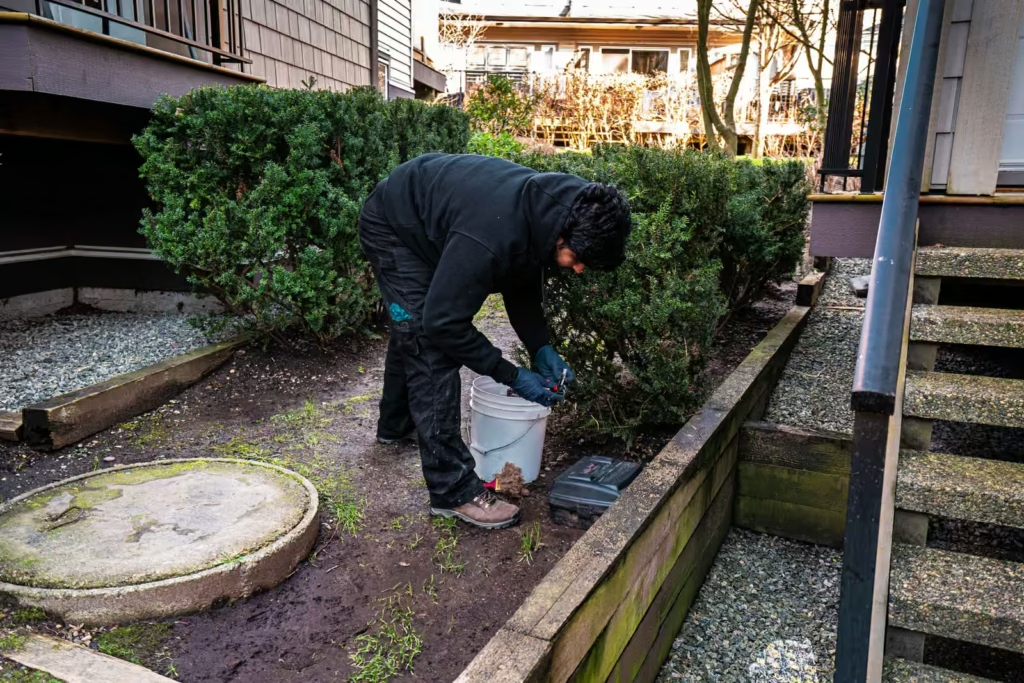
Servicing a rodent bait station in a townhouse yard, reasons to book Phantom, and what to have ready when you call.

Why book Phantom
- 15+ years of pest control experience serving British Columbia
- Our own K9 teams for bed bug screening
- A written report with photos after a home buyer or seller inspection
- Preparation sheets for bed bug, insect and rodent treatments, on the client forms page
Before you call
- Your neighbourhood, and whether it’s in the City or the Township
- What you’ve seen, where and since when; photos help
- Whether there’s an attic or crawl space to check, which adds to the inspection fee
Estimates over the phone are free, Monday to Friday, 9 AM to 5 PM.
Pests to Watch Across Langley
The Township says it isn’t uncommon to find rats and mice throughout its area, given its variety of land uses, its farms and ranches and its recently cleared properties. Beyond that, housing and land change a lot from one part of Langley to the next, and an inspection finds what’s actually there.
- A
Langley City and the Nicomekl
Downtown Langley, low-rise apartment blocks and the Nicomekl floodplain
In the 2021 Census, 61% of the City’s homes were apartments and 37% were rented, about twice the Township’s rate, mostly in buildings under five storeys. Homes now line the edge of the Nicomekl floodplain, as apartment blocks, townhouses and single detached dwellings. Inside a building, cockroaches travel quite easily, and Health Canada advises checking the walls you share with neighbours for gaps that could let bed bugs through.
Pests to watch here
- B
Willoughby, Willowbrook and Walnut Grove
The Township’s northwest: new townhouses and apartments, Carvolth’s job hub and Walnut Grove’s streets
The Township says Willoughby has grown from about 3% to 30% of its population in 35 years and expects it to stay its fastest-growing area. Its 2025 draft community plan says townhomes and apartments had become the predominant housing by 2016, particularly around Willoughby Town Centre. In June 2026, conservation officers received reports of a black bear in the Walnut Grove area, with no aggressive behaviour reported. The Township asks residents to report bear sightings to the Conservation Officer Service and to take care with garbage and compost. Phantom’s wildlife control covers animals such as raccoons, skunks and squirrels.
Pests to watch here
- C
Murrayville and Brookswood-Fernridge
The civic core around Langley Memorial Hospital, and the large treed lots to the south
Murrayville is the Township’s traditional civic core, home to Langley Memorial Hospital and the regional airport. To the south, the Township’s 2021 forest report puts Brookswood-Fernridge highest for tree canopy among its urban areas, where many large trees have grown on relatively large lots. Trees close to a house matter: Health Canada says roof rats are agile climbers that live in trees and vines and infest attics, and carpenter ants can get in where branches touch the house; the Province advises removing overhanging limbs to keep raccoons off it.
Pests to watch here
- D
Campbell Valley
Campbell Valley Regional Park and the Little Campbell River valley
Metro Vancouver’s plan for this 548-hectare park, with its floodplain, wetlands, meadows and forest, says the old fields give habitat to voles, mice, moles, deer and coyote, and that squirrels, raccoons and bats live in the forest. Health Canada says deer mice may move into buildings near fields and woodlands in the fall. For low-risk wildlife, the Province’s advice is to remove garbage, bird seed, ripe and fallen fruit and outdoor pet food, and to secure compost.
- E
The farmland
The Agricultural Land Reserve, which covers about 75% of the Township
About 75% of the Township, 235 square kilometres, is in the Agricultural Land Reserve, and the Township says nearly half of Metro Vancouver’s farms are here. The Province says flies and rodents are the most common pests on livestock and poultry farms, because feed and manure are present in large quantities. The Township’s farm profile, on 2016 data, counts 236 properties whose main use is poultry, and says the urban edge is mostly pasture and outdoor livestock, with more intensive operations seeming to sit away from it.
Pests to watch here
Who Handles What in Langley
Phantom treats pests on private property; the Province deals with wildlife that threatens people. The City and the Township have different rules on rodents and pesticides, and both ask for a pest declaration before a building comes down.
| If you have | Who handles it | What to know |
|---|---|---|
A bear, cougar or coyote that’s a danger to people | BC Conservation Officer Service: 1-877-952-7277 | Call it day or night. The Township doesn’t respond to general wildlife complaints, and sends injured, orphaned or dangerous wild animals to this line. Source: Province of B.C., Township of Langley |
Raccoons or skunks damaging your property | A licensed pest control company | Conservation officers don’t attend these conflicts, and the Province points owners to a licensed company. The Langley Animal Protection Society gives the same advice for nuisance raccoons. Source: Province of B.C., LAPS |
Rats or mice around a building | Its owner or occupier | The City’s Community Standards Bylaw 3075 (consolidated June 2021) bars allowing an infestation of rodents or insects, and an inspector can order it fixed. The Township’s rodent page calls getting rid of them every property owner’s responsibility, and says to contact a licensed provider when prevention isn’t working. Source: City Bylaw 3075 (2021 consolidation), Township of Langley |
A building about to be demolished | A qualified pest control company, on each municipality’s form | Both ask for a signed declaration with the permit application: the Township’s Rodent Abatement and Control Declaration (form PLI25-036) and the City’s Pest Abatement and Control Declaration. Each asks for the company’s B.C. pesticide licence in the structural category and a local business licence number. Source: Township form, City package |
Flies or rats you trace to a nearby farm | The farm first, then the B.C. Farm Industry Review Board | The Township says normal farm practices are protected by the provincial right-to-farm law. The Board reviews written complaints only from people directly affected by a farm business’s practice on designated farmland, not hobby farms, and filing costs $100. In a 2005 Aldergrove case, it ordered a poultry farm to put fly and rodent control systems in place. Source: Township of Langley, The Board, Filing a complaint, 2005 decision |
When Pests Peak in Langley
Some Langley pests follow the calendar and some don’t. We set the months from the seasons Phantom publishes and, for chafer beetles, the Province’s; federal, provincial and Township sources and WildSafeBC supply the notes.
This month: November 2026
- Rats & mice
- Chafer beetles
Not seasonal
- Bed bugs
- Cockroaches
Ants
March to August
Winged carpenter ants usually swarm in spring. Indoors, they can signal a moisture problem or decaying wood.
Wasps
May to September
B.C.’s hornet alert says yellowjackets and bald-faced hornets start new nests each spring, and Health Canada says wasps are more abundant and active in late summer.
Rats & mice
October to March
Deer mice may come inside from fields and woods in the fall, Health Canada says.
Wildlife
March to May
Skunk kits are born in early May, and raccoon kits can leave the den at seven weeks.
Chafer beetles
October to March
The Township says larvae feed on grass roots for 10 to 11 months and adults emerge in June; the Province says animals dig for them in the fall and winter.
Not seasonal
Bed bugs
Adults usually live about 10 months, or a year or more at 21 to 28 °C, so they can turn up in any month.
Cockroaches
Health Canada says they’re most active at night, so they may go unnoticed for some time.
Neighbourhoods We Serve in Langley
We work in both municipalities: the City, including Downtown and the Nicomekl and Douglas neighbourhoods, and the Township’s communities, from Walnut Grove to the rural area and the US border.
City of Langley
- Downtown Langley
- Nicomekl
- Douglas
Township of Langley
- Aldergrove
- Brookswood-Fernridge
- Fort Langley
- Murrayville
- Rural Area
- Walnut Grove
- Willoughby-Willowbrook
More location pages
Not on the list? Call or text 604-771-0404 and the office will confirm.
What Pest Control Costs, and How a Visit Works
Here are the inspection fees Phantom publishes, then the four steps a visit follows. Confirm the fee for your Langley address when you call.
Inspection fees
- House
- $150 + GST
- Condo, apartment or townhouse
- $125 + GST
- Attic or crawl space
- + $50
- Waived if the service is booked on the same day.
- Commercial site inspection
- Free
- Estimate over the phone
- Free
Treatment prices for each pest
Describe the problem by phone
Call or text 604-771-0404 on a weekday between 9 AM and 5 PM. The estimate costs nothing.
An inspection where one is needed
The technician identifies the pest and finds how it gets in.
Get ready with the preparation sheet
For bed bug and cockroach treatments, the preparation sheets ask everyone to stay out for at least 6 to 8 hours. The bed bug sheet extends that to 24 hours for infants under 2, pregnant or nursing mothers, people with respiratory or immune conditions, and pets; the cockroach sheet lists its own group. The sheets are on the client forms page.
Treatment, then the weeks after
A few pests for a while after treatment is normal. Past the time on your sheet, call us.
Pest Control Services in Langley
Pick the pest you’ve seen or your type of property; each page below explains the work.
By pest

Deer mice near the Township’s fields and woods in the fall, roof rats in attics and Norway rats in damp ground.

Raccoons, skunks and squirrels, which conservation officers don’t attend and the Township doesn’t take complaints about.

Spikes, netting and wire for the ledges and balconies of Langley’s apartment and commercial buildings.
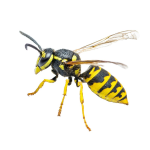
Yellowjackets and bald-faced hornets, which start new nests each spring; wasps are more active in late summer.
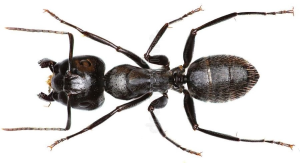
Carpenter ants, which can get in where branches touch the house and prefer moist, decaying wood.
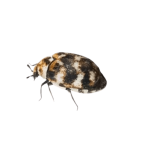
European chafer, now found in the Township, whose larvae bring birds and raccoons digging into lawns.
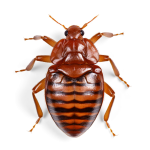
Apartments and shared walls, starting with a K9 detection.
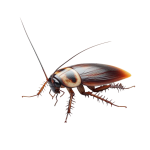
They travel easily inside a building and hide by day, so they can go unnoticed for a while.
For homes
One suite in a City low-rise or a Willoughby apartment building.
Single-family and laneway homes
Houses on Brookswood’s treed lots, and across Murrayville and Walnut Grove.
Row houses made up 58% of the Township’s new homes from 2016 to 2021.
Crawl spaces and attics that rats, raccoons and squirrels get into.
For buildings and businesses
Strata and apartment buildings
Programs across a whole building for strata councils and landlords; the 2021 Census counted 37% of the City’s homes as rented.
Kitchen programs for the restaurants Fraser Health’s Langley office inspects.
Retail stores and shopping centres
Stores and malls in downtown Langley and Willowbrook.
Offices around Carvolth, which the Township calls Willoughby’s major job hub.
Langley Pest Control Questions
Answers for homeowners, renters, strata councils and businesses in the City and the Township.
Prefer to talk?
604-771-0404Do you serve both the City and the Township of Langley?
Yes, both, and it helps to know which one you’re in. The City is a separate municipality of about 10 square kilometres, with the Township on its north, east and south. They have different rules on pesticides and infestations, and different bylaw offices: the City’s Community Safety Team is at 604-514-2800 and the Township’s Bylaw Enforcement at 604-532-7551. Fort Langley and Aldergrove, both in the Township, have their own pages.
Is rat poison allowed in Langley?
Not the strongest kind around homes. Since January 21, 2023, B.C. has barred second-generation anticoagulant rodenticides in or around homes, offices, parks, schools and ordinary shops. Essential services, a list that includes land used for agriculture, can use them only through a licence holder, and preventative baiting is prohibited even there.
The Township also advises against poison and baits at home, because a poisoned rodent can die out of sight and poison can harm pets, wild animals or children. It calls traps the best way, and says to seal building gaps over 6 mm. Licensed companies can still trap, seal and bait with other rodenticides.
What are Phantom’s treatment prices?
Some of Phantom’s published prices follow, all + GST; ask the office to confirm them for your Langley address. A three-visit rodent program is $495–$650 for a house and $395–$495 for a condo, and exterior bait stations are a $150 minimum to set up, then $78.75–$95 a visit.
Cockroach treatment is $250–$350. A K9 bed bug detection is $195–$275 for one unit, and bed bug treatment is $525–$695 for a condo, apartment or townhouse and $725–$1,595 for a house. Phone estimates are free.
Can pesticides be sprayed outdoors in Langley?
It depends which side of the line you’re on. The City’s Pesticide Control Bylaw 2879 bans pesticides for maintaining outdoor trees, shrubs, flowers and lawns on residential land and City land. It doesn’t apply to pesticides used in or on buildings or on land used for agriculture, and a certified applicator may treat a pest causing an infestation, which the bylaw defines as an immediate risk of property damage or significant financial loss. We found no such ban in the Township, which encourages residents to reduce or stop cosmetic use.
Do you remove raccoons, skunks and squirrels in Langley?
Yes, through wildlife control. After removal, exclusion work seals the entry points and gaps that let the animal in. Our published prices for a house are $350 + GST for two traps and two visits over a week, and $125 + GST to relocate an animal; ask the office to confirm them for your Langley address and to quote the exclusion work. We can’t guarantee catching the animal. Langley’s Critter Care Wildlife Society says raccoons shelter in chimneys, attics, garages and under decks. If you’ve found an injured or orphaned mammal, its helpline is 604-530-2064 ext. 3; call before bringing the animal in, and note that it doesn’t take birds. Our guide to keeping squirrels out of a garden lists seven humane ways.
Why are animals digging up my lawn in Langley?
It may be European chafer. The Township says it can now be found here and is most noticeable where wildlife has torn up lawns. The larvae feed on grass roots for 10 to 11 months, and birds and raccoons dig for them. The Township says nematodes are best applied in late July, and both it and the City issue free water exemption permits for that, with proof of purchase or of hiring a professional. We treat chafer too; see beetle control.
Who deals with pests in a Langley rental?
For insects, usually the landlord. The Residential Tenancy Branch says landlords are generally responsible for insects such as bed bugs, and tenants must ask for repairs in writing and allow reasonable time. For rodents it points to municipal standards of maintenance bylaws, so check with your City or Township bylaw office. Fraser Health says landlords can’t legally apply pesticides themselves in rental suites. For bed bugs, Phantom requires a K9 detection before treatment.
Are there giant hornets in Langley?
The Invasive Species Council of BC says they aren’t established in B.C. The Province recorded single hornets in Langley in 2019 and on 0 Avenue in 2020, and said that November that no nest had ever been found in the Fraser Valley or Lower Mainland. The Council takes reports of sightings. B.C.’s native wasps, including yellowjackets and bald-faced hornets, also start nests each spring, and we treat those; see wasp control.
Who inspects Langley restaurants for pests?
Fraser Health. Its Langley Health Protection Office, at 6470 201 Street (604-514-6121), inspects restaurants and food service locations. Under B.C.’s Food Premises Regulation, operators must keep premises free of pests and of conditions that harbour them, and protected against their entry. For a kitchen program, see restaurant pest control.
Get a Free Estimate in Langley
Send a few photos and your neighbourhood, and we’ll call you back to talk through the job.
- Office and Service Hours
- Monday to Friday, 9 AM to 5 PM: calls, estimates and call-backs.
- Commercial
- Open 24/7 for pre-arranged commercial services: evening, night and weekend visits when booked ahead.
Free estimate request

Book a Langley Inspection
Say whether you’re in the City or the Township and what you’ve noticed, and the first visit gets planned around it.
Estimates over the phone are free, Monday to Friday, 9 AM to 5 PM. Open 24/7 for pre-arranged commercial services.