Ant Control in Vancouver, BC
Phantom Pest Control provides ant control and removal in Vancouver, BC and across the Lower Mainland and Fraser Valley, for houses, condos, rental suites and businesses. Our certified technicians identify the ant, follow its trail to the nest and the way in, and treat inside, outside or both, with bait, spray or a mix of the two.
- Fully licensed, insured and certified
- Read our Google reviews
- Ant treatment From $125 + GST Interior baiting in a condo; a full inside-and-outside house treatment is $450–$550 + GST
- Carpenter ants $450–$650 + GST Inside and outside, for a house; $395–$595 + GST for a condo, apartment or townhouse
- Inspection From $125 + GST $150 + GST for a house; free for businesses
- Stay out At least 6 hours After the job is done; 24 hours for some people and pets, as the ant preparation sheet explains
How to Tell Which Type of Ant You Have
Size and the nodes in the waist tell the common household ants apart. Carpenter ants are large, black or red and black, up to 15 mm; pavement, odorous house and pharaoh ants are 1.5–4 mm. Carpenter and odorous house ants have one node in the waist; pavement and pharaoh ants have two, as UC IPM’s identification table shows.
Carpenter ant Camponotus
The largest ants in B.C., 8–15 mm long, the B.C. Home and Garden guide says, and black or red and black, as UC IPM describes them. They tunnel into damp or decaying wood without eating it, and push out sawdust-like shavings. Treated inside and out: $450–$650 + GST for a house. Carpenter ants in your walls
European fire ant Myrmica rubra
Reddish-brown and 4–5 mm long, with two waist segments and two backward spines, says the City of North Vancouver. It stings, nests in moist lawns and garden beds without building mounds, and has spread in Metro Vancouver since 2010. Phantom treats it: call or text for a quote.
Pavement ant Tetramorium immigrans
Dark brown to black, 2.5–4 mm, with fine parallel grooves on the head and thorax, Penn State Extension notes. Colonies live under sidewalks, slabs and large rocks, and push small piles of soil up through the cracks. Treated as general ants, from $150 + GST for a house.
Odorous house ant Tapinoma sessile
Penn State Extension describes workers 2.4–3.3 mm long, brown to black and all about the same size. Washington State University reports it is also called the sugar ant, for its taste for sweets, and that its smell is likened to rotten coconut. It trails to sweets indoors and moves its nests often, frequently within 21 days. Treated as general ants, from $150 + GST for a house.
Pharaoh ant Monomorium pharaonis
Pale yellow to light brown, 1.5–2 mm, with a darker tail end, the University of Florida notes. In B.C. it lives only indoors, in heated buildings. Repellent sprays can make the colony split and spread, Ohio State warns. Phantom’s pharaoh ant treatment includes 2 visits: $550–$650 + GST for a house.
Illustrations of worker ants, drawn to one scale from the sizes above.
Flying Ants and Winged Termites
Flying ant
Winged queens and males leaving the nest to mate. A pinched waist and front wings longer than the hind wings, and in queens and workers, elbowed antennae, as UC IPM describes. Flying ants in Vancouver
Winged termite
A thick waist, straight antennae and front and hind wings about the same size. Both drop their wings soon after the flight, UC IPM explains, so check the waist and antennae. If they’re termites, see termite control and prices and how to get rid of termites.
When Ants Indoors Mean a Nest Inside
Ants are most active in spring and summer, so ants indoors in winter usually mean a nest indoors: the Province’s IPM guide to carpenter ants says carpenter ants seen inside from November through February probably have one in the house; from March through October, look outdoors first. Ants carrying food in, or winged ants coming out indoors, also point to a nest inside.
Points to a nest inside
- Large black or red-and-black ants indoors from November through February
- Winged ants coming out of a wall, floor or window frame indoors
- More than 10–12 large ants in the house in one evening, the point at which the Province suggests checking for a nest
- Small piles of sawdust-like shavings under a window frame, beam or baseboard
- Rustling inside a wall or ceiling, often after dark
- Tiny pale ants turning up all year in a heated building
Not proof on its own
- A few ants on the kitchen floor in spring or summer: the B.C. guide notes several kinds come indoors for food from nests outside
- A trail to spilled food that stops once the food is sealed away
- Small piles of soil between patio stones or along the driveway: pavement ants nest under the slabs
You can add a note and a photo of the ants to your estimate request, and read about treating a carpenter ant nest in your home.
Where Ant Trails Lead in a Vancouver Home
Several kinds of ants usually nest outside, in lawns, stumps and under rocks, and come indoors for food, the B.C. Home and Garden Pest Management Guide says. Carpenter ants also get in where branches touch the house, and about 80% of their main nests are outdoors in rotting wood, with satellite nests in nearby homes.
In the house
- A
Kitchen counter and sink
Odorous house and pavement ants trail to sweets, grease and crumbs on counters. Food in sealed containers takes away the reason to come in.
- B
Window sills and frames
Carpenter ants nest in wood that has started to rot, and UC IPM names hollow doors and window frames among their nest sites. Look for sawdust-like shavings on the sill.
- C
Wall voids by a leak
A damp wall void behind a bathroom or a leaking pipe can hold a nest. Carpenter ants, odorous house ants and, in heated buildings, pharaoh ants all use them.
Around the house and yard
- D
Eaves where branches touch
Health Canada says carpenter ants get in where tree branches or other plants touch the house. Pruning branches back from the roof and walls cuts that route.
- E
Deck and posts
Wood in contact with soil stays damp. The Province advises keeping wood siding and structures off the soil near the foundation.
- F
Patio and sidewalk cracks
Pavement ants nest under slabs and pavers. Pouring water into the cracks doesn’t end the colony, Ohio State explains, because the ants move the nest.
- G
Garden beds and pots
European fire ants nest in moist lawns and garden beds and under rocks and pots. Their nests move with potted plants, soil and mulch, so the City of North Vancouver asks people not to move soil from an infested yard.
- H
Stump and firewood
Washington State University reports that a carpenter ant colony’s parent nest is often outdoors in a stump or log. The B.C. guide says not to store firewood next to the house for more than a year, or on the ground.
- I
Foundation and door thresholds
Pavement ants come in through cracks in the foundation and slab, Penn State Extension notes. Exterior perimeter treatments along the foundation need 3 days of dry forecast.
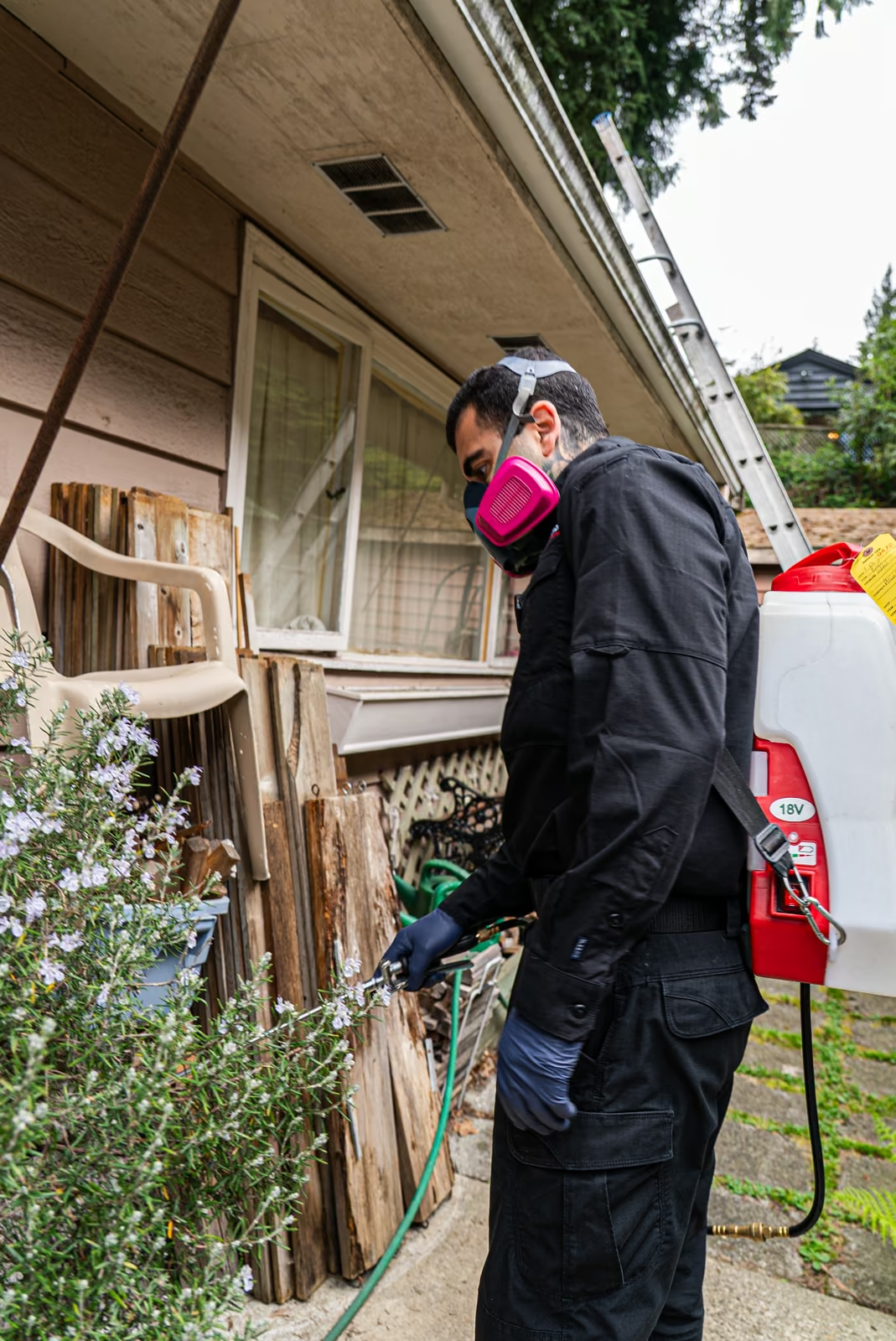
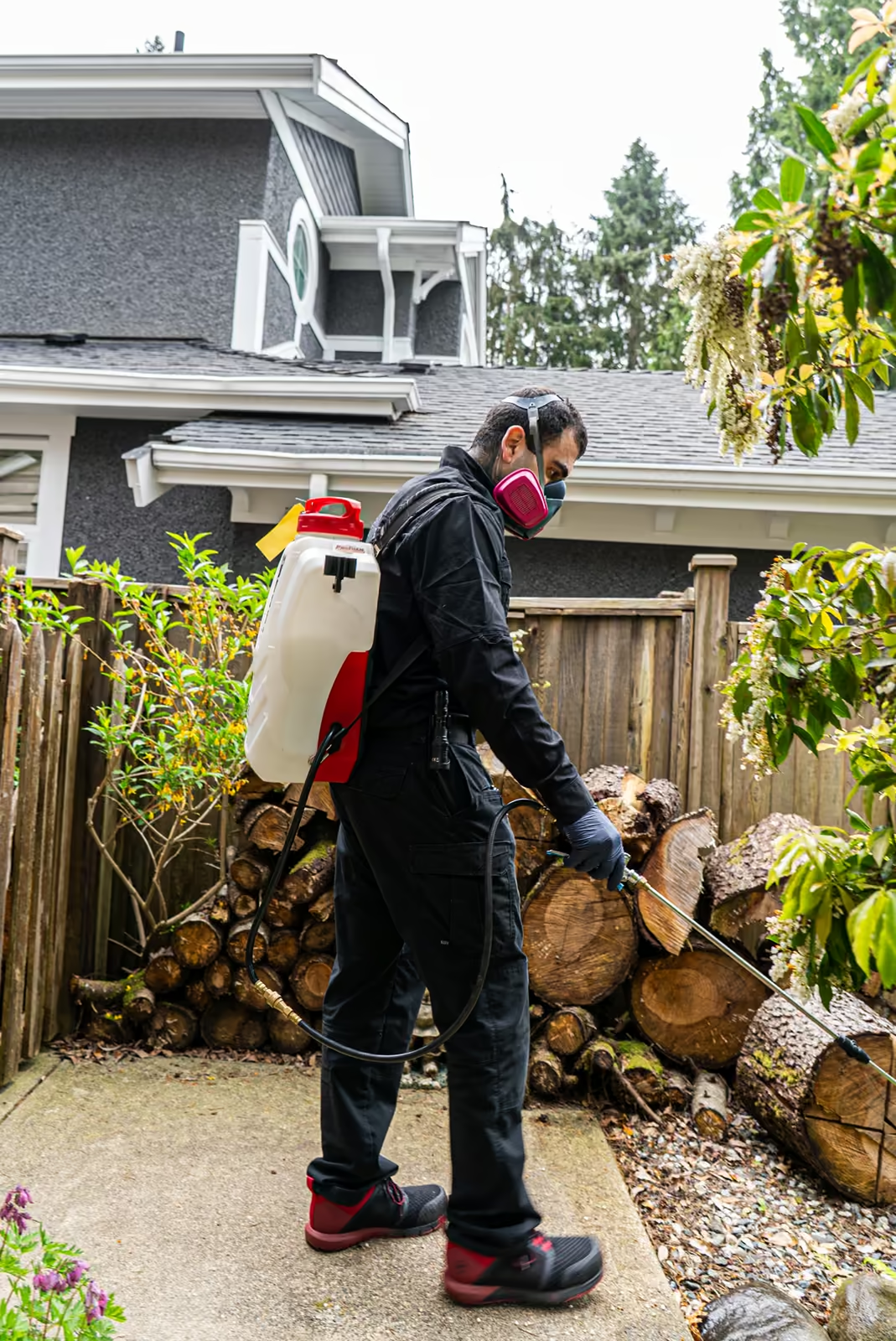
Firewood stacks
Spraying a stacked woodpile by the fence; UC IPM lists firewood among carpenter ant nest sites.
Lumber against the wall
Spraying old boards leaning on a house wall, the kind of stored wood the Province advises clearing.
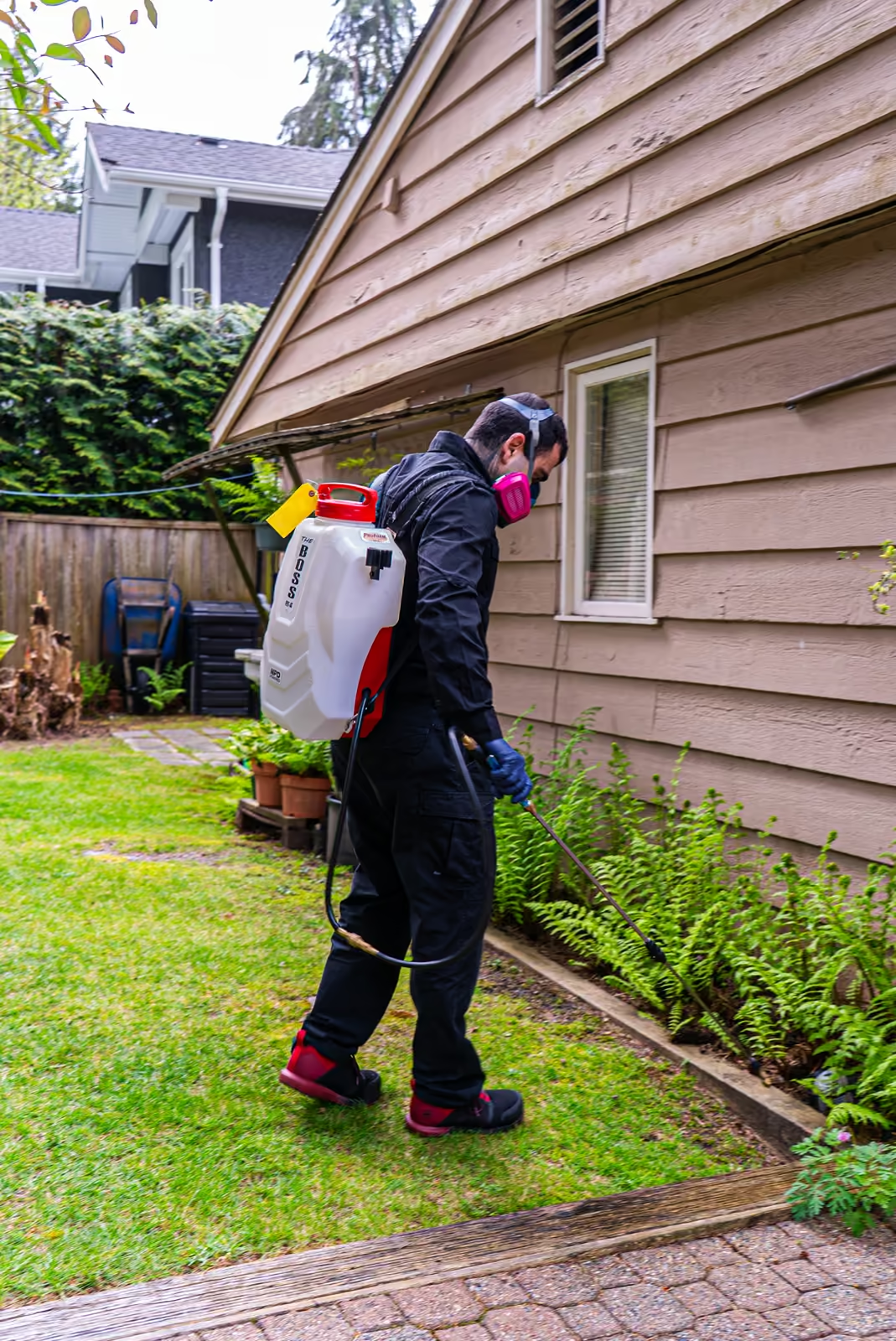
Beds along the siding
Treating a fern bed along the wood siding.
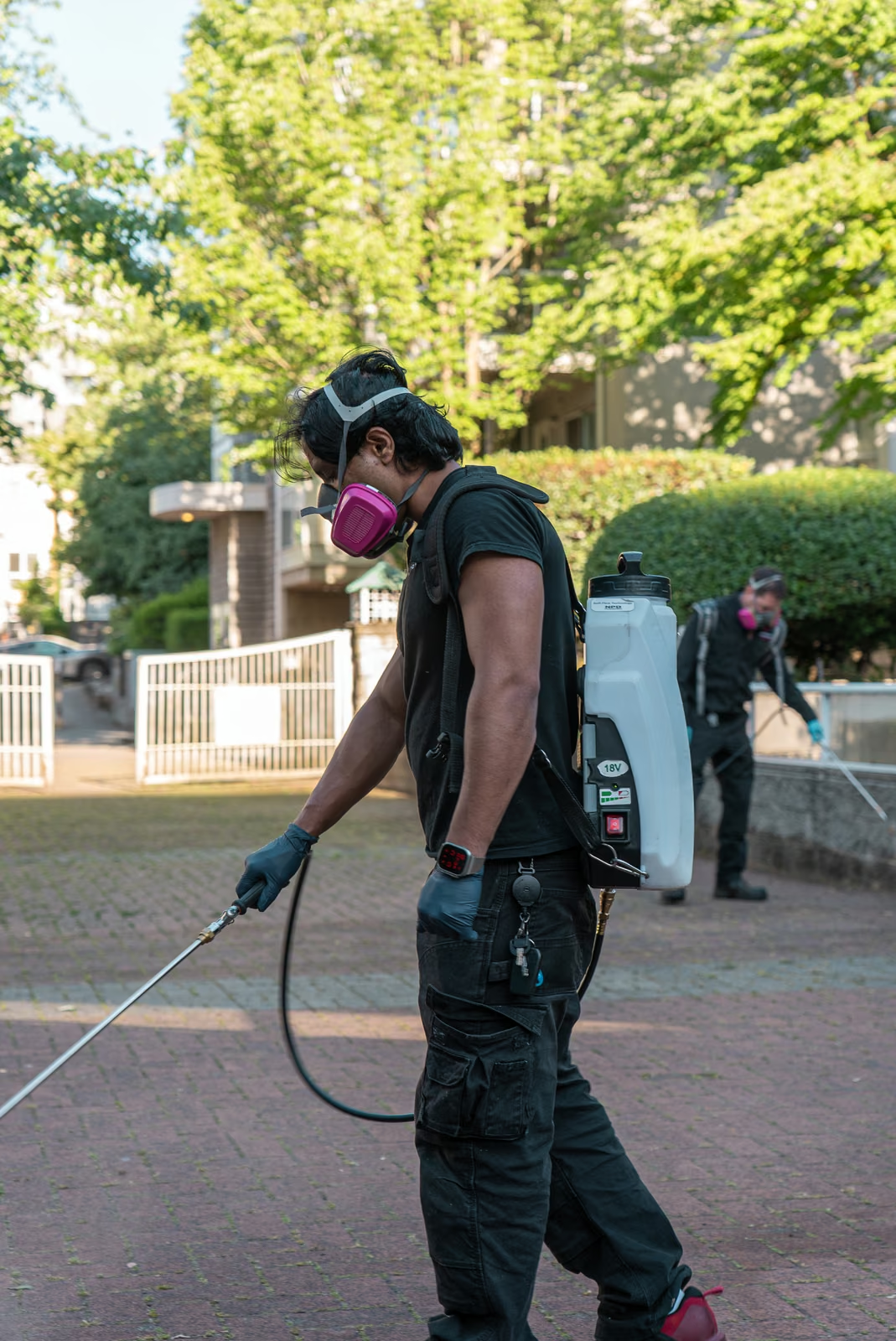
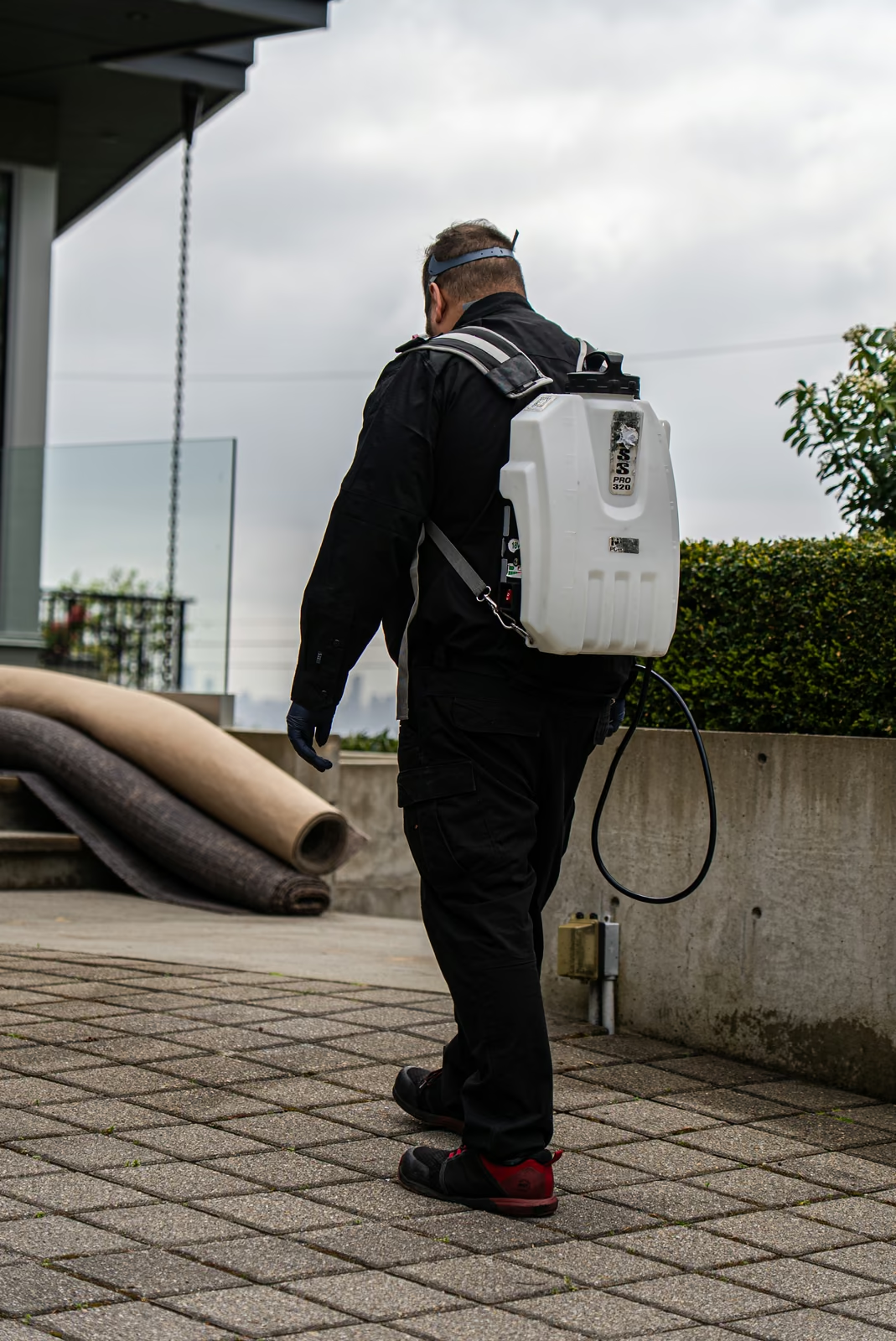
Pavers and walkways
Treating brick paving at a townhouse complex; pavement ants nest under pavers like these.
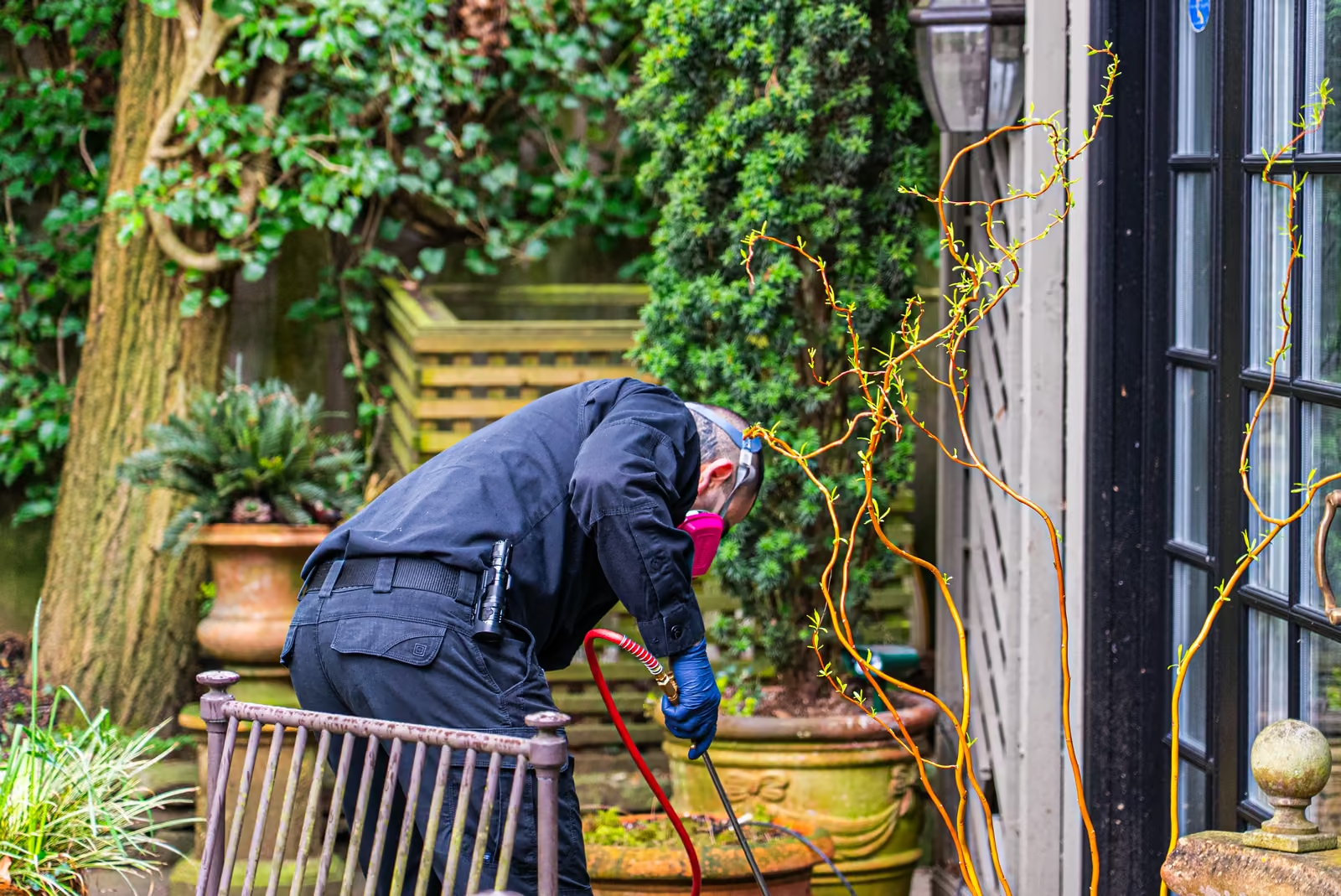
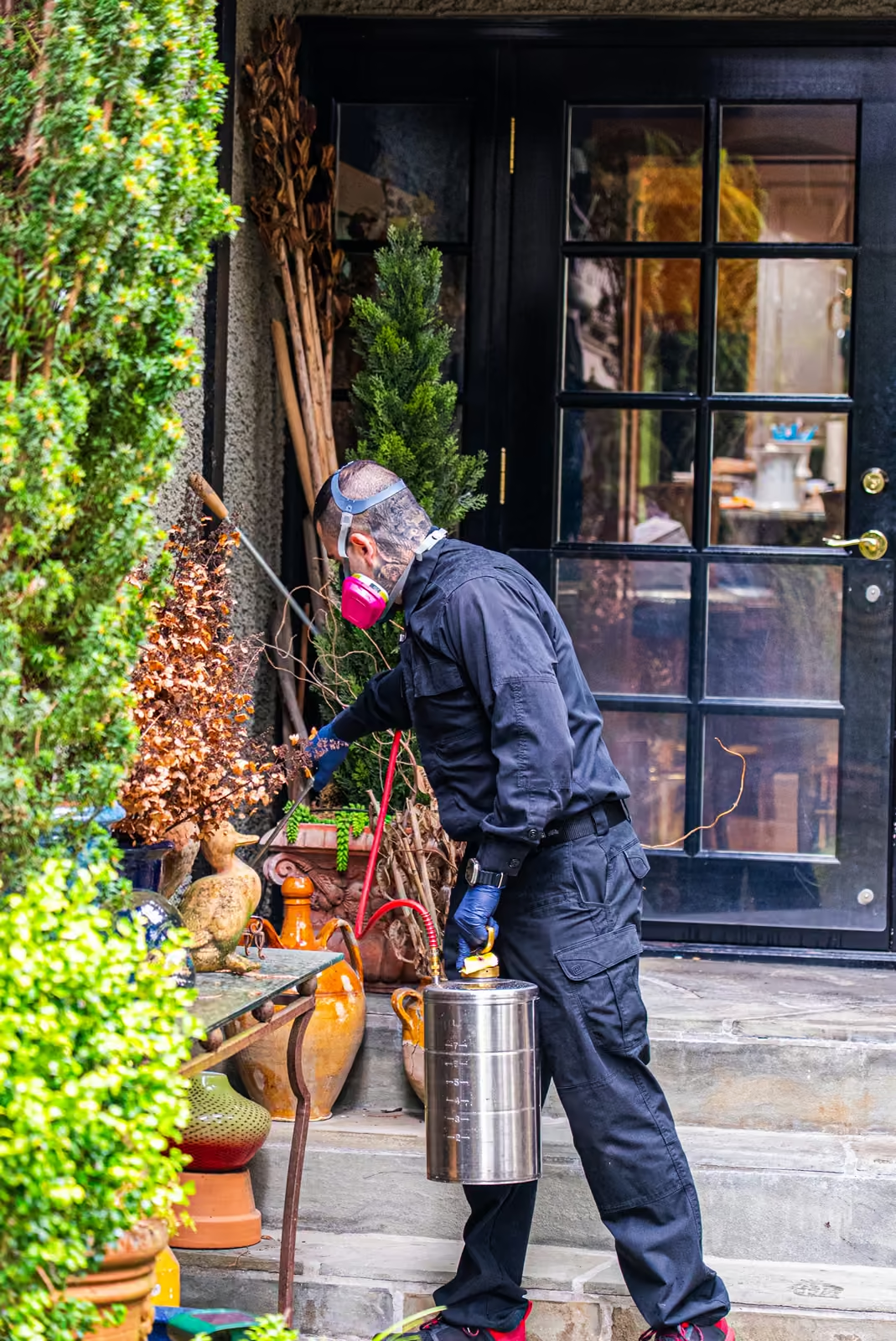
Planters by the doors
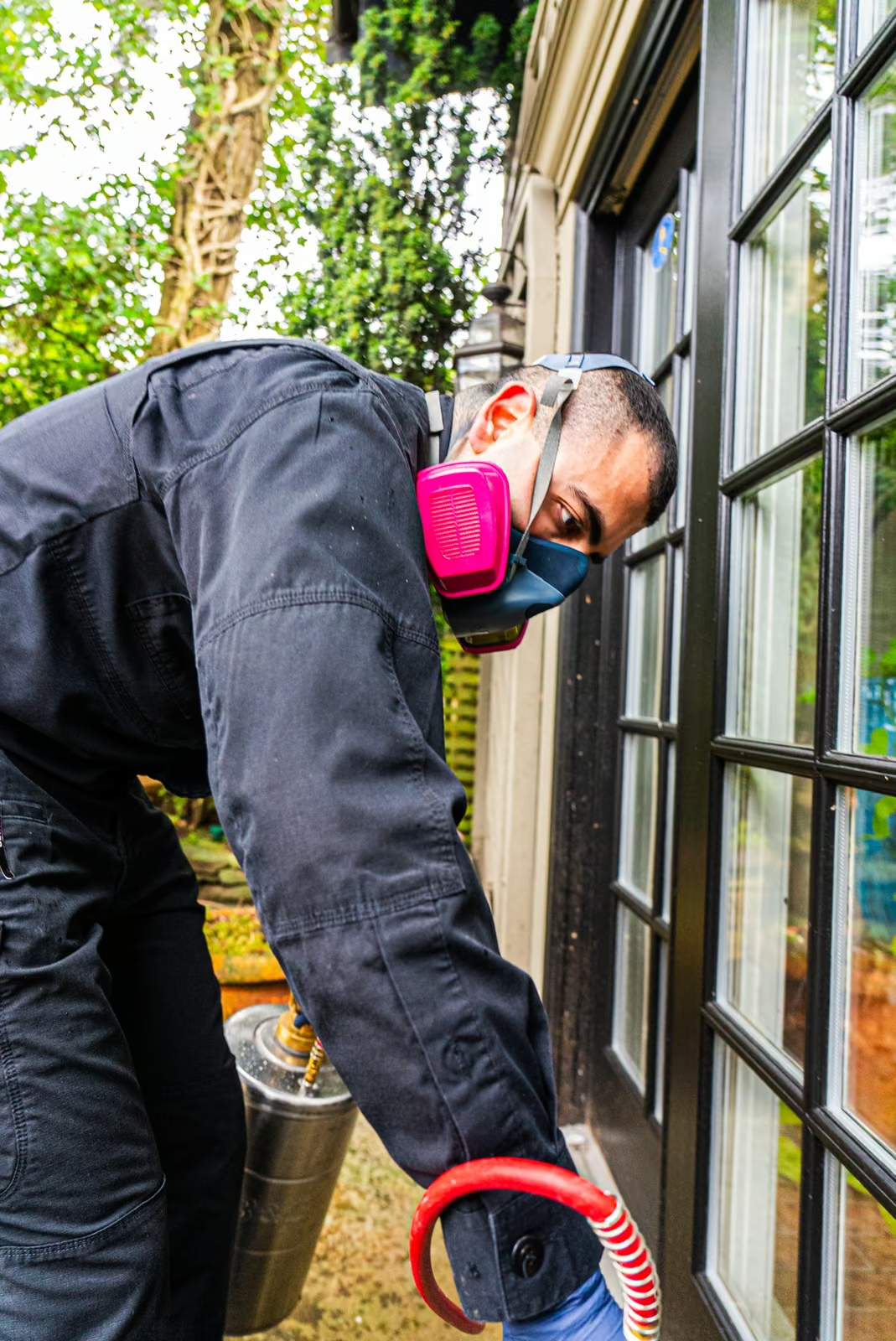
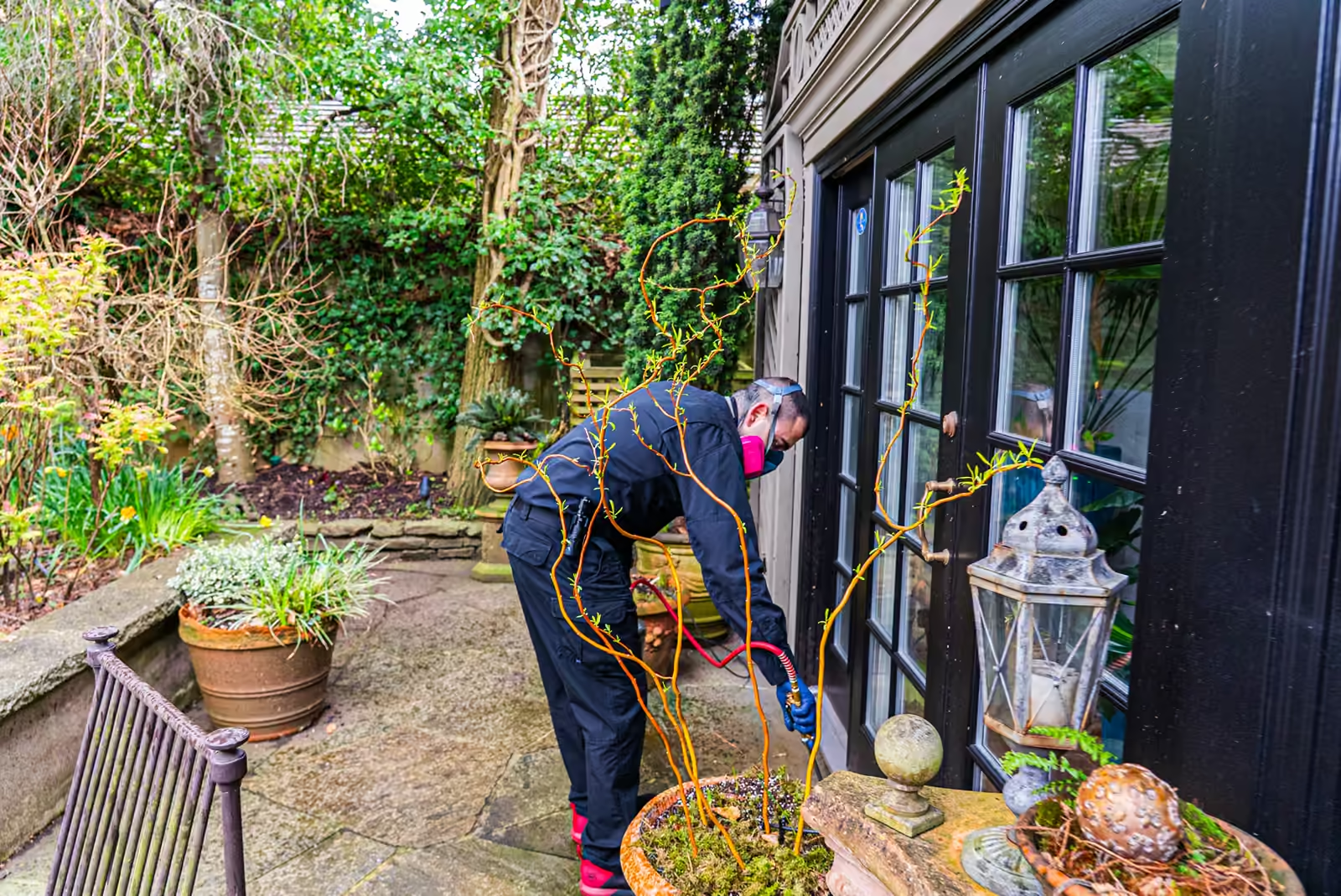
Treating the base of a patio planter beside the French doors.
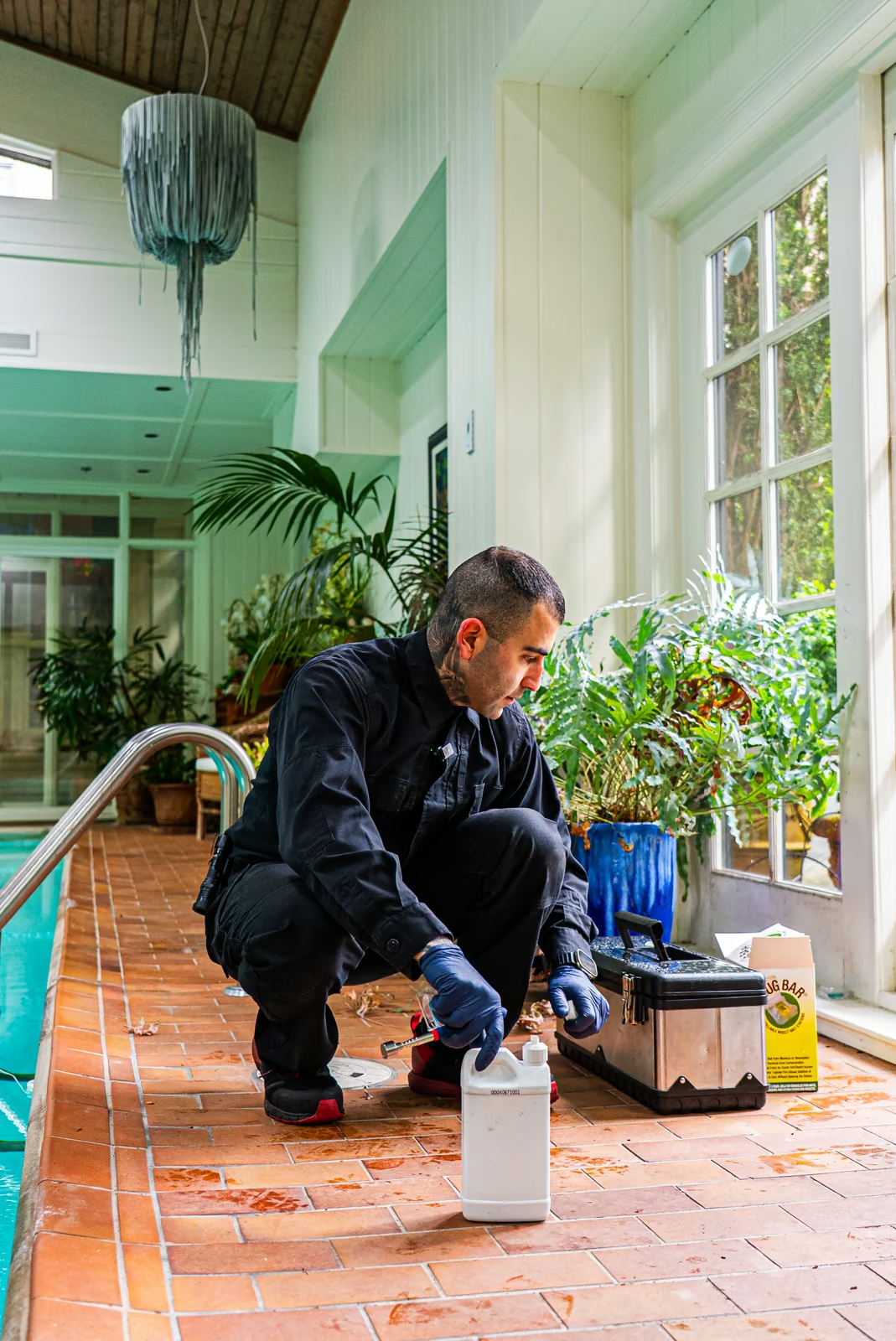
Liquid bait indoors
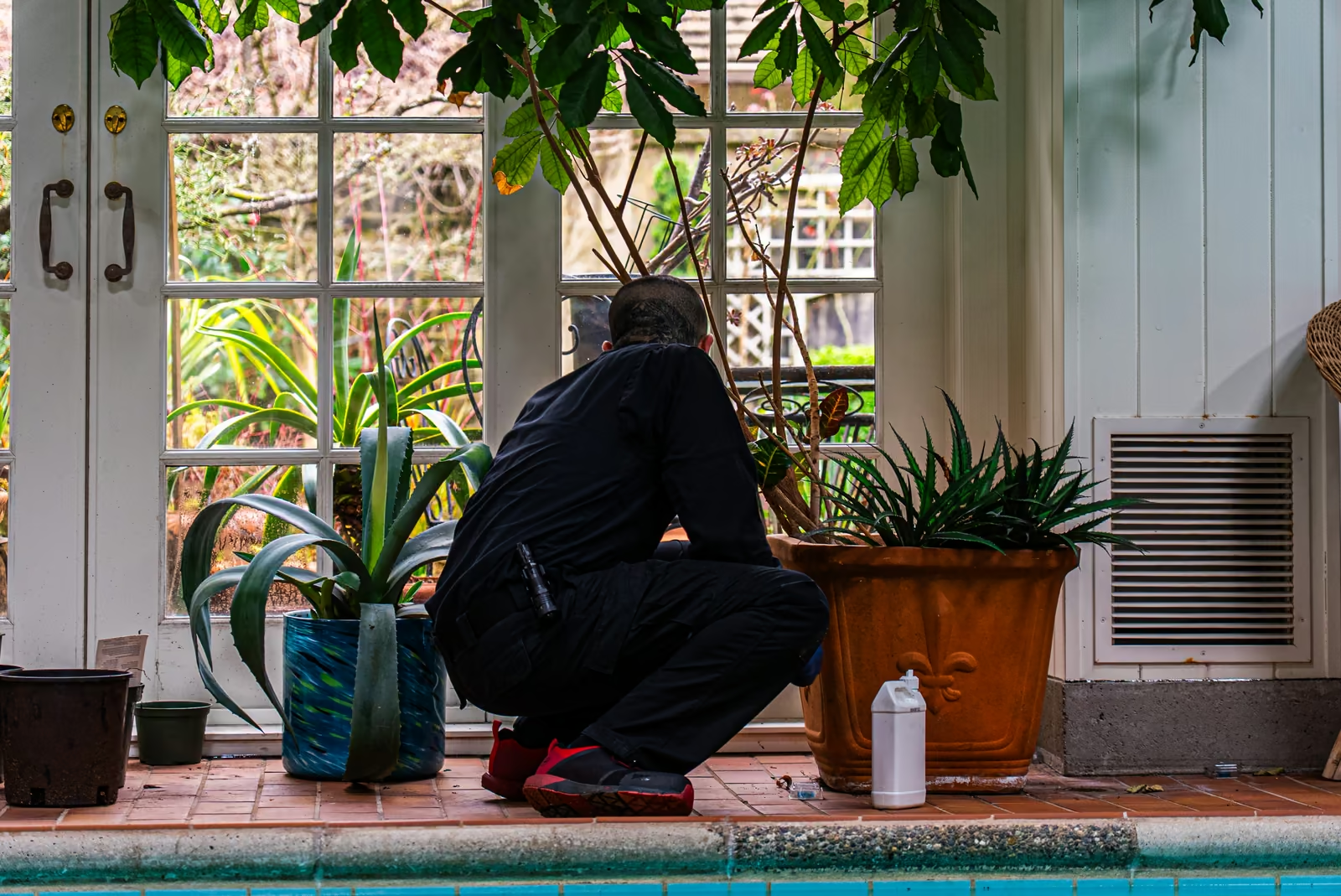
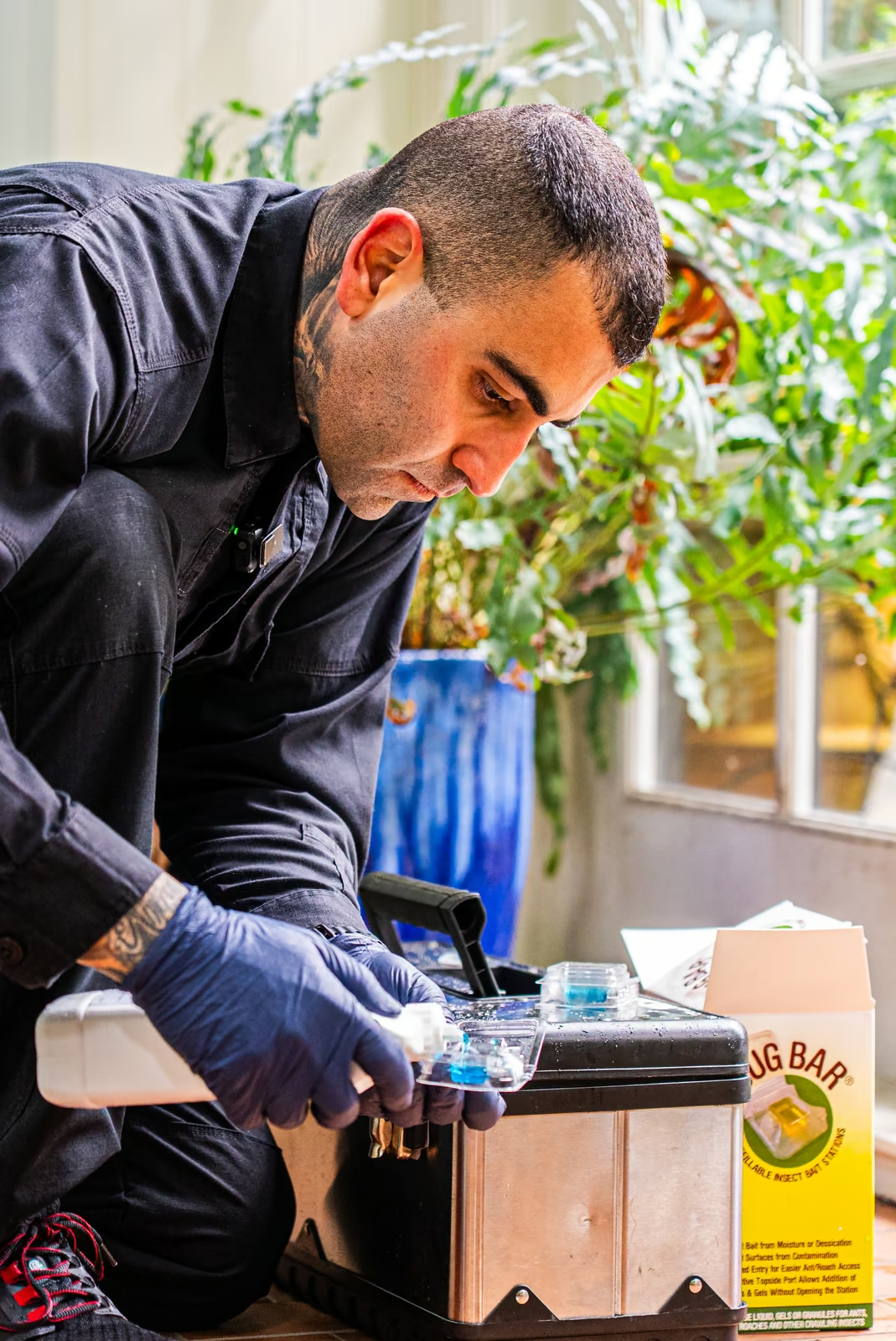
Working with liquid ant bait by the planters in an indoor pool room.
How Our Ant Treatment Process Works
An ant treatment starts by identifying the ant and following its trails to the nest and the way in. The price list covers spraying, baiting or both, inside and outside, and exterior spraying needs 3 days of dry forecast. The preparation sheet says to expect a significant knockdown in 4 to 7 days.
Identify and inspect
A technician identifies the ant, follows its trails, and checks the likely nest sites and the ways in, inside and out.
Bait, spray or both
The price list offers spraying, baiting or both, inside or out. Baits work slowly on purpose: foraging ants carry them back to feed the nest, Health Canada explains.
Inside and out
Interior spray or baiting works on the trails and nest sites; exterior spray or baiting goes around the foundation and the ways in. Carpenter ant treatments cover both, with an optional fogging add-on.
Knockdown and follow-up
Expect a significant knockdown in 4 to 7 days; some ants may wander for up to 3 to 4 weeks. Pharaoh ant treatment includes a second visit.
Ant treatment Ant preparation and aftercare sheet
- Stay out The ant preparation sheet asks everyone to stay out for at least 6 hours after the job is done.
- Some people and pets The sheet recommends 24 hours for children under 2, expecting and nursing mothers, people with a respiratory ailment, and pets.
- Knockdown The sheet says to expect a significant knockdown in 4 to 7 days.
- Wandering Some ants may wander for up to 3 to 4 weeks.
- Baseboards No vacuuming, mopping or cleaning within 6 inches of baseboards and treated surfaces for at least 4 weeks.
- Residual After a residual spray, the barrier keeps working for up to 3 months, the sheet says.
Your booked service’s preparation sheet lists the exact times for your treatment.
How to Prepare for Ant Treatment
Before the technician arrives, empty the lower cupboards, pull furniture and plants a foot from the walls, clear closet floors and pick things up off the floor. Everyone, pets included, leaves during the treatment and stays out at least 6 hours after it, or 24 hours for some people and pets, as the ant preparation sheet asks.
Before the treatment
- Empty the lower cupboards in the kitchen, bathrooms and bedrooms
- Pull furniture and plants at least a foot from the walls
- Clear all closet floors
- Pick toys, clothes and books up off the floor
- Plan for everyone, pets included, to be out during the treatment
- Unplug the fish tank’s air pump and lay a wet towel over it
After the treatment
- Stay out for at least 6 hours after the job is done; the preparation sheet recommends 24 hours for children under 2, expecting and nursing mothers, people with a respiratory ailment, and pets
- Don’t vacuum, mop or clean within 6 inches of baseboards and treated surfaces for at least 4 weeks
- Expect a significant knockdown in 4 to 7 days; some ants may wander for up to 3 to 4 weeks
- Open the windows to air out the home, keep food covered, and don’t wipe the treated areas
- After a residual spray, the barrier keeps working for up to 3 months
- Exterior spraying needs 3 days of dry forecast
Ant Control Cost in Vancouver
A one-time general ant treatment costs $150–$550 + GST for a house and $125–$395 + GST for a condo, apartment or townhouse. Carpenter ant treatment is $450–$650 + GST for a house, and pharaoh ant treatment, with 2 visits, $550–$650 + GST for a house. Inspections start at $125 + GST; phone estimates are free.
General ants, house
- Interior spray $225–$295 + GST
- Interior baiting $150–$195 + GST
- Exterior spray $250–$450 + GST Needs 3 days of dry forecast.
- Exterior baiting $175–$250 + GST
- Full treatment, inside and outside $450–$550 + GST Liquid baiting and spray; needs 3 days of dry forecast.
General ants, condo, apartment or townhouse
- Interior spray $195–$295 + GST
- Interior baiting $125–$195 + GST
- Exterior spray $175–$250 + GST Needs 3 days of dry forecast.
- Exterior baiting $150–$225 + GST
- Full treatment, inside and outside $325–$395 + GST Liquid baiting and spray; needs 3 days of dry forecast.
Carpenter ants
- Inside and outside, house $450–$650 + GST
- Inside and outside, condo, apartment or townhouse $395–$595 + GST
- Fogging, added to the treatment $150–$250 + GST
Pharaoh ants
- Treatment with 2 visits, house $550–$650 + GST
- Treatment with 2 visits, condo, apartment or townhouse $350–$495 + GST
- Condo bundle, first unit $195 + GST
- Condo bundle, each additional unit, per visit $65 + GST
Estimate and inspection
- Estimate over the phone Free
- Inspection, house $150 + GST
- Inspection, condo, apartment or townhouse $125 + GST
- Attic or crawl space, added to the inspection +$50 Waived if you book the service the same day.
Businesses
Savings
- Two or more services together 15% off
- Seniors 5% off
- Referrals, for both you and the new client $25 off
Prices are in CAD and exclude GST. Standard prices apply to homes in Greater Vancouver and the Lower Mainland, and they can change with the size of the property, how severe the infestation is and the treatment it needs. Businesses get a free site inspection and a quote for their site.
One Ant Treatment or an Ongoing Program
A one-time treatment suits ants you’re seeing now. If ants return year after year, the ant control program schedules visits for your property, and carpenter ants have a program of their own.
Ant treatment
- When it fits Ants active in or around your home now.
- Visits One treatment; pharaoh ant treatment includes 2 visits.
- Price From $125 + GST, as listed above.
- When it fits Pavement, odorous house, pharaoh or European fire ants that return year after year.
- Visits Our ant control program sets a visit schedule for your property after the first inspection, and an extra visit is free if ants return between visits.
- Price Quoted for your property; one-time prices are above.
- When it fits Carpenter ants that return, or a home near woods or with damp wood.
- Visits Each visit of the carpenter ant control program includes a nest search and treatment inside and out.
- Price A free estimate for your property.
How to Keep Ants Out of Your Home
Store food in sealed containers, fix leaks, seal gaps at doors and windows, and keep branches, firewood and damp wood away from the house. The B.C. guide notes good sanitation will help control most home ant infestations, but a nest in the home has to be destroyed before the problem is solved.
What helps at home
- Keep sweets, pet food and garbage in sealed containers, and wipe up spills
- Fix leaks, ventilate damp areas and keep the gutters clear
- Prune trees and shrubs so their branches don’t touch the house
- Store firewood on a raised platform away from the house, and never next to the house for more than a year
- Remove rotted stumps, logs and landscaping wood near the house
- Keep wood siding and structures off the soil by the foundation
- Seal cracks and gaps at doors, windows and pipes; larger openings can be sealed as exclusion work
- Don’t move soil, mulch or potted plants out of a yard with European fire ants
DIY or an Ant Exterminator: What Each Can Do
Store-bought sprays
What it does Kills the ants it touches.
Where it falls short Most ants you see are foragers, a small share of the colony, UC IPM notes. Health Canada says spraying indoor trails can split a colony into several, and Ohio State says repellent sprays can scatter pharaoh ants through a building.
Store-bought ant baits
What it does Foraging ants carry slow-acting bait back to feed the nest.
Where it falls short Results take weeks, and spraying near the bait stops ants eating it. Look for a PCP number on the label and place bait out of reach of children and pets, Health Canada advises.
Flooding or digging out a nest
What it does Disturbs the part of the nest you can see.
Where it falls short Pavement ants move the nest when disturbed, and the Invasive Species Council of B.C. asks people not to try removing a European fire ant nest themselves.
Professional treatment
What it does Finds the nest and the ways in, then sprays, baits or both.
Where it falls short Works best with the clean-up and repairs above. The B.C. guide says spot-treating where carpenter ants come in isn’t effective: the nest has to be found.
For methods you can try first, read how to get rid of carpenter ants in your house.
Why Choose Phantom for Ant Control
Phantom Pest Control publishes its one-time ant treatments, prices and preparation sheet on this page, and every photo here comes from one of its own ant jobs.
- Our owner 15+ years of pest control experience serving British Columbia
- Since 2019 29,000+ locations serviced from 2019 to 2026
- Credentials Fully licensed, insured and certified Licensed under B.C.’s pest control regulations
- Area 24 communities From Squamish to Abbotsford
Along patio doors
Doors and thresholds are common ways in, so treatment follows them.
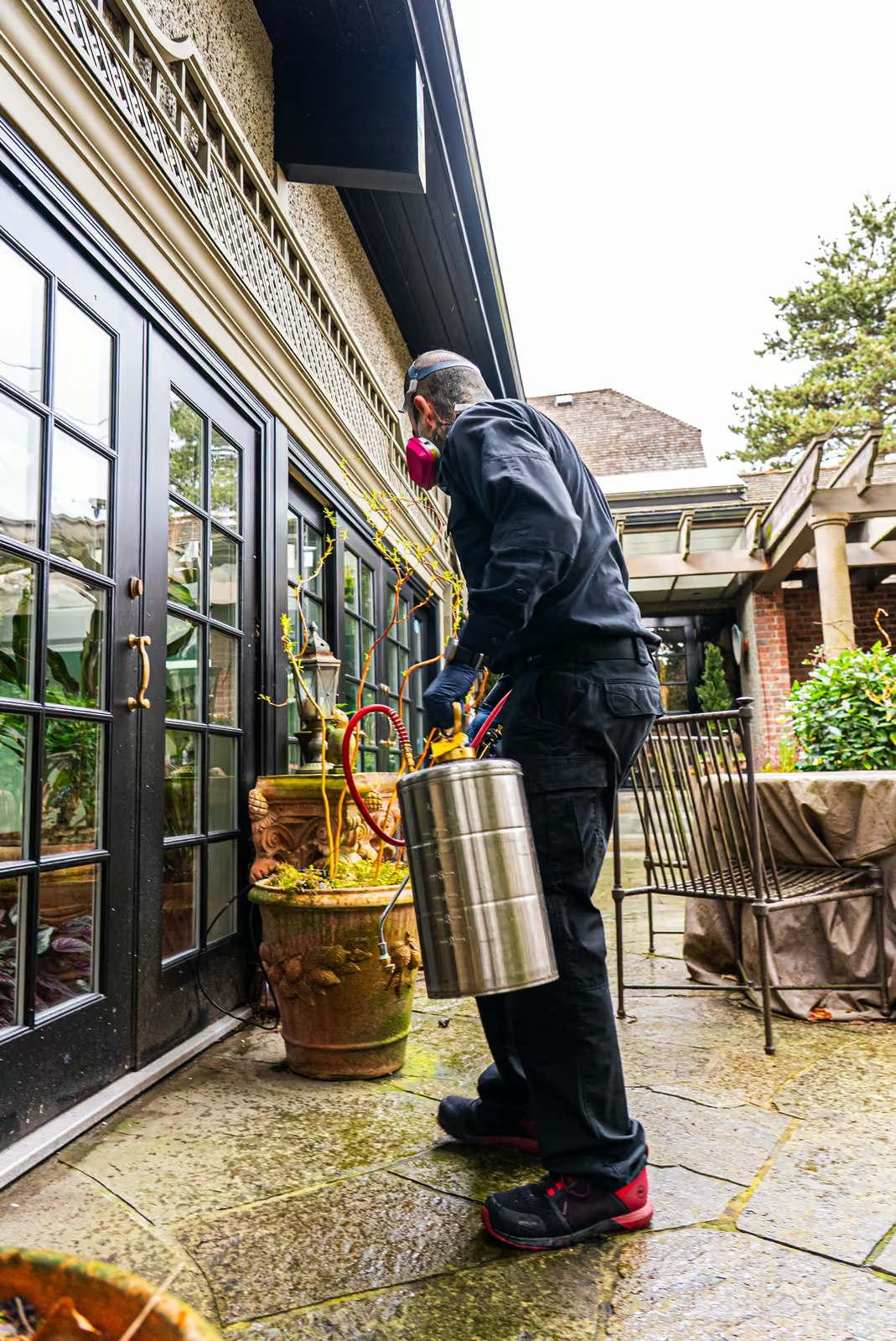
Courtyards
Treating the base of French doors off a stone courtyard.
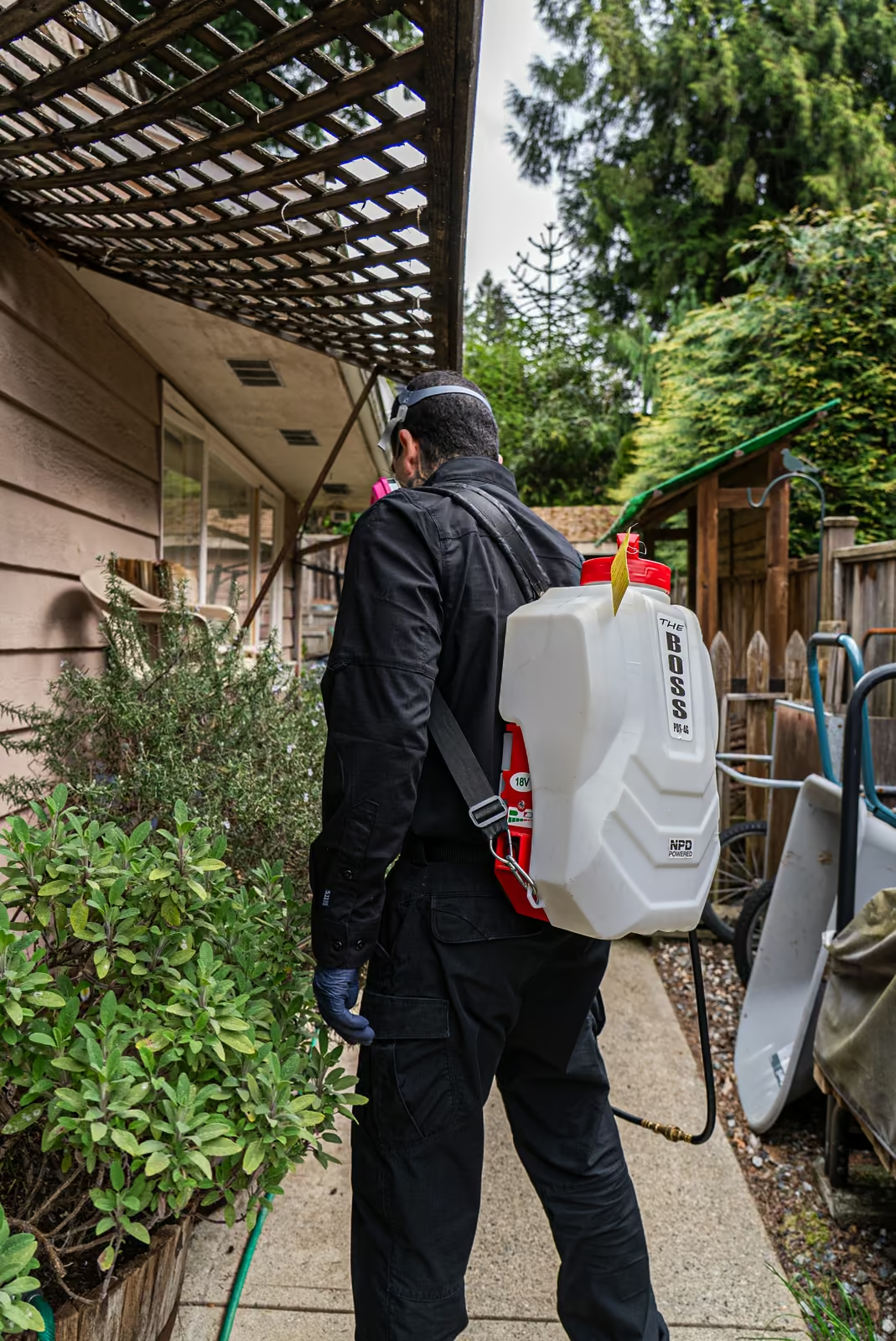
Garden paths
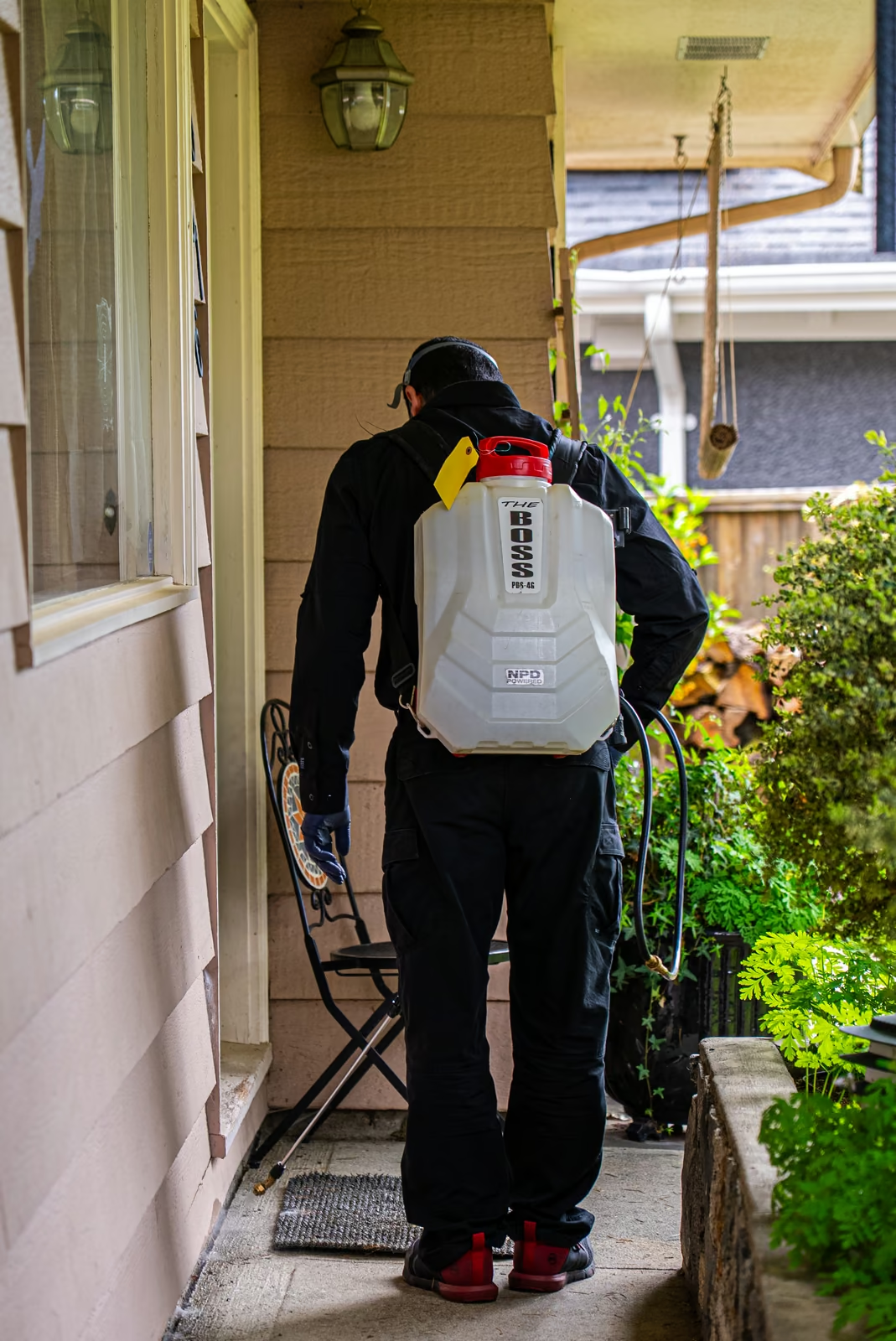
Carrying the sprayer along a side path under a pergola.
Patios and pavers
Crossing a paver patio with the backpack sprayer on a carpenter ant job.
Where We Treat Ants in Vancouver & the Fraser Valley
Phantom treats ants in 24 communities with a local service page, from Squamish to Abbotsford. Not on the list? Tell us your city in the form, or call the office.
Vancouver, the North Shore and Squamish
Burnaby, the Tri-Cities and Ridge Meadows
Richmond and Delta
Surrey, Langley and Abbotsford
Local rules that affect ant treatments
- Lower Mainland pesticide bylaws, such as Richmond’s Bylaw 8514 and the City of North Vancouver’s Bylaw 8041, limit lawn and garden pesticides but don’t apply to treatments on or inside a building
- European fire ants: the City of North Vancouver asks residents to report suspected infestations and not to move soil, mulch or plants from infested areas. European fire ants in North Vancouver
Ant Control FAQs
Prefer to talk?
604-771-0404Why are there ants in my house in winter?
Most often because they’re nesting inside the building, where it’s warm. Penn State Extension says pavement ants can swarm in heated buildings from late fall into February, and Ohio State reports that pharaoh ants breed all year in heated buildings. UC IPM lists the warm, damp places pharaoh ants use: wall voids, under floors, and near hot water pipes or heating. A winter treatment starts with finding that nest, because spraying the ants you can see only reaches foragers.
Why are there more ants at the bait after a treatment?
Because the bait is working. Kentucky Extension notes ant numbers at a bait often rise at first, which shows they are carrying it back to the nest, so don’t spray them or wipe around the bait. Health Canada adds that spraying while a bait system is in use makes the bait fail, and UC IPM notes that baits are slow by design, so foragers feed the rest of the colony before they die, and that control with baits can take several weeks or more.
Can carpenter ants damage a house?
Yes, over time. Carpenter ants don’t eat wood, the Province notes; they tunnel into it, which eventually causes damage. They start in wood that is already damp or decaying, such as window frames, sills, decks and roof edges, and can move into drier wood in walls, eaves and attics. Sawdust-like shavings under a window or beam and rustling in a wall are the signs to check. After treatment, the Province advises replacing damaged wood and fixing the moisture so the problem doesn’t recur. Managing carpenter ants in B.C.
How can I tell if I have European fire ants?
Look for small reddish-brown ants that sting when you disturb the soil of a moist lawn or garden bed with no ant hill in sight. Their nests make no above-ground mounds, the Invasive Species Council of B.C. notes, and Thompson Rivers University’s Robert Higgins found that a grid of apple slices left out for about 90 minutes at 15–25 °C usually shows roughly where the nests are. The Province says a sting burns for 30 minutes to two hours. Other B.C. ants are red and sting too, so the City of North Vancouver advises having an expert confirm it. Phantom treats European fire ants.
I rent or live in a strata building. What should I do about ants?
Tell your landlord, property manager or strata council first. In an apartment building, the ants in your suite may be nesting in a wall void or in another suite, so a treatment in one unit may not reach the nest; Phantom’s multi-unit pest control program schedules visits for the whole building. Before a licensed applicator uses a pesticide in an occupied home or suite, B.C.’s Integrated Pest Management Regulation requires a treatment notice to the occupant, and to the owner or manager if different, at least 72 hours ahead.
How to Book an Ant Treatment
Tell us where you’re seeing ants, how many and since when, and the office will call you back. You can add a photo of the ants to the request. Estimates over the phone are free.
Free estimate request
Prefer to talk?
604-771-0404Office and Service Hours: Monday to Friday, 9 AM to 5 PM.