Seasonal Perimeter Pest Control in Vancouver & Fraser Valley
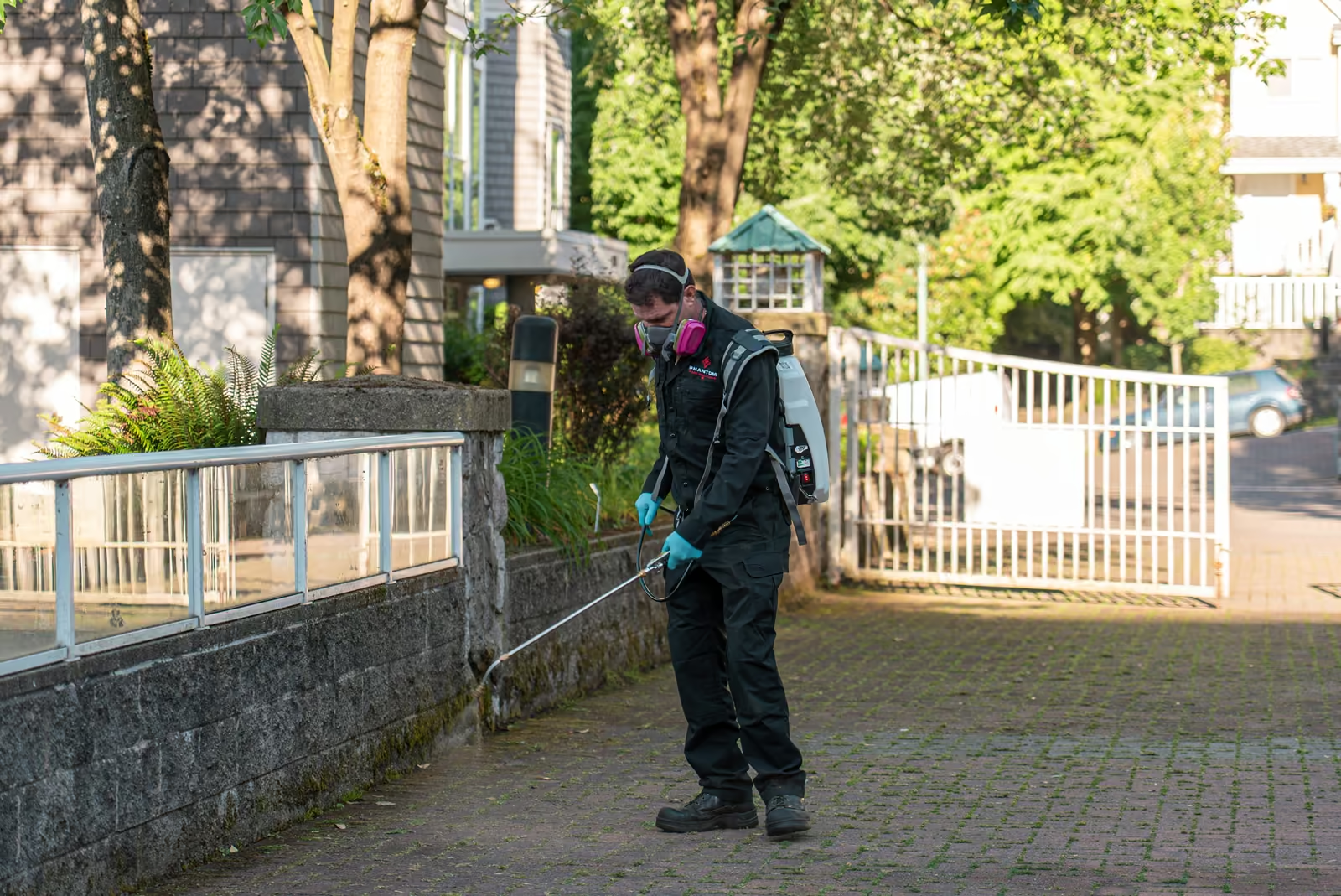
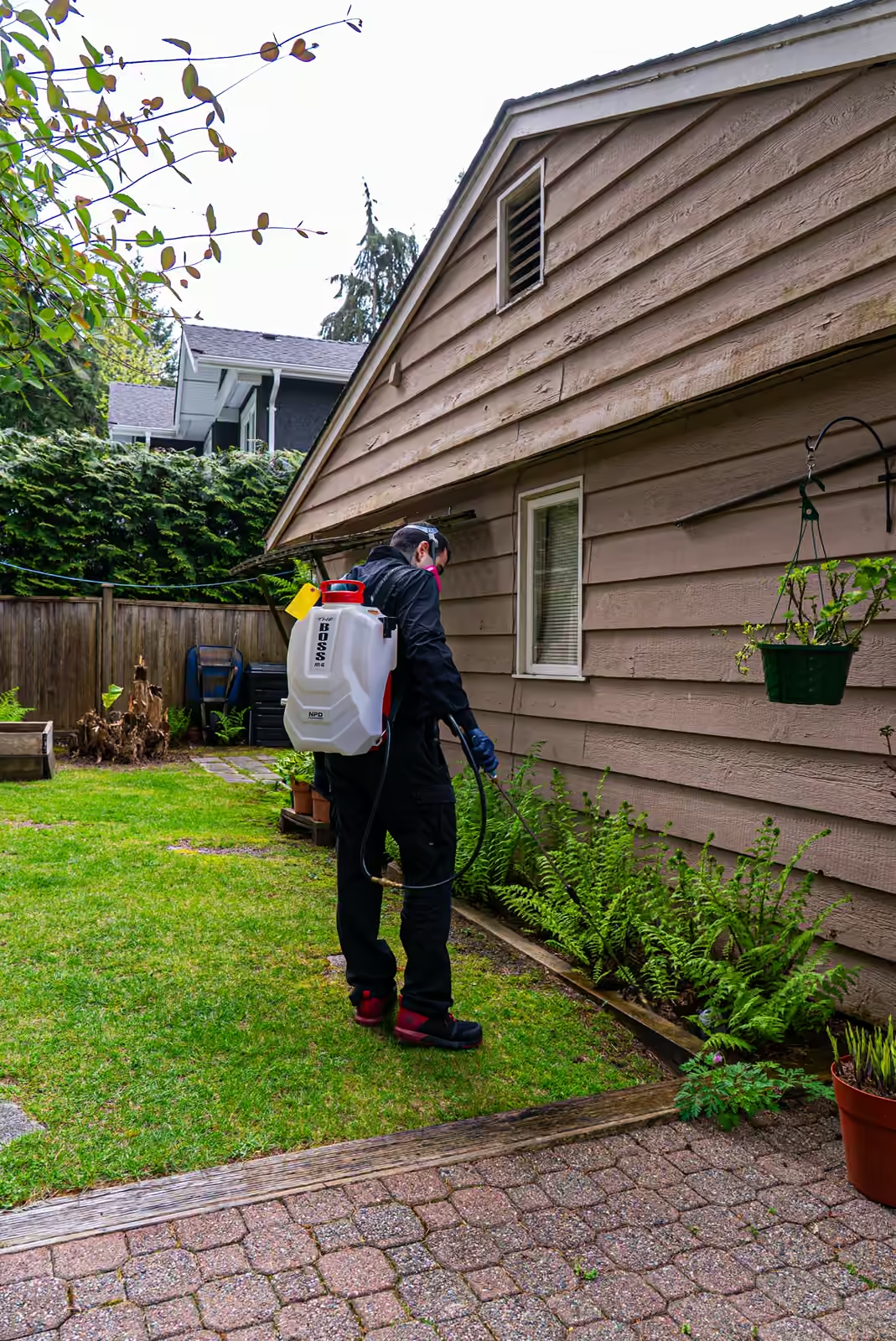
Phantom Pest Control’s Seasonal Perimeter Protection Program is perimeter pest control for homes and businesses in Vancouver, BC and the Fraser Valley. On every visit a technician sprays a band along the foundation, the door and window frames and the eaves, brushes down webs, treats new wasp nests at the eaves, and checks the walls for gaps, sealing the small ones.
For
Homes and business buildings
Service area
What Is Perimeter Pest Control?
Perimeter pest control treats the outside of a building: the base of its walls, the openings in them and the eaves above, where insects and spiders arrive before they find a way in.
Phantom’s pest pages price one exterior treatment at a time: an exterior spray on our ant control page, a seasonal exterior treatment on our crawling insect control page and an exterior treatment on our spider control page. The Seasonal Perimeter Protection Program repeats the outside work on a schedule the technician sets for your property after the first visit, with the same three checks every time.
It covers the outside only. If crawling insects are getting indoors too, our seasonal pest control program covers the inside as well. Rats and mice are handled on our rodent control page, openings too large to seal on a visit go to Exclusion work, and our regular maintenance page lists Phantom’s other scheduled programs.
Many of the ants that raid homes nest outside, in lawns, stumps or under rocks, and walk in along the ground.
Yellowjackets build under overhanging roofs, and paper wasps attach their small nests to eaves and window frames.
Outdoor lights and landscaping draw insects, and the insects draw spiders closer to the doors and windows.
Branches and shrubs that touch the house give carpenter ants a road from their nest to the walls.
Wood mulch, leaf litter and wood piles against the walls keep millipedes, sowbugs and earwigs damp and sheltered.
B.C.’s pest guide lists caulking where utility pipes enter the building among the ways to keep spiders out.
What Pests Does a Perimeter Treatment Target?
The pests that live and travel outside before they find a way in, each linked to the page that covers it in full.

From spring into summer, foraging trails run along the foundation and patio edges and in at doors and windows.

Webs collect at the eaves, window frames and porch lights, where the insects they feed on gather after dark.

New nests are started every spring, often under the eaves, and colonies are largest in late summer.

They hide by day in damp mulch, debris and wood, climb walls at dusk, and may wander indoors in June or July.
They need damp and soon die indoors, so a steady stream of them points to damp, outside at the foundation or inside the house.
They need damp, shelter in mulch and leaf litter, and may move into homes in spring and fall, through gaps an entry-point check can close.

Brown marmorated stink bugs, found in B.C. since 2015, gather on walls in the fall looking for a place to spend the winter.
Tell us where you saw it and add photos to your estimate request; the first visit starts from what you send.
When Pest Pressure Peaks Outside Your Walls
Outdoor pests rise and fall with the weather, so each seasonal one gets a bar; the ones that follow damp and shelter are listed under the chart.
The ant and wasp bars show the seasons Phantom’s pest pages name; the millipede and stink bug bars follow B.C.’s Home & Garden Pest Management Guide.
Driven by damp and shelter
Any month the soil and leaf litter stay wet beside the foundation.
Damp mulch and debris by day; Health Canada says they may wander indoors in June or July.
Webs build up in sheltered spots where night insects gather: at lights, eaves and window frames.
Where Pests Get In From the Outside
Each visit covers the outside: the base of the walls, the doors and windows, the openings for pipes and vents, the eaves, and the yard against the house.
- AFoundation and soil line
The spray band runs along the base of the walls, where crawling insects walk in.
- BFoundation vents
Vent screens and the gaps around their frames, checked on every visit.
- CDoors, thresholds and porch lights
Worn sweeps, gaps under doors and garage door seals, and the light that draws night insects to the door.
- DWindow frames
Frames and sills, where the band reaches up the wall and gaps are noted.
- EPipe, cable and vent openings
Hose pipes, cables and dryer vents: small gaps are sealed on the visit, bigger ones quoted as Exclusion work.
- FEaves and soffits
Webs brushed down and new wasp nests treated where the roof overhangs the wall.
- GPlants against the siding
Branches and shrubs touching the wall let ants come and go between their nests and the house.
- HMulch beds
Wood mulch against the foundation keeps millipedes, sowbugs and earwigs damp and close.
- IFirewood and stored items
Wood, stone and boxes stacked against a wall shelter pests right next to the house.
What You Can Do Yourself, and What a Technician Handles
Much of what draws pests to the walls is around the house: plants, mulch, firewood and lights. You control those, and a technician handles the spray band, the nests and the sealing.
You can
B.C.’s Home & Garden Pest Management Guide suggests a mulch-free band 2 to 3 feet (60 to 90 cm) wide around the house, left bare or filled with gravel or crushed stone.
Stack firewood and other piles off the ground and away from the foundation, and prune branches and shrubs so they don’t touch the house.
Health Canada says yellow outdoor bulbs attract fewer insects, which discourages spiders from spinning webs near the house.
Needs a technician
Phantom’s technicians apply it, following each product’s label as federal law requires.
A nest is a job for the technician: our post on leaving wasp nests alone says why not to knock one down yourself.
Small gaps found on the visit are sealed there and then; larger openings get a separate quote for Exclusion work.
Webs come down from the eaves, soffits and window frames on every visit, and Phantom’s spider page notes that regularly removing webs can discourage spiders from settling.
How the Seasonal Perimeter Protection Program Works
Five steps, from the first walk around the outside to a schedule set for your property.
The first visit starts at the foundation and works up the walls to the eaves and out to the yard against the house, noting where pests get in.
A residual spray goes along the foundation, the door and window frames and the eaves, on a dry day.
Webs come down from the eaves, soffits and frames, and new wasp nests at the eaves are treated.
Gaps around pipes, vents, doors and windows are noted; small ones are sealed and larger ones quoted as Exclusion work.
After the first visit, the technician sets the visit schedule for your property, and every visit repeats the same three checks.
Our regular maintenance page lists Phantom’s other scheduled programs, each with its own visits.
Before the First Visit
Six things that help the first visit cover every wall. Our client forms page holds Phantom’s preparation sheets for indoor ant, spider and crawling insect treatments.
Move bins, planters and stored items a little away from the walls, so the band reaches the foundation.
Unlock side gates and clear a path, so the technician can walk every side of the building.
Note what, where and when, such as ant trails at the patio door or webs at a window, and add photos to your estimate request.
Tell us where you’ve seen nests, and keep people away from them until the visit.
Keep the windows near the walls being treated closed while the technician works.
Each visit is booked for a stretch with a three-day dry forecast, so a wet spell can move the date.
After the First Visit: How the Program Runs
What follows the first visit. The schedule is set for your property, and every visit repeats the same three checks.
First visit
The technician walks the outside, sprays the band, clears webs and nests and checks the entry points.
Small gaps
Small gaps are sealed on the visit; larger openings go into a quote for Exclusion work.
Schedule
The technician sets the visit schedule for your property after that first visit.
Return visits
Each one renews the band, clears new webs and nests, and checks the walls again.
Your notes
What you see between visits points the next one at the problem.
At a home, B.C.’s IPM Regulation requires a written treatment notice before outdoor pesticide use, giving the product’s registration number and active ingredient, the target pest and how long to stay off the treated area.
Note what you saw, where and when, and send it in before the next visit.
The Dry-Weather Window: Why Rain Sets the Date
At Vancouver International Airport, Environment and Climate Change Canada’s 1991–2020 normals count about 20 days with at least 0.2 mm of precipitation in each of November, December and January, and about 6 in July and in August. Each visit is booked for a three-day dry forecast, the rule Phantom’s ant and crawling insect pages also give for exterior sprays.
Fix leaky taps and downspouts, and point the drains away from the foundation.
Grade the soil so water runs away from the house.
Use coarse mulch that drains, and let the soil dry between waterings.
Repair foundation and window cracks before the fall.
B.C.’s law points the same way. The Integrated Pest Management Regulation has a licensee inspect the treatment area before a treatment, bars a residual pesticide on water-saturated soil, during heavy rainfall or when heavy rainfall is imminent, and has the temperature, precipitation and wind written into the record of every outdoor treatment. Health Canada gives households the same advice: check the forecast, and don’t spray outdoors while it is raining, when the wind is over 8 km/h or when the air is hotter than 30 °C.
Those figures are Environment and Climate Change Canada’s normals for the airport station. Abbotsford, in the Fraser Valley, is wetter still: its airport averages about 179 wet days a year against about 170 at Vancouver’s, with roughly 20 in each of November, December and January and about 7 in each of July and August. Water matters after a treatment too: Health Canada’s earwig advice is to treat in warm, dry weather and leave treated areas unwatered for at least two nights.
Why Choose Phantom for Perimeter Pest Control
Who does the work, what every visit covers, and how the schedule is set.
Experience
15+ years of pest control experience serving British Columbia
Credentials
Fully licensed, insured and certified
Schedule
Set for your property after the first visit
Office and Service Hours
Monday to Friday, 9 AM to 5 PM
Estimates
EXCELLENT Based on 830 reviews
 Posted on Google

 Ashley WoodWe were having some problems with mice at our home so we contacted Phantom and Darcey came and resolved the issues quickly. Darcey was friendly, great with our dog and made sure we understood everything he was doing and what to expect. Happy to report no more mice! Thank you, Darcey!Posted on Google
 Michelle HerrExcellent pest control service! The team was professional, friendly, and knowledgeable. They arrived on time, explained the treatment process clearly, and made sure everything was taken care of. Their attention to detail and commitment to customer satisfaction were impressive. I really appreciate their prompt service and effective results. Highly recommend them to anyone looking for reliable and professional pest control services!Posted on Google
 Nasib AbdulMark was great and he did a great job and was very knowledgeable.Posted on Google
 HenryDarcey provided exceptional support in resolving our pest concerns. He was punctual, highly knowledgeable, and professional throughout the process. We have been trying to deal with these issues for quite some time without any luck but thankfully the matter is now resolved. We appreciate the dedication he demonstrated and will be sure to reach out should we require his services again.Posted on Google
 Jacqueline BruceI want to let you know that June did an amazing job on our house for the moths. He was really friendly, patient, professional and conscientious. I wasn't fully ready for the treatment when he arrived and he managed to move some clients so he could return later. He explained a lot about the treatment and the moths' habits which really helped with other areas that he wasn't even treating. He kindly helped me moved some things to barricade the area from pets. I would get Phantom back and highly recommend them.Posted on Google
 Fraser HannayDarcey was amazing at helping us deal with a wasp nest. Friendly, knowledgeable and on time! Thank you!Posted on Google
 JanetWe hired Phantom Pest Control to eliminate a wasp nest inside our house and the service was great. Information on the phone when I first called to book an appointment was clear and we got an appointment quickly. Juan, the specialist who arrived to do the job, fully explained the process, did the work, and explained what to watch in the outside chance additional work might be needed. We are happy with the job and were glad to have Juan as our technician.Posted on Google
 Jenny WuWe received exceptional service from Joy. She was both professional and knowledgeable, explaining the service thoroughly.Posted on Google
 Sean AbbottThey showed up on time, early actually. Mark was very professional and explained how the cockroaches work. He was personable and efficient, and hygienic with how he worked (wearing protective boot covers and gloves). I was impressed and would definely call again if needed.
Perimeter Pest Control Across Vancouver & Fraser Valley
The program reaches homes and business buildings throughout the Lower Mainland and the Fraser Valley. Choose your city below.
Vancouver & North Shore
Burnaby & Tri-Cities
Richmond & Delta
Fraser Valley
Related One-Time Services
When you need a single treatment instead of a schedule, these pages price or quote it.
Interior and exterior ant treatments, one treatment at a time.
Interior and exterior spider treatments, priced per treatment.
Nest treatments anywhere on the property, priced per nest.
Sealing for openings too big to close on a perimeter visit.
Perimeter Pest Control FAQs
Visit timing, spiders, indoor work, rodents, wasp nests, businesses, cost, B.C.’s pesticide rules, children and pets, and mosquitoes, one question at a time.
Prefer to talk?
How often is perimeter pest control done?
There’s no fixed count. Phantom plans the dates once the first visit has shown what the walls and the yard need, and the pests keep their own calendar: B.C.’s pest guide says to destroy nuisance wasp nests in early summer, before numbers build up, and Health Canada times earwig treatments for warm, dry weather in June or early July. Under section 68 of B.C.’s IPM Regulation, a licensee also monitors the pests and weighs prevention before every treatment.
Will a perimeter treatment keep spiders out?
Not by spraying alone. B.C.’s Home & Garden Pest Management Guide says insecticides are not generally effective against spiders, and recommends sweeping webs away as they appear and caulking the cracks around doors, window frames and utility pipes. A Washington State University fact sheet says outdoor spider spraying is not usually advised and stays temporary unless a pest control company repeats it regularly and spider entry is also prevented. That is why each visit brushes down webs and checks the walls for gaps.
Do you treat inside the house too?
Not on this program, which covers the outside of the building. Indoors, the ant and spider pages price their own interior treatments, and our client forms page holds the ant, spider and crawling insect preparation sheets. Some outdoor pests need nothing inside: Health Canada notes that sowbugs, pillbugs and millipedes soon die indoors because homes are too dry for them.
Does the program cover rats and mice?
No, rodents are a separate program. Rats and mice need traps and locked bait stations rather than a spray band, so Phantom runs them on their own schedule: our rodent control page prices the rodent program and an exterior baiting service, billed per visit.
What happens if you find a wasp nest?
If it’s a new nest at the eaves, it’s treated on the visit; one in a hedge, a shed or the ground is priced on our wasp control page. Health Canada advises looking over the outside of the home in early summer for paper nests taking shape, because a single queen is easier to deal with than a full-sized nest later in the season.
Do you work on business buildings and strata properties?
Yes, the program is for homes and businesses. At a townhouse complex or any property with two or more homes, B.C.’s IPM Regulation counts outdoor areas within 5 metres of a door or window as common areas, which need a treatment notice at least 48 hours ahead. For condominium and apartment buildings run by a strata council, our strata pest control page explains how building-wide work is arranged.
How much does the program cost?
There’s no set program price: as on Phantom’s pest pages, the price depends on the property’s size, how severe the problem is and what treatment it needs. Estimates over the phone are free. For a home, ask on the estimate call whether it needs an inspection first: the inspection is $150 + GST for a house and $125 + GST for a condo, apartment or townhouse. Businesses get a complimentary site inspection and a customized quote.
Is perimeter pest control allowed under B.C.’s pesticide rules?
Yes. Under B.C.’s Integrated Pest Management Act and its Regulation, a company that applies pesticides for a fee needs a pesticide user service licence, and the province’s guidance says its 2016 landscape rules don’t cover pesticide use outdoors to control structural pests such as carpenter ants and wasps.
The regulation also sets buffers. Section 71 keeps a 30-metre no-treatment zone around a well or water intake used for household or farm water, which the licensee may reduce only when reasonably satisfied a smaller zone will keep pesticide out of it. It also keeps spray and runoff off a neighbour’s property unless the neighbour agrees otherwise.
Do children and pets need to stay off treated areas?
Yes, until the spray has dried, and longer if the treatment notice says so. Phantom asks that people and pets stay off sprayed areas until they are dry, and that nearby windows stay closed during the visit. B.C.’s IPM Regulation has the treatment notice give the period to stay out of the treated area, and Health Canada suggests asking your pest control company which products it uses and what precautions to take; the technician can answer both before the band goes on.
Does it cover mosquitoes and flies?
No. Mosquitoes breed in standing water, which B.C.’s pest guide says to get rid of, and flies breed in garbage, drains, compost and decaying material, as our fly control page explains: neither breeds along the walls. Phantom covers each one separately: see mosquito control and fly control for the treatment and the price.
Book Your First Perimeter Visit
Tell us about your property and what you’ve seen around it, and we’ll book the first visit for a dry day.
After that first visit, the technician sets the schedule for your property.