Farm Pest Control in Vancouver & Fraser Valley
Phantom Pest Control provides farm pest control in Vancouver, BC and the Fraser Valley for the buildings of agricultural operations: poultry and dairy barns, horse stables, feed rooms, packing sheds, farm markets and greenhouse buildings. The work covers the buildings and the yard around them, not the crops, and every visit ends with a written report.
Facility type
Barns, feed rooms, packing sheds, greenhouses
Common pests
Where they get in
Service area
Why Farm Buildings Draw Pests
A farmyard keeps feed, water, warmth and shelter in one place. Feed spills at the bins and in the alleys, manure and wet bedding breed flies, and rafters, hay and parked equipment give rodents and birds cover a few steps from the food.
Rodents, insects and wild birds also carry disease onto farms. For poultry, the Canadian Food Inspection Agency names them as a source and a route for spreading pathogens, and avian influenza has made the risk plain here: since December 2021, CFIA has listed 279 B.C. premises released after highly pathogenic avian influenza and 3 still infected, with 10,107,000 birds impacted, in figures updated November 10, 2026.
B.C.’s pesticide rules decide what counts as agriculture by how the land is used, through the qualifying agricultural uses of the Classification of Land as a Farm Regulation: livestock raising, poultry included, horse rearing, fruit and vegetable production, floriculture and horticulture among them. This program covers the buildings those farms run on.
This program is for the farm’s own buildings. A stand-alone plant that processes what the farm grows is covered by our food processing program, an off-farm cold store by our cold storage page, and a licensed cannabis site, its greenhouses included, by our cannabis facility page. Raccoons and skunks denning under a shed or a porch are a job for our wildlife control service.
Feed that spills at the bin boots, the augers and the alleys feeds rats, mice and sparrows, and grain beetles breed in what’s left in the corners.
Flies breed in manure, soiled bedding and wet feed, so a pad that sits too long can supply flies to the buildings around it.
Barn rafters, open eaves and ventilation openings give starlings, sparrows and pigeons dry roosts and nest sites above the animals and their feed.
Stacked hay and straw, pallets and equipment left in one spot give mice and rats cover close to food and water.
Milk rooms, brooder rooms, workshops and staff rooms stay warm when the fields turn cold and wet, and rodents move in.
Barn and shed doors stand open for tractors and deliveries, and a worn door seal or a gap at the sill lets rodents in after dark.
Pests Found in Barns, Feed Rooms and Farm Sheds
These are the pests a walk-through looks for in the barns and around the yard, each linked to its service page.

They burrow under slabs, bin pads and the manure pad, run the base of the walls, and feed on spilled grain and feed.
They nest in hay, insulation and stored gear, and gnaw wiring and insulation in barns, sheds and headhouses.
In Canada, hantavirus is found only in wild deer mice, which move into outbuildings and sheds that stay shut between seasons.

Starlings, sparrows and pigeons roost in rafters and nest in eaves and vents, and their droppings land on feed, bedding and equipment.

They breed in manure, wet bedding and spilled feed, and gather in milk rooms, staff rooms and at windows.

They build nests in roof eaves, wall cavities and sheds, and colonies grow fast over the summer.

Sawtoothed grain beetles and other stored-product insects breed in feed rooms, bins and the dust and leftovers in their corners.
Tell us where and when you see it in your estimate request, and the walk-through starts there.
When Pest Pressure Peaks on a Farm
Rodents push into barns and sheds as the fields turn cold and wet, flies build with the warm weather, and birds nest from spring into summer. Three pests below the chart keep going whatever the month.
Each bar is drawn from the season on Phantom’s pest page for it, and the nesting bar from Environment and Climate Change Canada’s nesting calendar.
On B.C.’s south coast, the federal calendar puts the main nesting season from late March to mid-August, so a nest found then is checked before anything moves.
Not seasonal
With feed on hand and a warm room, house mice keep breeding through every season.
They stay on the farm through the winter, so a rafter can be roosted in any month.
In a heated feed room or store, they can keep breeding through the winter.
Where Pests Get Into a Farmyard
The walk-through starts where the feed and manure are and works outward: the sheds, the greenhouse and the market, then the barns and the stable.
- AFeed bins & feed room
Spilled feed under the bin boots and augers, chewed bags, and the corners of the feed room where grain beetles breed.
- BManure pad
The pad and soiled bedding where flies breed, and the edges where rats burrow.
- CMachine shed & hay bay
Stacked bales, pallets and parked equipment where mice nest and gnaw at the wiring.
- DPacking shed & cold room
Doors that stand open at harvest, produce waste in the bins, and the gaps around the cold room’s panels.
- EGreenhouse headhouse
Potting benches, bagged growing media and the staff room, where mice nest; the plants stay with your grower.
- FFarm market
Food displays, waste bins and washrooms, where flies, wasps and mice follow the food.
- GPoultry barn
Fan housings, side curtains and feed lines, where rodents travel the walls and wild birds look for a way in.
- HDairy barn & milk room
The feed alley, the calf pens and the warm milk room, where rats, mice and flies gather.
- IHorse stable & arena
Feed and tack rooms, stall bedding and the arena’s roof steel, where mice nest and pigeons roost.
What Your Farm Crew Can Do, and What Needs a Technician
Daily habits in the barns and the feed room keep pressure down between visits. Paid pesticide work, rodent stations and bird deterrents are the technician’s side.
Your crew can
Sweep under the bin boots, augers and feed alley, and keep bagged feed in closed bins or on pallets off the floor.
Clear manure and soiled bedding before flies can breed in it, and keep the edges of the pad scraped clean.
Close barn, shed and feed-room doors at night, repair torn screens and curtains, and keep hay and gear off the walls so the wall line stays in view.
Needs a technician
Applying a pesticide as a service takes a provincial licence under section 4 of B.C.’s Integrated Pest Management Act, and Health Canada requires every product to be used as its label directs.
Under Health Canada’s bait-station requirements, outdoor bait that livestock, pets or wildlife could reach goes in locked, tamper-resistant stations, within 15 m of a building or up to 100 m along a fence when the station is fastened down.
Netting closes off rafters and open bays, and spikes or wire go on ledges, beams and rooflines, through our bird control service.
The rodent program closes holes up to the size of a toonie; a broken sill, a gap under a sliding door or an open eave gets its own exclusion quote.
How Our Farm Pest Control Program Works
Five steps from the first walk-through to a program that runs around chores, milking and harvest.
Around the bins, the manure pad and every building, inside and out, in the order your biosecurity rules set, marking burrows, droppings, roosts and gaps.
Droppings, gnaw marks, grease marks, nests or breeding flies show which pest it is and what it’s feeding on.
Locked stations and traps go where animals can’t reach them, and netting or spikes go where birds roost.
Visits are pre-arranged with you around chores, milking, shipping days and harvest, and kept clear of the animals.
Each visit ends with a written service report and the station map for your farm records, and the program changes with the seasons.
Our regular maintenance program sets the visits in advance and keeps a record of each one.
Before the First Farm Visit
A little preparation gets more out of the first visit. The Rodent Program sheet on our client forms page explains how the visits run and what to have ready.
Tell us your sign-in, footwear and clothing rules, which barns are restricted, and the order you want buildings visited in.
A sketch with the barns, bins, sheds and greenhouse marked lets the walk-through start where the pests are.
Write down each find with its building and date: droppings in the feed room, birds in the rafters, flies in the milk room.
Take the picture with a coin beside the droppings for scale, and attach it to your estimate request.
Tell us which pens hold animals, where the feed and water lines run, and where any farm dogs or cats roam outside the barns.
Pull hay, pallets and stored gear back from the walls in sheds and feed rooms, so corners and sills can be checked.
After the First Visit: How the Program Runs
What follows the walk-through. The schedule is agreed with you or your farm manager.
Walk-through
The first visit covers the yard, bins, barns, sheds, greenhouse and market, and the quote follows from what it finds.
Gaps sealed
Small holes are closed during the rodent program, and larger openings get their own quote.
Scheduled visits
Visits follow the agreed calendar, set around chores, milking, shipping and harvest.
Service reports
Each visit closes with a written report for your farm records.
Program review
The program shifts with the seasons, from flies, wasps and nesting birds in summer to rodents in the wet months.
If a station is in the way of a tractor, a feeder or a gate, tell us instead of moving it, so it stays locked and fastened down.
Noting the building and the time of each sighting sends the next visit straight to it, and it adds to your farm’s pest records.
What a Technician Checks Along a Barn Wall
A barn’s walls are where a farm program starts. Rodents travel the base of a wall rather than the open floor, so droppings, grease marks and gnawing collect at the sill, and birds build on the ledge under the eave.
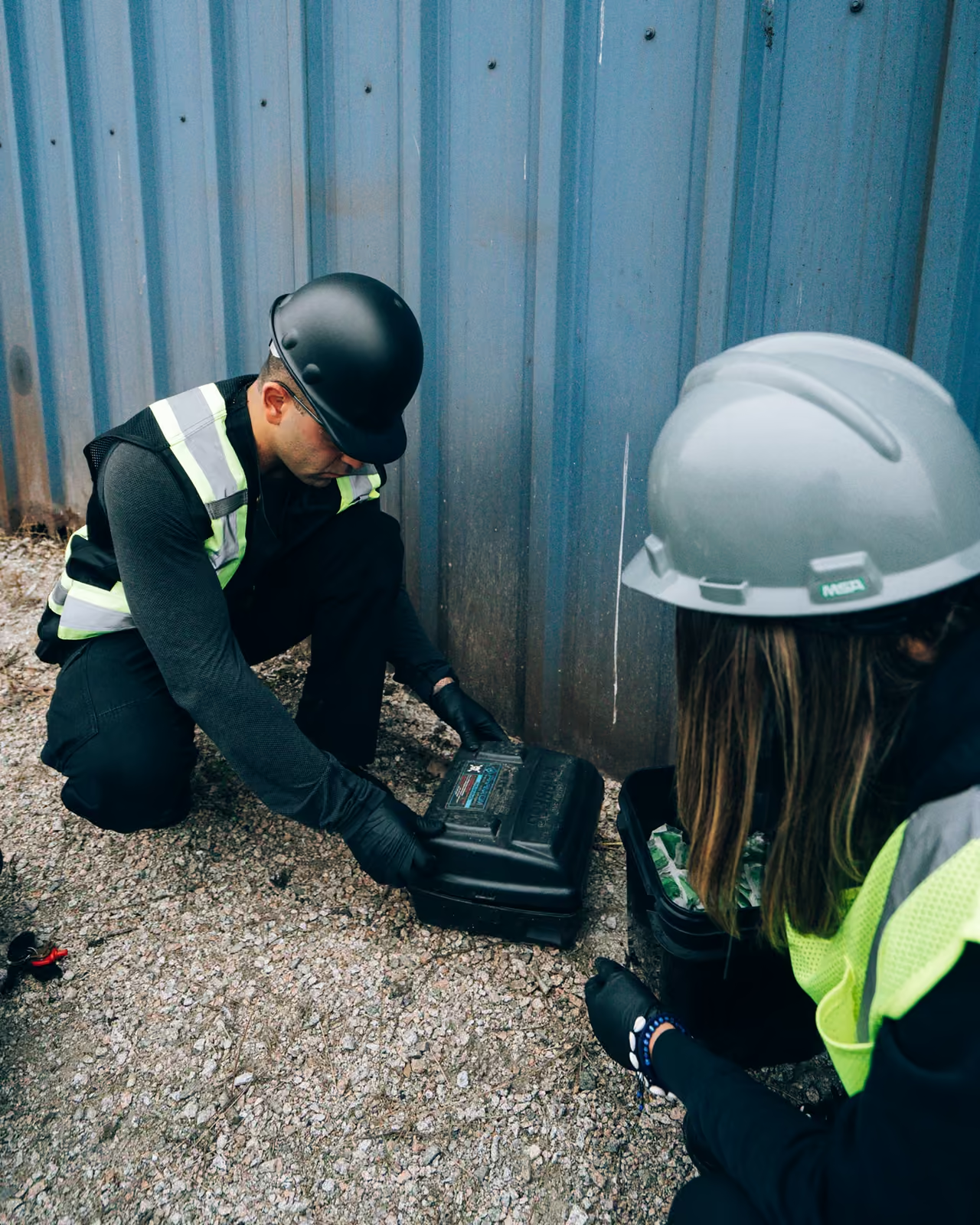
Gaps, gnawing and burrows where the wall meets the slab.
Spilled feed and runways under the boot and the auger.
Nests, droppings and roosting birds on the ledge.
Each station locked, fastened and logged where it sits.
The check runs along the outside of the wall for burrows and gaps where it meets the slab, under the feed bins for spills and runways, and up to the eave for nests and droppings. Inside, the same line is followed behind hay, pallets and feed bags, because anything stacked against a wall can hide a nest. Smudged grease marks along the base show a run in regular use, and fresh gnawing on wood or wiring shows where the rodents are working now.
Holes found on the walk are closed during our rodent program when they’re small, and anything larger, from a rotted sill to an open eave, is quoted as exclusion work. Roosting ledges under the roof go into the bird work quote, and a sill or post that stays wet gets a look for dampwood termites, which live in damp, decaying timber.
Why Choose Phantom for Your Farm
Our credentials, the records you keep after each visit, and how the program is set up.
Experience
15+ years of pest control experience serving British Columbia
Credentials
Fully licensed, insured and certified
Reporting
A written report for your farm records after every visit
Bird control
Quotes
A free site inspection, then a quote for your farm
EXCELLENT Based on 830 reviews
 Posted on Google

 Ashley WoodWe were having some problems with mice at our home so we contacted Phantom and Darcey came and resolved the issues quickly. Darcey was friendly, great with our dog and made sure we understood everything he was doing and what to expect. Happy to report no more mice! Thank you, Darcey!Posted on Google
 Michelle HerrExcellent pest control service! The team was professional, friendly, and knowledgeable. They arrived on time, explained the treatment process clearly, and made sure everything was taken care of. Their attention to detail and commitment to customer satisfaction were impressive. I really appreciate their prompt service and effective results. Highly recommend them to anyone looking for reliable and professional pest control services!Posted on Google
 Nasib AbdulMark was great and he did a great job and was very knowledgeable.Posted on Google
 HenryDarcey provided exceptional support in resolving our pest concerns. He was punctual, highly knowledgeable, and professional throughout the process. We have been trying to deal with these issues for quite some time without any luck but thankfully the matter is now resolved. We appreciate the dedication he demonstrated and will be sure to reach out should we require his services again.Posted on Google
 Jacqueline BruceI want to let you know that June did an amazing job on our house for the moths. He was really friendly, patient, professional and conscientious. I wasn't fully ready for the treatment when he arrived and he managed to move some clients so he could return later. He explained a lot about the treatment and the moths' habits which really helped with other areas that he wasn't even treating. He kindly helped me moved some things to barricade the area from pets. I would get Phantom back and highly recommend them.Posted on Google
 Fraser HannayDarcey was amazing at helping us deal with a wasp nest. Friendly, knowledgeable and on time! Thank you!Posted on Google
 JanetWe hired Phantom Pest Control to eliminate a wasp nest inside our house and the service was great. Information on the phone when I first called to book an appointment was clear and we got an appointment quickly. Juan, the specialist who arrived to do the job, fully explained the process, did the work, and explained what to watch in the outside chance additional work might be needed. We are happy with the job and were glad to have Juan as our technician.Posted on Google
 Jenny WuWe received exceptional service from Joy. She was both professional and knowledgeable, explaining the service thoroughly.Posted on Google
 Sean AbbottThey showed up on time, early actually. Mark was very professional and explained how the cockroaches work. He was personable and efficient, and hygienic with how he worked (wearing protective boot covers and gloves). I was impressed and would definely call again if needed.
Farm Pest Control Across Vancouver & Fraser Valley
Our farm program covers the Lower Mainland and the Fraser Valley, from the farmland of Richmond, Delta and Ladner to Pitt Meadows, Langley, Aldergrove and Abbotsford. Every city in the list links to its own page.
Vancouver & North Shore
Burnaby & Tri-Cities
Richmond & Delta
Fraser Valley
Related Services for Farms
Services that can run alongside a farm program.
Locked stations, traps and gap sealing for rats and mice around barns and sheds.
Netting, spikes and wire for rafters, open bays, ledges and rooflines.
Fly work in milk rooms, staff rooms and around the barns.
Monitoring for grain beetles and other stored-product insects in feed rooms and bins.
Farm Pest Control FAQs
Rodent bait on farms, farm dogs, cats and owls, barn swallows, droppings, farm programs, biosecurity, greenhouse crops, wells, timing and cost.
Prefer to talk?
Can rodent bait be used on a farm in B.C.?
Yes: a farm is one of the places where even the strongest baits are still allowed. B.C. limits second-generation anticoagulant rodenticides, the baits it treats as highly toxic, to essential service locations, and Schedule 6 of the Integrated Pest Management Regulation lists places where land is used for agriculture. A stable that only boards or trains horses, without horse rearing, isn’t an agricultural use.
Section 81’s conditions still apply. The licensee must find rodents or recent signs of them, the farm’s prevention measures must be in place and practical alternatives must have failed, so the baits never go down just in case. Use stops at 35 consecutive days and 120 days in a year, under a written rodent management plan, and wildlife sanctuaries, critical wildlife areas, ecological reserves and migratory bird sanctuaries are off limits unless a government or First Nation program there targets non-native rodents.
Is rodent bait a risk to farm dogs, cats and owls?
It can be. B.C.’s rodenticide page warns that pets and wildlife can be poisoned by the bait itself or by eating a poisoned rodent, and that hawks and owls can die that way. Second-generation baits carry the higher risk, because they stay in the rodent’s body far longer, and concern for owls is why the province restricted them.
So the work leans on traps, sealing and taking food away, and any bait sits in locked stations dogs, cats and livestock can’t open. A farm cat that eats a poisoned mouse is still exposed, which is why second-generation baits come only after the other steps have failed. Chicken Farmers of Canada’s food safety manual goes further: never allow pets in the barns. Barn owls hunting the yard fall under B.C.’s Wildlife Act, which protects wild birds, their eggs and their occupied nests.
Are barn swallows protected?
Yes. Swallows are on the federal list of protected migratory birds, so under the Migratory Birds Regulations, 2022 a nest can’t be damaged or removed without a permit while it holds a live bird or a viable egg, and B.C.’s Wildlife Act protects an occupied nest too. A federal order registered on September 25, 2026 moved the barn swallow from threatened to special concern under the Species at Risk Act.
Our bird control leaves barn swallows and their nests alone. It works on starlings, house sparrows and rock pigeons, which are outside the federal list and exempt from B.C.’s nest protection.
How should farm staff clean up mouse droppings?
Wet them first, never sweep them dry, and don’t vacuum. HealthLink BC says to air an enclosed room for 30 minutes, then, wearing an N95 or P100 mask (not a dust mask), rubber gloves and goggles, pour a disinfectant or 1 part bleach to 9 parts water onto the droppings and nests, without a sprayer. After 10 minutes of soaking, wipe it up with paper towels and double-bag it.
The reason is hantavirus, which deer mice carry in B.C. WorkSafeBC puts sweeping out a barn or other farm building among the jobs with the greatest risk of exposure. Our hantavirus guide covers the illness and how we handle rodent jobs where it’s a concern.
What do farm food-safety programs ask about pest control?
Written records, mostly. CanadaGAP, the food-safety program for fruit and vegetable farms and packers, asks a pest company hired to monitor its buildings while they’re in use for a letter with the applicator’s licence number and a written manual naming the products, their PCP numbers and the visit frequency, monthly at the least, with every device numbered. Inside packing and storage buildings it allows bait only in a trap the rodent can’t escape from.
Under Start Clean-Stay Clean, an egg farm that hires a licensed provider gets monthly visits at the least, with the inspection report kept on file; a farm that monitors on its own checks for rodents every week. Dairy farms have B.C.’s own rule: the milk industry standards say flies must be kept under control at all times. Each of our farm visits ends with a written report and the station map for your binder.
How does pest control fit a poultry farm’s biosecurity?
It’s one of the standard’s parts. CFIA’s National Avian On-Farm Biosecurity Standard asks for an integrated pest control program covering insects, wild birds and rodents. Its examples are covered feed bins and closed feed systems, screened openings, a gravel strip along the foundation, emptying the feed lines and hoppers at clean-out, and keeping the zone around the barns clear of debris and long grass.
A visit has to fit the farm’s own controls as well. Tell us your sign-in, footwear and clothing rules, which barns are off limits and the order you want them visited in when you book, and the walk-through is planned around them.
Do you treat pests on greenhouse crops or in the fields?
No. Our work is the buildings and the yard around them. B.C. certifies pesticide applicators by kind of work: managing pests in nurseries and greenhouses, and in field and orchard crops, are their own agriculture categories, while the structural category covers insects, rodents and birds in and around buildings. Pests on the plants stay with your grower or crop adviser; mice in the headhouse and wasps in the eaves are ours.
What rules apply near wells and ditches?
A 30-metre buffer around the water. Section 71 of the regulation keeps pesticides 30 metres from any well or water intake used for household water, livestock or irrigation, unless the licensee is reasonably satisfied a smaller zone will still keep the pesticide out, and the basis for that decision goes into the licensee’s records. Pump houses and well sheds fall inside that zone, so treatments there are planned around it.
Near ditches, sloughs and streams, the licensee keeps a no-treatment zone wide enough that no spray or runoff reaches the water. Farmers who apply their own pesticides for the farm follow section 33.1, which keeps drift and runoff out of watercourses, groundwater and neighbouring land and has each application recorded.
Can you work around animals, milking and harvest?
Yes, by booking ahead. Our office takes bookings Monday to Friday, 9 AM to 5 PM, and we’re open 24/7 for pre-arranged commercial services, so a visit can fall between milkings, after the birds are settled or outside harvest hours. Tell us which barns and sheds are busiest, and the visit is set for when they’re quiet.
How much does farm pest control cost?
There’s no set price. Commercial clients get a complimentary site inspection, and the quote depends on what it finds: the number of buildings and stations, how much sealing is needed and how often visits are needed. Larger sealing, such as a gap under a sliding barn door, is quoted on its own as exclusion work.
Book a Farmyard Walk-Through
Tell us about the farm, its barns, bins and sheds, and what you’ve seen, and we’ll plan the first walk-through around your chores and biosecurity rules.
Commercial site inspections are complimentary, and the quote follows from what the walk-through finds.