Food Facility Pest Prevention Program in Vancouver & Fraser Valley
Phantom Pest Control runs a food facility pest prevention program for food plants, grocery stores and cold stores in Vancouver, BC and the Fraser Valley. Each scheduled visit checks numbered devices, inspects for activity and entry points, treats only where pests are found, and adds a written report to your pest file.
Who it’s for
Food plants, grocery stores, cold stores
Each visit
Your records
Service area
What Does a Food Facility Pest Prevention Program Include?
A food facility pest prevention program puts pest checks on a schedule instead of waiting for a sighting. In Phantom’s program, numbered traps inside, locked bait stations outside and in non-food areas, pheromone and insect monitors and insect light traps away from food sit on a device map, and a written report with photos follows every visit.
CFIA’s pest control guidance for food businesses describes a program by five questions: who does the work, where each numbered device sits on a floor plan, what is used, how often activity is monitored, and how the work avoids contaminating food. On this program, the device map, the visit reports and the product list put the who, where and what of each visit on paper.
Each kind of site also has its own page for its pests and rules: food processing pest control, grocery store pest control and cold storage pest control. This page covers the scheduled visits that keep those sites checked.
B.C.’s Food Premises Regulation covers most places where food for public consumption is sold, handled, prepared, packaged, processed or stored, and section 26 has the operator keep each one free of pests.
Health Canada notes cockroaches and their egg cases can ride in on food items and shipping cartons, and CFIA asks for incoming goods to be inspected when they arrive.
Canada’s Grain Commission lists processed and packaged foods among those Indianmeal moths attack, and warehouse beetle larvae get into bagged grain and packaged food.
Cold doesn’t keep rodents out: CFIA warns they can infest coolers and freezers and nest in the insulated walls or beneath the floor.
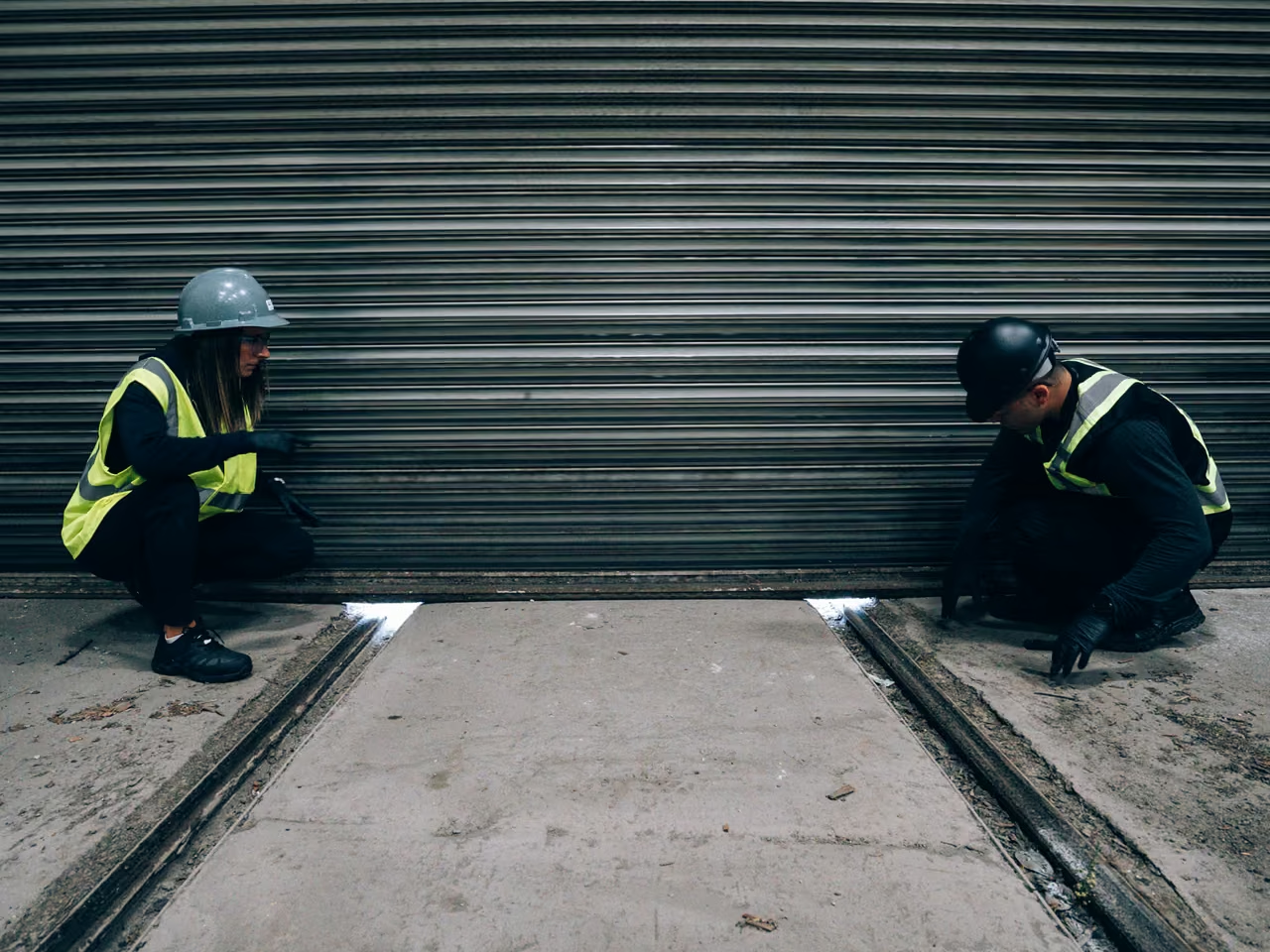
CFIA asks for overhead doors that fit tightly along the sides, top and bottom, and for the space under dock levellers to stay clean and rodent proof.
CFIA asks for compactors and dumpsters on a paved pad, kept covered or closed, and large enough to hold at least a day’s refuse.
Which Pests Turn Up in Food Facilities
Rodents and stored-product insects follow the food, cockroaches ride in with deliveries, and flies and birds gather around waste areas and rooflines. Every row links to the page that treats that pest on its own.

They can squeeze under a gap about 6 mm (¼ inch) tall, the University of California’s IPM guide notes, and Health Canada lists gnawing and damaged food packages among the signs.
Norway rats burrow at ground level along building perimeters, while roof rats climb into upper floors, rafters and roofs.

Their larvae cover food in silky webbing and frass, and the Grain Commission notes the webbing can clog machinery.

Sawtoothed grain beetles build up fast in stored grain in heated buildings; cast larval skins are the clearest sign of warehouse beetles.

Health Canada says they’re particularly fond of food processing facilities and drawn to warm, damp kitchens and plumbing areas.

Fruit and drain flies stay active in every season in commercial kitchens and food service areas such as a store’s deli; insect light traps sit away from food.

Feral rock pigeons are common in cities, and CFIA’s guidance has roof nesting and roosting sites removed and exposed rafters screened off.
Keep a photo of it with the date and the spot where it turned up, and bring it to the first site inspection.
Which Months Bring Which Pests to a Food Facility
In the Lower Mainland, flying insect pressure builds through the warmer months, and rodents push indoors in the colder, wetter ones. Pests that live indoors, from cockroaches to stored-product insects, keep going in any season, which is why the devices stay in place between visits.
The bars follow the University of California’s IPM guides, B.C.’s rodent guide for residents and our own pest pages. The pests under the chart don’t keep to a season indoors.
Summer and fall bring more in on purchased produce; in drains and kitchens they can keep breeding in any season.
In autumn, as nights get colder, house mice often move indoors, the University of California’s IPM guide notes.
B.C.’s rodent guide for residents times inspections for spring and fall; a food facility’s visits follow the schedule set in its quote.
Not seasonal
Health Canada says they live wherever food, water and shelter are available, so a heated building suits them in any month.
Vancouver’s temperate climate and warehouse conditions favour them in every season, and the Grain Commission notes cigarette beetles survive winter only in heated buildings.
In commercial facilities, house mice often arrive in or on packaged goods, or from delivery vehicles, the University of California’s IPM guide notes.
Where the Devices Go on a Food Facility Map
Every device has a number and a spot on the site’s floor plan, from the stations along the fence line to the monitors in dry storage. The plan below walks the outside, the docks, the storage rooms and the floor inside.
- APerimeter stations
Locked bait stations line the building and the fence, where CFIA asks for the ground to stay clear of debris, plants and stored materials.
- BDumpsters & compactors
Waste breeds flies and draws rats and mice, so the pad around the bins is part of every visit’s inspection.
- CDock doors & levellers
Traps sit inside next to the exterior doors, and each visit checks the door seals and the space under the levellers for gaps.
- DReceiving area
Pallets and cartons are how stored-product insects and cockroaches arrive, which is why goods are checked when they come in.
- EDry storage aisles
Pheromone monitors hang in dry storage, beside a clear, light-coloured aisle along the walls where droppings and insects are easy to spot.
- FCoolers & freezers
Traps along the cold-room walls inside, and the door seals checked for gaps on each visit.
- GIngredient & packaging stores
Insect and pheromone monitors where raw materials and packaging wait, stored off the floor and rotated.
- HProduction or sales floor
Traps and insect monitors along the walls, with insect light traps placed away from food.
- IStaff rooms & offices
Locked stations can sit in non-food areas such as locker rooms and offices, which CFIA also wants kept free of food scraps.
Splitting the Work: Your Staff and the Program
Daily habits at the docks, in storage and around the waste area keep pest pressure down between visits. Devices, treatment and sealing stay with the program, and our grocery store prevention tips add more habits for store staff.
Your team can
Look over incoming pallets and cartons for insects, webbing, droppings and chewed packaging before they go into storage.
Keep stock off the floor and away from the walls, rotate it, and sweep the wall aisle so signs of pests show up.
Keep dock and staff doors shut when they aren’t in use, and keep waste containers covered and the waste pad swept.
Needs a technician
Under section 4 of B.C.’s Integrated Pest Management Act, a pesticide service needs a licence unless its regulations exempt it.
Placing, numbering and checking the traps, stations and monitors stay with the technician, so the map matches the site.
Each visit’s report, the trend summary and the product list come from the technician, ready for your pest file.
Gaps small enough to close on the spot are sealed during the visit; bigger openings are quoted as exclusion work, a separate job.
The Five Steps of Each Food Facility Program Visit
Every visit follows the same five steps and is booked into your site’s down-time or sanitation window.
The technician walks the site inside and out, looking for droppings, gnawing, webbing, damaged packaging and the gaps pests use.
Traps, locked stations, pheromone and insect monitors and insect light traps are checked against the device map.
Treatment is limited to the spots where the visit found activity; B.C.’s IPM Regulation (section 68) has a licensee monitor and set an injury threshold before using a pesticide.
Gaps found on the visit are sealed when they’re small, and larger ones go on a quote for exclusion work.
A written report with photos records what was found and done, and the trend summary shows how activity is changing over time.
Our regular maintenance page lists the other scheduled programs, from rodents to flies.
Starting the Program: The First Site Inspection
The program starts with a free commercial site inspection, then a custom quote. With these ready, the first visit can number the devices and map the whole site. Our client forms page holds Phantom’s preparation sheets, including the one for food handling areas.
Each device gets its number and its spot on a current plan of the building and yard.
Note the area, the date and what was seen: droppings, insects, webbing or damaged packaging.
Say whether the site holds a CFIA licence, works under procedures a health officer approved, or faces an SQF, BRCGS or AIB audit.
Tell us when lines stop for sanitation, or when the store is quiet, so visits can be booked then.
SQF’s Edition 10 code has the contractor report to a responsible person on arrival and after each inspection, so say who that is.
Make the coolers, freezers, roof and any locked storage reachable on the day.
How the Program Runs Between Audits
CFIA asks every program to state how often activity is monitored; yours is set in the custom quote after the first inspection.
Site inspection
The first walk-through maps the building, the yard and the cold rooms, and leads to a custom quote.
Device set-up
Traps, stations, monitors and insect light traps go in, each numbered on the device map.
Each visit
Devices are checked, the site is inspected, and activity is treated where it’s found.
Reports
A written report with photos after every visit, and a trend summary that builds over time.
Before an audit
Before a CFIA or health inspection, or a BRCGS, SQF or AIB audit, the pest file is reviewed with your QA team.
A moved trap or monitor no longer matches its number on the map, so ask before moving one.
A new wall, door or storage room changes the map, so mention it on the next visit.
What SQF Edition 10 Asks of a Pest Prevention Program
SQFI expects audits against Edition 10 to start on January 2, 2027, pending GFSI benchmarking. Its Food Manufacturing code opens the pest clauses with a documented pest prevention program. Clause 11.2.4.1 asks it to record and trend pest sightings, map every device, list the chemicals with their Safety Data Sheets, and measure its own results.
Every device’s number, location and type, on one map.
Sightings recorded and pest activity trended over time.
The chemicals used, listed with their Safety Data Sheets.
Results measured and trends identified.
Clause 11.2.4.2 of the Food Manufacturing code sets the duties of pest contractors and internal pest controllers: be licensed and approved by the relevant authority, provide a plan with a site map of bait stations, traps and other devices, report to a responsible person on arrival and when the work is done, and leave a written report. Clause 11.2.4.3 then asks for records of every pest control inspection and application. The Storage and Distribution code, which covers cold stores, sets near-identical clauses under 12.2.4, with its records clause at 12.2.4.4.
BRCGS and AIB set their own pest requirements, and this page doesn’t quote them, so your certification body has the final word on editions and clauses. SQF’s edition guide explains which code applies to an audit. On this program, each visit adds its report to that file, together with the current device map and the product list.
Why Choose Phantom for a Food Facility Program
Phantom is fully licensed, insured and certified, leaves a written report after every visit, and books visits around your production or opening hours.
Owner’s experience
15+ years of pest control experience serving British Columbia
Credentials
Fully licensed, insured and certified
Reporting
Photos and a written report from every visit
Hours
Open 24/7 for pre-arranged commercial services
EXCELLENT Based on 830 reviews
 Posted on Google

 Ashley WoodWe were having some problems with mice at our home so we contacted Phantom and Darcey came and resolved the issues quickly. Darcey was friendly, great with our dog and made sure we understood everything he was doing and what to expect. Happy to report no more mice! Thank you, Darcey!Posted on Google
 Michelle HerrExcellent pest control service! The team was professional, friendly, and knowledgeable. They arrived on time, explained the treatment process clearly, and made sure everything was taken care of. Their attention to detail and commitment to customer satisfaction were impressive. I really appreciate their prompt service and effective results. Highly recommend them to anyone looking for reliable and professional pest control services!Posted on Google
 Nasib AbdulMark was great and he did a great job and was very knowledgeable.Posted on Google
 HenryDarcey provided exceptional support in resolving our pest concerns. He was punctual, highly knowledgeable, and professional throughout the process. We have been trying to deal with these issues for quite some time without any luck but thankfully the matter is now resolved. We appreciate the dedication he demonstrated and will be sure to reach out should we require his services again.Posted on Google
 Jacqueline BruceI want to let you know that June did an amazing job on our house for the moths. He was really friendly, patient, professional and conscientious. I wasn't fully ready for the treatment when he arrived and he managed to move some clients so he could return later. He explained a lot about the treatment and the moths' habits which really helped with other areas that he wasn't even treating. He kindly helped me moved some things to barricade the area from pets. I would get Phantom back and highly recommend them.Posted on Google
 Fraser HannayDarcey was amazing at helping us deal with a wasp nest. Friendly, knowledgeable and on time! Thank you!Posted on Google
 JanetWe hired Phantom Pest Control to eliminate a wasp nest inside our house and the service was great. Information on the phone when I first called to book an appointment was clear and we got an appointment quickly. Juan, the specialist who arrived to do the job, fully explained the process, did the work, and explained what to watch in the outside chance additional work might be needed. We are happy with the job and were glad to have Juan as our technician.Posted on Google
 Jenny WuWe received exceptional service from Joy. She was both professional and knowledgeable, explaining the service thoroughly.Posted on Google
 Sean AbbottThey showed up on time, early actually. Mark was very professional and explained how the cockroaches work. He was personable and efficient, and hygienic with how he worked (wearing protective boot covers and gloves). I was impressed and would definely call again if needed.
Food Facility Pest Prevention Across Vancouver & Fraser Valley
We run the program for food plants, grocery stores and cold stores across the Lower Mainland and the Fraser Valley. Each city below links to its own local page.
Vancouver & North Shore
Burnaby & Tri-Cities
Richmond & Delta
Fraser Valley
Related Services for Food Facilities
These services run alongside the program. For monitoring visits with any treatment quoted separately, there is our pest monitoring program; for scheduled re-checks of sealed gaps, our pest proofing program; and for installed netting and spikes at docks and rooflines, our bird deterrent maintenance program.
Processing and packing plants: their pests, entry points and the rules behind a plant’s pest program.
Grocery stores and food markets, from the receiving dock to the produce and deli counters.
Cooler and freezer warehouses and cold-chain distribution centres.
Scheduled rodent visits: locked stations outside, and traps inside when activity is found.
Food Facility Pest Prevention Program FAQs
Who it covers, one-time treatments, grocery stores and plants, pest records, cold rooms, visit times, sanitation, sightings and cost.
Prefer to talk?
Which food facilities is the program for?
Food processing and packing plants, including commercial bakery plants and beverage plants, plus grocery stores, food markets and their delis, and cold stores that hold food. It’s one of the scheduled programs within our commercial pest control services.
Wineries, breweries and distilleries count as beverage plants, so they’re covered; their own pests and rules are on our brewery pest control page. Restaurants have our restaurant pest prevention program, and dry warehouses have our warehouse and storage pest prevention program.
How is a food facility pest prevention program different from a one-time treatment?
A one-time treatment answers the pests in front of you today; the program keeps checking the places they come back to. Devices stay in place between visits, each visit inspects the site and the devices, and the reports build a record of where activity rises and falls.
For an active problem today, treatment starts on the pest’s own page, such as rodent control, cockroach control, fly control or moth control.
Does a grocery store need the same program as a food plant?
The visit is the same; the rules behind it differ. CFIA’s licensing guidance says a supermarket, grocery store or bakery doesn’t need a licence under the Safe Food for Canadians Regulations for food it makes, packages or labels at retail and sells directly to consumers, though other requirements in those Regulations may still apply.
B.C.’s Food Premises Regulation covers both, apart from the exemptions in its section 2, such as dairy and fish plants under their own Acts. Where food is processed or prepared, as in a plant, a deli or an in-store bakery, section 24 asks for written sanitation procedures that identify every pesticide used, approved by a health officer. For a processor selling only in B.C., the province’s Sanitation Plan Workbook sets out that list: each pesticide’s name and how it’s used and stored.
Who is responsible for the pest records when a contractor does the work?
The food business is. CFIA tells food businesses that when a contractor does their pest control, they remain responsible for keeping the records of that work, and that the contract should spell out the program well enough to verify it was done as written.
So each visit’s report belongs in your own file, beside your staff’s sightings log and any corrective actions you take.
How long are pest control records kept?
Two years for the documents that show a licensed food business’s plan was carried out, and 3 years for the pest control company’s pesticide-use records in B.C. A licence holder under the Safe Food for Canadians Regulations keeps a written preventive control plan (section 86), and keeps each document that shows the plan was carried out for two years after the day it’s prepared (section 89).
B.C.’s IPM Regulation has a licensee record each pesticide use, including the date and time, the pest, each product’s name and registration number and the amount applied (section 35), and keep those records for 3 years (section 83). A store outside the SFCR’s licensing rules follows its health authority: in Vancouver Coastal Health’s region, the operator guide asks for pest control reports to stay on site for at least 3 months, for the Environmental Health Officer to review. In the Fraser Health region, ask your officer what they expect to see.
How does the program handle coolers and freezers?
As part of the same visit. CFIA’s guidance asks for cooler and freezer doors that fit tightly, floor drains with covers, and storage kept away from the walls with a light-coloured aisle, the same as in dry storage.
CFIA also asks for coolers and freezers to be checked for cleanliness and structural soundness, so each visit’s inspection covers them like any other room.
Can visits fit around production or store hours?
Yes. Visits are booked in your down-time or sanitation windows, with nights and weekends by pre-arrangement, so a plant’s running lines and a store’s busy hours are left alone.
Our office takes bookings Monday to Friday, 9 AM to 5 PM, and we’re open 24/7 for pre-arranged commercial services.
Does the program replace our own sanitation?
No. CFIA’s guidance says pest control starts with the condition of the establishment and how it’s maintained and run, inside and out, and B.C.’s Food Premises Regulation puts the duty to keep premises free of pests on the operator.
The program adds the devices, the inspections, treatment where pests are found and the sealing of small gaps.
What should staff do if they see a pest between visits?
Write down what was seen, where it was, and the date and time. Keep a photo, leave the nearest devices as they are, and set aside any product that may be affected, so your QA team can decide what happens to it.
Then call or text 604-771-0404 to report it.
How much does a food facility pest prevention program cost?
There’s no set price and no fixed number of visits. The commercial site inspection is free, and a custom quote follows from what it finds at your site.
Because each quote is built for one site, two sites of the same kind can get different quotes. Gaps too large to seal during a visit are quoted separately as exclusion work.
Start With a Site Inspection
Tell us what the site makes, stores or sells, where pests have shown up, and which inspections or audits it faces. We’ll plan the first site inspection around your production or opening hours.
Send a floor plan with the request, and the first inspection can start numbering the devices on it.