Restaurant Pest Prevention Program in Vancouver & Fraser Valley
Phantom Pest Control runs a restaurant pest prevention program for restaurants, cafés, bars and other food-service kitchens in Vancouver, BC and the Fraser Valley. Every scheduled visit inspects the kitchen and storage, checks the cockroach monitors, services the rodent stations and fly lights, treats the floor drains and ends with a written report.
Who it’s for
Restaurants, cafés, bars, food trucks, ghost kitchens
Every visit
After each visit
Service area
Why Restaurants Need Pest Checks Between Problems
The pests a kitchen gets work at night, ride in with deliveries and breed fast, so a problem is often well started before anyone on shift sees it. Scheduled checks look for the first signs at the monitors, stations and drains instead of waiting for a sighting during service.
Vancouver Coastal Health’s guide for food premises operators lists what a hired pest control service does: assess the premises and set up traps, leave a written report of the work completed, and give recommendations. A prevention program does that on a schedule, not only after pests turn up.
Cockroaches are most active at night and can go unnoticed for some time; UC IPM, the University of California’s pest management program, says an adult German cockroach can hide in a crack 1/16 inch wide.
Cockroach egg cases travel on bottles and shipping cartons, and in commercial kitchens mice often come in with packaged goods or off the delivery truck.
The German cockroach has the fastest breeding cycle of the common pest cockroaches, with about 30 young in each egg case, UC IPM notes.
Vancouver Coastal Health’s operator guide says openings ¼ inch in diameter or bigger will allow the entry of rodents.
Floor drains build up the film that drain and phorid flies breed in, out of sight below the grate.
B.C.’s Food Premises Regulation has the operator keep the premises free of pests, free of conditions that lead to their harbouring or breeding, and protected against their entrance.
Which Pests Do Program Visits Watch For?
Cockroaches, rodents and flies are the program’s work on every visit. Each name links to the service for a one-off problem with that pest.

The kitchen cockroach: UC IPM says a single female and her offspring can produce over 30,000 in a year, so the monitors are read on every visit.

UC IPM says they can squeeze under gaps ¼ inch tall and through openings 3/8 inch wide, which is why door sweeps are part of the inspection.
Wary of anything new: UC IPM says it might take several days to weeks for rats to enter and feed in bait stations, so the stations stay put between visits.

They breed in garbage and other moist waste and fly in through open doors; the fly lights catch the ones that make it inside.
Small flies that breed in the film inside floor drains and in fermenting spills at the bar, which the drain foam is aimed at.

Beetles and moths in flour, grains and spices turn up on the dry-storage check and are handled as stored-product pest control.

Ant trails along doors and walls are handled through our ant control program, which runs on its own schedule.
You can add a photo to your estimate request, with a note on where and when staff saw it.
Which Restaurant Pests Follow the Seasons?
House and blow flies build up through the warm months, and mice move indoors as autumn nights turn cold. Cockroaches, fruit and drain flies and the mice that come in with deliveries keep no season, so their checks run on every visit.
The bars follow UC IPM, eXtension’s fly guide, Washington State University and B.C.’s rodent guide; Phantom’s flying insect page adds that the region’s mild temperatures and high humidity support flying insect breeding. The pests under the chart keep going in any month.
In greatest numbers in the hotter summer months, UC IPM says; they breed in garbage and other moist waste.
Abundant in summer, eXtension’s fly guide says; like house flies, they usually develop outside and follow odours inside.
Pavement ant swarms are most common in June and July, Washington State University’s extension says.
B.C.’s rodent guide times inspections for spring and fall, to match the seasonality of rodent problems.
Checked on every visit
They live and breed indoors near food preparation, in warm, humid spots, so the cockroach monitors are read on every visit.
UC IPM notes that in commercial facilities mice often arrive in packaged goods or from delivery vehicles, in any month.
They breed in drain film and fermenting spills, so commercial kitchens see them in every season, as Phantom’s flying insect page notes; the floor drains are foamed on every visit.
Where Each Visit Looks in a Restaurant
Each visit covers the same areas, from the bins outside to the dining room, and every station, trap and monitor on the way has its own number on the device map.
- ABins & grease bin
Locked bait stations along the walls near the bins are opened and serviced, and open lids or spills around the bins go in the report.
- BBack door & receiving
The door sweep and the gaps around the frame are checked, since the back door takes deliveries and garbage runs all day.
- CCook line
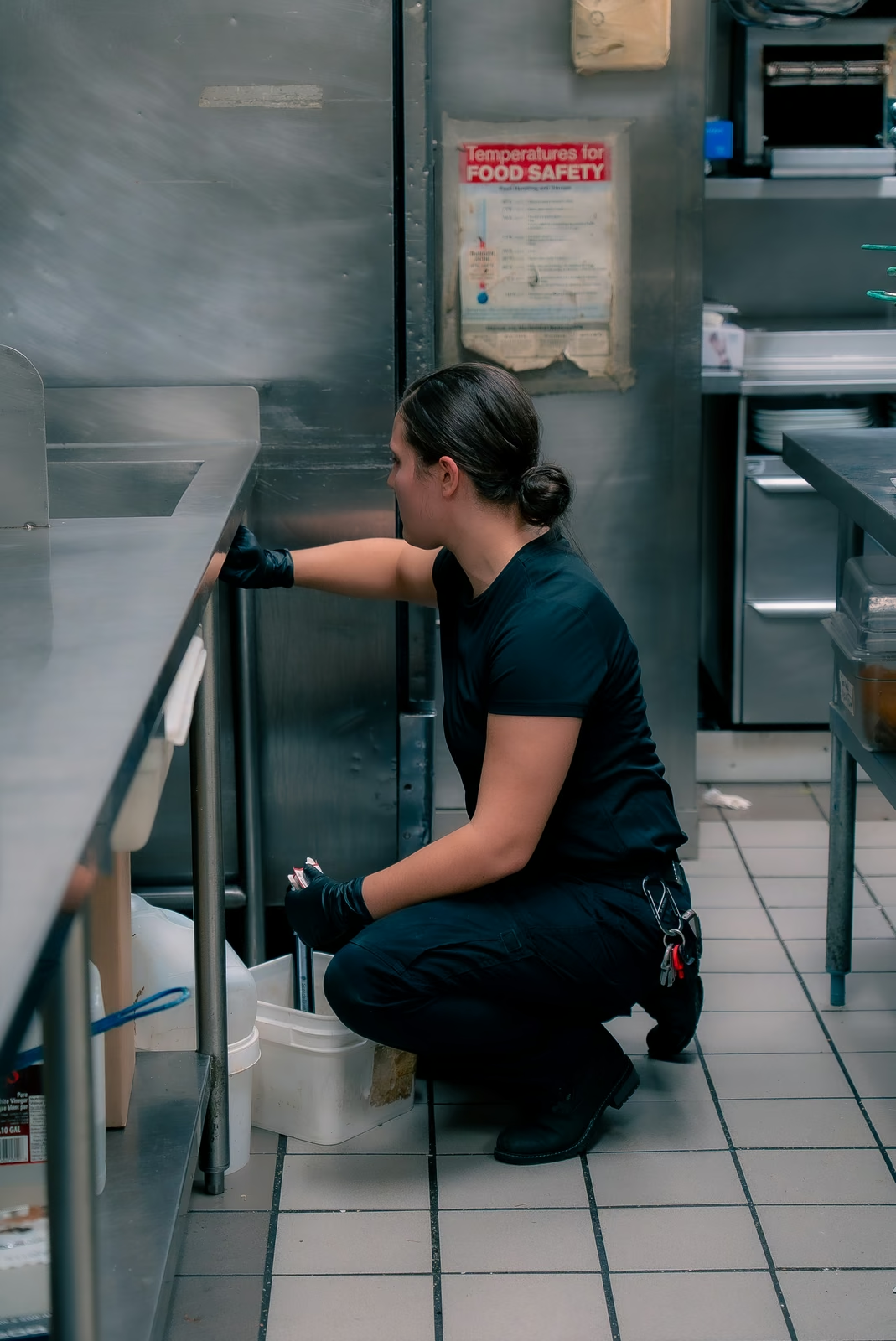
Monitors against the walls behind the ranges and fryers show whether cockroaches feed there, and gel bait goes into the cracks where they are.
- DDish area & floor drains
Each floor drain gets its foam treatment, and the monitors by the dish machine are read.
- EWalk-in cooler
Door seals, the floor along the walls and stored cartons are checked for gnawing and droppings.
- FDry storage
Shelving, sacks and cartons are checked for droppings, nesting material and chewed packaging, and traps go in when a visit finds activity.
- GOffice & staff room
Bags, boxes and paperwork come and go here, so this room is on the inspection route too.
- HBar & drink station
The bar’s floor drain is foamed and its monitors read; empty bottles and syrup spills that feed fruit flies are noted for staff.
- IDining room & service station
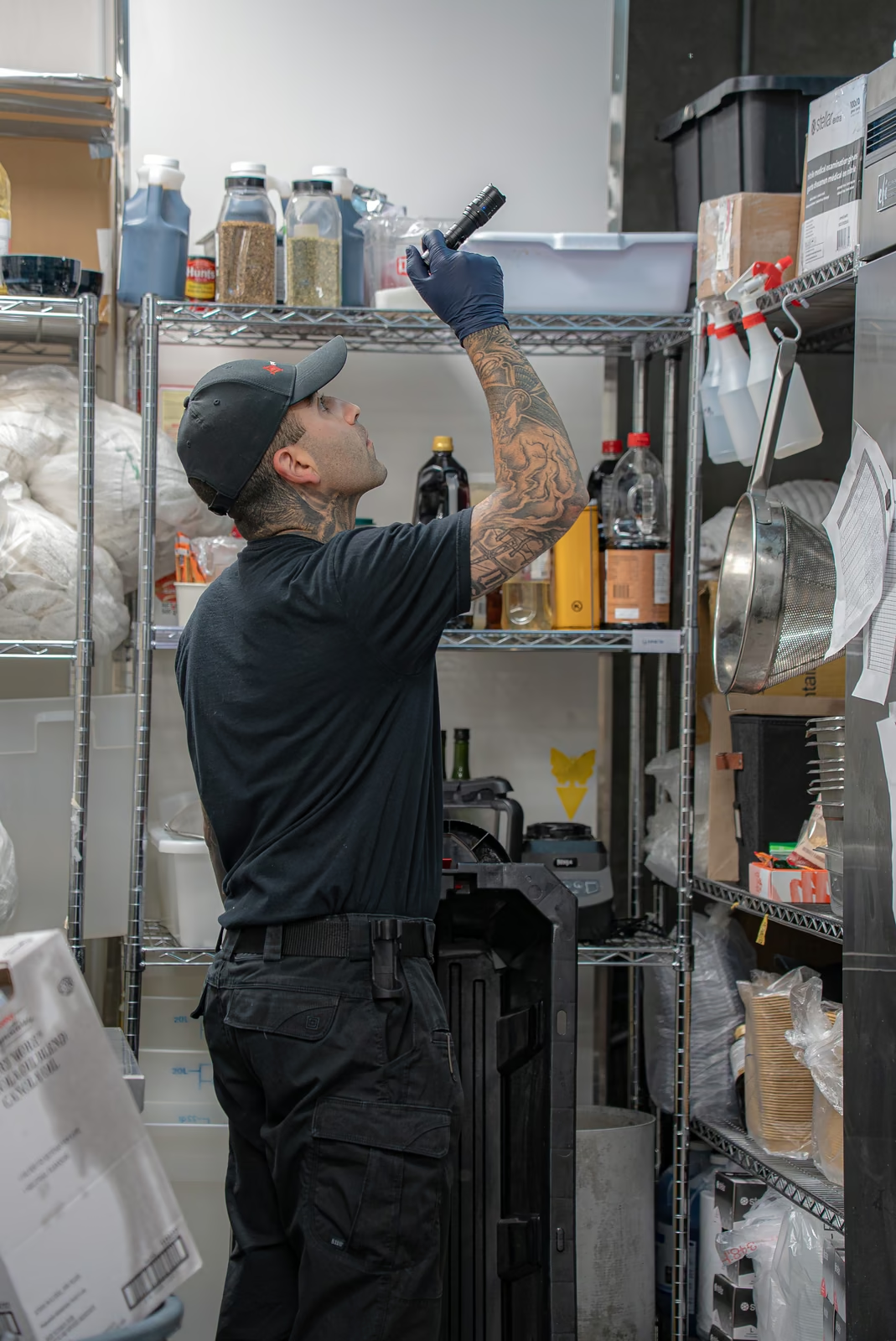
Booths and service stations get a flashlight check along the floor edges, where cockroaches hide by day.
What Your Staff Do Between Visits, and What the Program Does
Cleaning, storage and closing routines stay with your team; monitors, bait, stations, fly lights and drain treatment stay with the technician. Our guides to cockroaches in a restaurant and mice in a restaurant have more steps for staff.
Your team can
Clean under equipment and shelving, wash every dish and mop up pooled water before closing, as VCH’s operator guide lists.
Keep food at least 6 inches (15 cm) off the floor, keep open products in lidded containers, and break down extra cardboard.
Note droppings, live insects or chewed packaging with the place and the date, so the next visit starts there.
Needs a technician
B.C.’s Integrated Pest Management Act (section 4) requires a licence to provide a service respecting pesticides, apart from exemptions in its regulations. On the program, gel bait and any other pesticide work is the technician’s.
Placing, numbering and reading the monitors and servicing the locked stations stay with the technician, so the device map stays accurate.
The fly lights are serviced and the floor drains foamed by the technician on each visit.
Gaps up to the size of a toonie are sealed during the visit; larger openings and worn door sweeps go in the report and are quoted as exclusion work.
How Our Restaurant Pest Prevention Program Works
Five steps, from the first site inspection to a visit that repeats on your restaurant’s schedule.
A site inspection walks the kitchen, storage, bar and outside, and a custom quote with your restaurant’s visit schedule follows from what it finds.
The first visit sets out the cockroach monitors and the locked stations outside, and numbers each one on a floor plan of the restaurant.
Each visit reads the monitors, puts gel bait into the cracks where cockroaches turn up, and services the stations, with traps inside wherever activity is found.
The fly lights are serviced and the floor drains get their foam treatment on every visit, wherever the site has them.
A written report, sent digitally, closes each visit: what was found and done, the device map with each device’s catches, photos, the products used and the fixes your staff can make.
It sits with the other scheduled programs on our regular maintenance page.
Before the First Visit
With these ready, the first visit can map the whole restaurant. Our client forms page holds Phantom’s preparation sheets, including the kitchen sheet for treatments.
Mark the kitchen, storage rooms, walk-ins, bar, floor drains and outside doors, so each device can be numbered on it.
Note where and when staff saw droppings, cockroaches or small flies, and what came up at your last health inspection.
If another company served the restaurant, have its last reports and device map ready, so known problem spots carry over.
Make every room reachable on the day, including locked storage, the office, lockers and the area around the bins.
Pick one person who receives the reports and passes the fixes on to staff.
Move boxes off the floor along walls and under shelving, so the monitors can sit where cockroaches travel.
After Each Visit: What the Report Shows
Every visit ends with a written report. Kept together, the reports show where pests were found, what was done and which fixes were made.
First visit
The monitors and stations are set out and numbered on the device map.
Each visit
Monitors read, gel bait placed where needed, stations and traps serviced, fly lights serviced, drains foamed.
The report
Sent digitally after every visit, with photos, the products used and the fixes for your staff.
The trend
Visit after visit, the catches at each numbered device show where activity is rising or falling.
Treatment days
After a kitchen treatment for flying or crawling insects, the preparation sheet asks you to ventilate for 2 hours, sanitize counters, shelves and equipment, flush the drink and coffee machines, and keep mops, brooms and cleaners 6 inches back from baseboards and treated surfaces for at least 2 weeks.
If a monitor or station is in the way, ask for it to be moved rather than moving it yourself, so the map stays right.
Tell us about renovations, new suppliers or new delivery times before the next visit, so the inspection covers them.
What a Technician Reads on a Cockroach Monitor
A cockroach monitor is a sticky trap set where cockroaches forage, where floor meets wall near the spots they’re suspected. On Phantom’s restaurant visits, cockroach activity most often starts at the dish machine and the cook line, where it stays warm and wet. UC IPM says cockroaches are often caught within the first 24 hours of placing a trap, and advises numbering each trap so its catches can be compared.
What each numbered monitor caught since the last visit.
Placed in the cracks wherever cockroaches turn up.
Dark specks, cast skins and egg cases: signs of a hiding place.
The catches, the products used and photos.
A read is the count and the place. Dark specks, cast skins and egg cases near a monitor mark a hiding place, according to UC IPM’s cockroach guide, and gel bait goes into the cracks there, because bait doesn’t draw cockroaches from far away. Bait is also slow: UC IPM says an effective bait program may take 7 days or longer, so the next visit’s count shows whether it was taken. Because each monitor keeps its number from visit to visit, a rise at one of them shows the next technician where to look first.
Monitoring is also a step the law sets for a licensee: section 68 of B.C.’s Integrated Pest Management Regulation has a licensee monitor to find the pests’ numbers and location, among other steps, before using a pesticide, and evaluate how well each use worked afterwards. The next read of the monitors is that check.
Why Choose Phantom for Restaurant Pest Prevention
Credentials, a written report after every visit, and one schedule for cockroaches, rodents and flies.
Owner’s experience
15+ years of pest control experience serving British Columbia
Credentials
Fully licensed, insured and certified
Reporting
A written report after every visit
Hours
Open 24/7 for pre-arranged commercial services
Scheduling
EXCELLENT Based on 830 reviews
 Posted on Google

 Ashley WoodWe were having some problems with mice at our home so we contacted Phantom and Darcey came and resolved the issues quickly. Darcey was friendly, great with our dog and made sure we understood everything he was doing and what to expect. Happy to report no more mice! Thank you, Darcey!Posted on Google
 Michelle HerrExcellent pest control service! The team was professional, friendly, and knowledgeable. They arrived on time, explained the treatment process clearly, and made sure everything was taken care of. Their attention to detail and commitment to customer satisfaction were impressive. I really appreciate their prompt service and effective results. Highly recommend them to anyone looking for reliable and professional pest control services!Posted on Google
 Nasib AbdulMark was great and he did a great job and was very knowledgeable.Posted on Google
 HenryDarcey provided exceptional support in resolving our pest concerns. He was punctual, highly knowledgeable, and professional throughout the process. We have been trying to deal with these issues for quite some time without any luck but thankfully the matter is now resolved. We appreciate the dedication he demonstrated and will be sure to reach out should we require his services again.Posted on Google
 Jacqueline BruceI want to let you know that June did an amazing job on our house for the moths. He was really friendly, patient, professional and conscientious. I wasn't fully ready for the treatment when he arrived and he managed to move some clients so he could return later. He explained a lot about the treatment and the moths' habits which really helped with other areas that he wasn't even treating. He kindly helped me moved some things to barricade the area from pets. I would get Phantom back and highly recommend them.Posted on Google
 Fraser HannayDarcey was amazing at helping us deal with a wasp nest. Friendly, knowledgeable and on time! Thank you!Posted on Google
 JanetWe hired Phantom Pest Control to eliminate a wasp nest inside our house and the service was great. Information on the phone when I first called to book an appointment was clear and we got an appointment quickly. Juan, the specialist who arrived to do the job, fully explained the process, did the work, and explained what to watch in the outside chance additional work might be needed. We are happy with the job and were glad to have Juan as our technician.Posted on Google
 Jenny WuWe received exceptional service from Joy. She was both professional and knowledgeable, explaining the service thoroughly.Posted on Google
 Sean AbbottThey showed up on time, early actually. Mark was very professional and explained how the cockroaches work. He was personable and efficient, and hygienic with how he worked (wearing protective boot covers and gloves). I was impressed and would definely call again if needed.
Restaurant Pest Prevention Across Vancouver & Fraser Valley
We run the program for restaurants and food-service kitchens across the Lower Mainland and the Fraser Valley. Each city name links to its local page.
Vancouver & North Shore
Burnaby & Tri-Cities
Richmond & Delta
Fraser Valley
Related Services for Restaurants
Other services that pair with the program, each booked as its own job.
One-time treatment for an active problem in a restaurant, with the kitchen preparation sheet.
Treatment for an active cockroach infestation, at homes and businesses.
Trapping and baiting programs for rats and mice inside and around a building.
Sealing the larger gaps and entry points pests use, quoted as its own job.
Restaurant Pest Prevention Program FAQs
A program or a one-time treatment, the other programs, the schedule, closing for a visit, records, drain cleaning, which kitchens, food trucks, the health inspection and cost.
Prefer to talk?
How is a pest prevention program different from a one-time restaurant treatment?
A one-time treatment deals with the pests you have now. The program keeps checking on a schedule, so new activity can show up at a monitor or a station rather than in front of a customer.
For an active problem, our restaurant pest control page covers the one-time treatment and how to prepare the kitchen for it.
How is this program different from Pest Watch or the rodent maintenance program?
Pest Watch is monitoring for homes and businesses: each visit checks fixed monitoring points and reports what it found, and treatment is quoted separately. The rodent maintenance program covers rats and mice alone.
This program puts the cockroach, rodent and fly work a restaurant needs on one schedule, with one report after each visit.
How is the visit schedule set for a restaurant?
It’s set for each restaurant after the site inspection, from what the kitchen, storage and outside show, so there’s no set number of visits. CFIA’s pest control guidance, written for businesses under the federal Safe Food for Canadians Regulations, suggests a written program state how often pest activity is monitored: daily, weekly, monthly or other.
Your quote sets out the schedule.
Does a program visit mean closing the kitchen?
Not for the routine work: reading monitors, placing gel bait, servicing stations and fly lights and foaming the drains don’t need the kitchen empty. An after-hours treatment for flying or crawling insects does: our kitchen preparation sheet asks for the area to be vacated for 6 to 8 hours after treatment is complete, so that work is booked around your hours.
Our office books visits Monday to Friday, 9 AM to 5 PM, and we’re open 24/7 for pre-arranged commercial services.
What records should we keep from the program?
The written report from each visit. Vancouver Coastal Health’s operator guide asks food premises to keep pest control reports on site for a minimum of 3 months so the environmental health officer can review them. In the Fraser Health region, ask your health officer what to keep.
Each report also lists the products used and carries photos and the device map, so the file shows what was found, where and what was done.
Does the drain treatment replace drain cleaning?
No. The foam treatment on each visit is aimed at the small flies that breed in the drains, but it doesn’t replace cleaning: Ohio State’s extension service calls removing the scum from drain pipes and traps the most effective way to prevent drain flies.
If flies are the only problem, our fly prevention program covers fly lights and drains for businesses and managed buildings without the cockroach and rodent work.
Which kitchens does the program cover?
Restaurants, cafés and coffee shops, bars and pubs (brewpub kitchens too), bakery-cafés, food trucks and commissaries, and ghost and catering kitchens. A restaurant’s storerooms, dry storage and walk-ins are part of every visit.
Hotel kitchens are covered under hotel pest control, and food plants under food processing pest control.
Can the program cover a food truck or a commissary kitchen?
Yes. Food trucks and the commissary kitchens they load from are part of the program, and each visit covers the parts the site has: a truck without a floor drain has no drain to foam, for example.
Fraser Health counts food trucks as mobile food premises, which need their own health operating permit or approval.
Does a prevention program help with a health inspection?
It gives the inspector a record to read, but the outcome is theirs to decide. Under section 24 of B.C.’s Food Premises Regulation, a food service establishment’s written procedures must identify all pesticides used there, with their uses and storage requirements.
Fraser Health calls those written procedures a sanitation plan, which every food premises operator in B.C. must have. Each report lists the products used, which keeps that part of the plan easy to update.
How much does a restaurant pest prevention program cost?
No price or visit count is fixed in advance; both depend on the restaurant. The site inspection is free for commercial clients, and the quote you get afterwards sets out the visits and the price.
Book a Restaurant Site Inspection
Tell us about the restaurant: where pests have shown up, how the kitchen and storage are laid out, and when you’re open, and we’ll book the site inspection, which is free for commercial clients.
Send a floor plan with the request, and the first visit can start numbering the devices on it.