Bird Deterrent Maintenance in Vancouver & Fraser Valley
Phantom Pest Control provides bird deterrent maintenance in Vancouver, BC and the Fraser Valley for commercial sites, strata and managed buildings. Each visit inspects and repairs the netting, spikes and tension wire already in place, including systems another company installed, clears droppings and old nest material, and is followed by a written report.
Buildings
Commercial sites, strata and managed buildings
Systems
Where we check
Service area
Why Bird Deterrents Stop Working
A deterrent works only while it’s whole and clear. Debris builds up on spikes, netting wears and works loose, wire goes slack, and birds learn their way around what’s left. The six reasons below come from Environment and Climate Change Canada’s handbook on gulls and other colonial waterbirds, and from two U.S. wildlife-damage guides.
Leaving it costs more than the mess. Health Canada says pigeon droppings are acidic and erode metal and stonework, and it associates pigeons with histoplasmosis and cryptococcosis. WorkSafeBC lists building maintenance workers among those at potential risk of histoplasmosis, which is caught by breathing in a fungus found in bird and bat droppings.
New netting, spikes and wire, bird removal and identifying the species are covered on our bird control in Vancouver page. This program starts where installation ends: it keeps those systems working, whoever put them up.
A U.S. Department of Agriculture guide says spikes stop working once material from the ledges above covers them, and some birds drop nest material onto spikes to build on.
Environment and Climate Change Canada says nets need clearing so heavy rain or snow can’t collapse them, and that high winds can damage them.
ECCC says netting needs care so gaps are repaired and trapped birds are found, and the U.S. guide warns that poorly installed nets can trap birds.
Tension wire is held taut by turnbuckles, and a U.S. wildlife-damage reference says persistent pigeons will likely get through wire systems.
ECCC says monofilament lines may break when birds collide with them, so worn or broken lines are replaced.
A U.S. wildlife-damage reference says most pest birds rebuild nests quickly, often in the same place, so a single clean-up may not end it.
Birds That Test Deterrents on Lower Mainland Buildings
The birds a maintenance visit plans around, and what federal and B.C. rules let a visit do with each one’s nests.

They breed largely on buildings and other structures, and neither federal nor B.C. rules protect their nests, so old nests can be cleared on any visit.
They’ve begun nesting on waterfront roofs in the Fraser River delta, and ECCC advises setting deterrents before nesting starts.
Their family is outside the federal bird convention and B.C. exempts them, so a visit can remove their nests.
Like starlings, they’re outside the convention and exempt in B.C.; a U.S. guide notes they sometimes cover spike strips with nest material.
They nest on buildings, even over busy doors, and if left undisturbed they return to the same site each year. In Canada their first eggs come, on average, in early to mid-May; active nests are protected.
They build colonies of mud nests on buildings and bridges, and the BC atlas asks for their nests to be tolerated; active nests are protected.
Section 34 of B.C.’s Wildlife Act protects their nests even when empty, so a visit leaves any it finds where they are.
Add photos of the birds, their nests or the droppings to your estimate request, and the site inspection can start from them.
When Birds Nest on Lower Mainland Buildings
Nesting decides what a visit can take down, so the chart shows Environment and Climate Change Canada’s nesting period for the south coast and its peak; nests that can come down in any month are listed under it.
Bars show ECCC’s dates for zone A1 and B.C.’s Wildlife Act. ECCC adds that work outside its nesting period might still break the rules.
Late March to mid-August for zone A1, the south coast, in ECCC’s nesting periods.
Mid-May to July 21, the predicted peak in ECCC’s open-habitat calendar for the same zone.
ECCC’s calendar records nests as early as March 16 and as late as August 17 in parts of the zone.
Any month
Phantom’s bird page notes pigeons can breed throughout the year in the Lower Mainland’s mild climate, and their nests aren’t protected.
Neither federal rules nor B.C.’s Wildlife Act protect them, so timing doesn’t limit their removal.
Once empty, they can come down without a permit, since no gull or swallow is on Schedule 1.
Where Deterrents Are Checked on a Building
A visit checks the deterrents wherever they’re installed: the roof edges and equipment, the walls and signs, and the docks, parkades and balconies.
- AParapets & roof edges
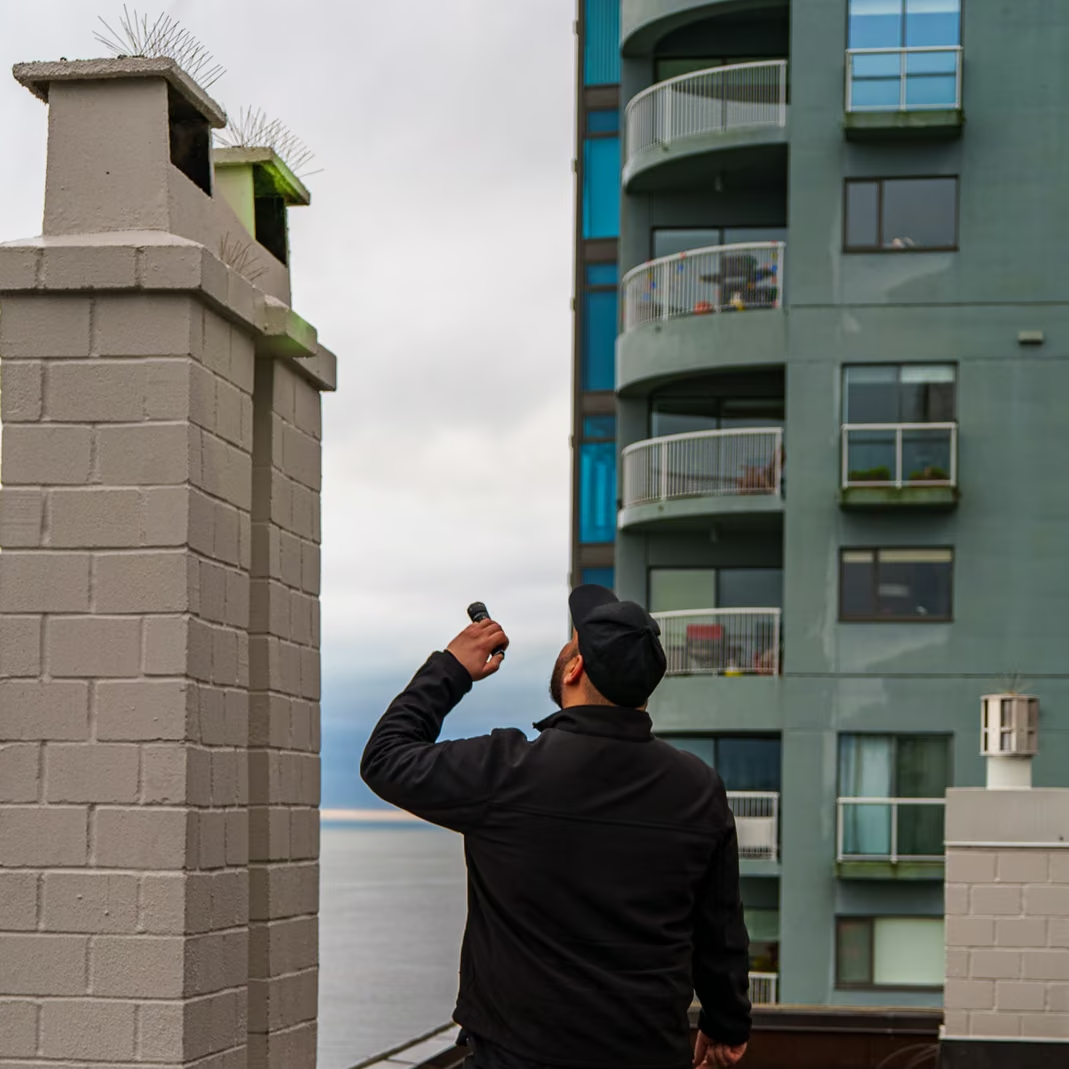
Spike runs along the coping, where dropped nest material and debris can cover the spikes.
- BFlat roofs
Tension-wire grids over open roof where gulls nest, set high enough, ECCC says, for maintenance staff to work under, such as 2 metres.
- CRooftop units & vents
Netting around the units, a use ECCC names, and Health Canada notes pigeons may drink from rooftop air conditioners.
- DGutters & roof drains
Old nest material and droppings are cleared out of gutters and drains on each visit.
- ELedges & window sills
Spike strips and wire along the ledges, checked for gaps, slack and debris.
- FSigns & canopies
Spikes and netting along the tops and undersides, kept clear of nest material.
- GLoading docks
Netting under the canopy and over the beams, checked for tears, sagging and gaps.
- HParkades
Netting across the beam bays, checked for gaps birds use to get back in.
- IBalconies
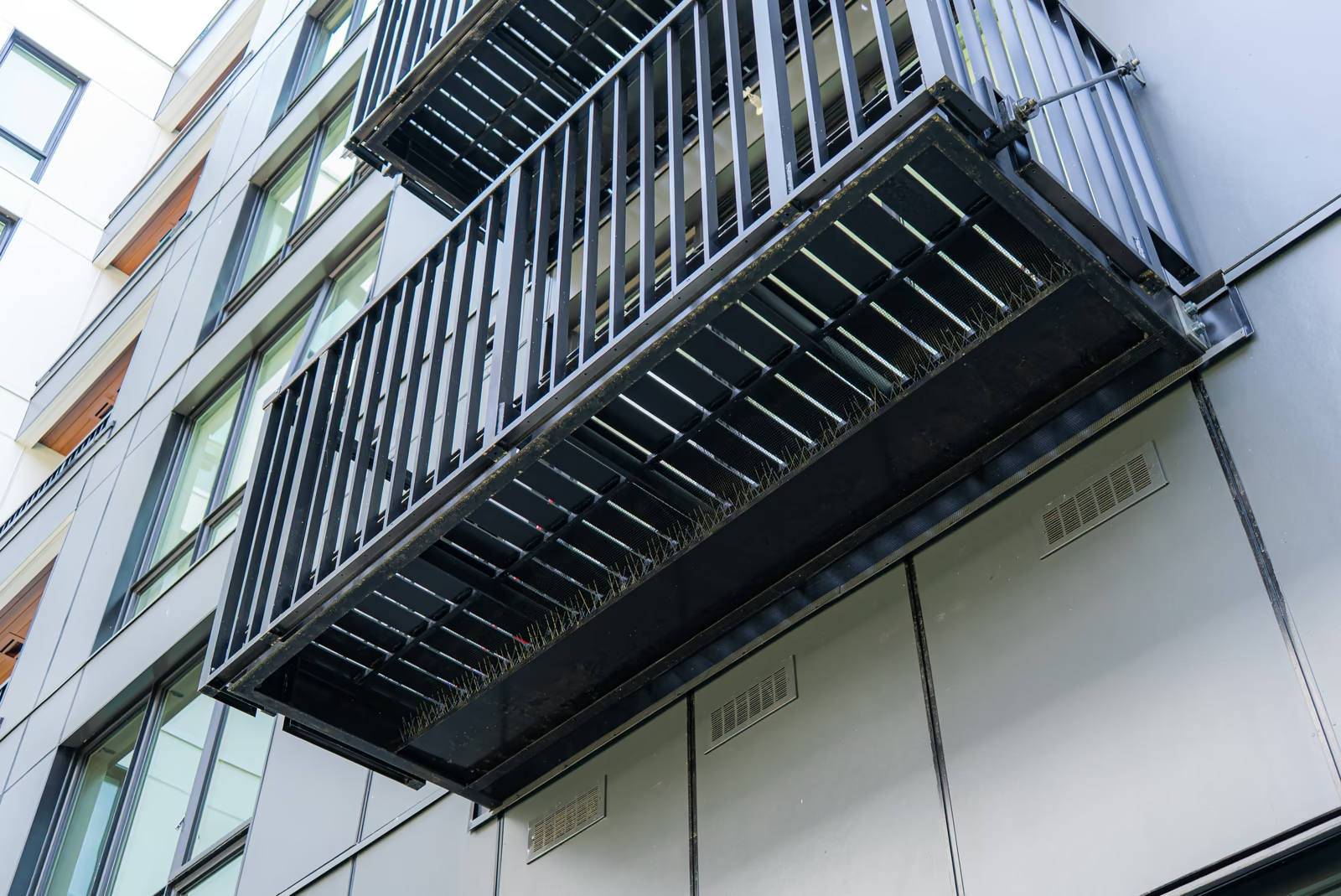
Spikes and netting on multi-unit balconies, where pigeons settle out of sight.
What Your Building Team Can Do, and What a Technician Handles
Caretakers and maintenance staff are on site between visits. They report what changes and keep food away from birds, and a technician does the work at height and around nests.
Your team can
ECCC asks for nets used against gulls to be checked several times a day for breakage and trapped birds; report a tear or a bird inside the day you see it. If a bird is trapped, a technician visits to free it and close the gap.
Health Canada’s advice is never to leave food out where pigeons can get it, so keep bin lids shut and clear spilled food near docks.
NIOSH, the U.S. workplace health agency, advises against sweeping dry droppings, and each visit clears them off ledges, spikes and drains.
Needs a technician
Netting, spikes and wire re-tensioned, re-fastened, patched or replaced, including systems another company installed.
Nests come down only where federal and B.C. rules allow, after a check for eggs and young.
Cleared off ledges, spikes, gutters and drains on each visit.
What the visit found and did, put in writing.
How Our Bird Deterrent Maintenance Program Works
Five steps on each visit.
Each run of netting, spikes and tension wire is checked, including systems another company installed.
In the nesting season, new nests and any bird trapped behind netting are looked for before anything is cleared.
Ledges, spikes, gutters and drains are cleared, and nests come down only where federal and B.C. bird rules allow.
Netting and wire are re-tensioned or re-fastened, and torn or broken sections are patched or replaced.
A written report of what was found and done follows each visit.
Our regular maintenance page lists Phantom’s other scheduled programs, from rodents to flying insects.
Before the First Visit
Six things that help the site inspection and the first visit cover the whole building. If a treatment runs alongside the program, its preparation sheet is on our client forms page.
A plan showing the roof, the docks, the parkade levels and the balconies helps one visit reach each system.
Note what was put up where (netting, spikes or wire) and who installed it, if you know.
Photos of ledges, signs or roof areas where birds perch or nest show the first visit where to start.
Say whether access is by hatch, stairs, ladder or lift, and who holds the keys.
Where gulls or swallows nested last season tells the first visit where to look before the birds return.
Move vehicles, stock or patio furniture away from the ledges, signs and canopies being worked on.
After the First Visit: How the Program Runs
What follows the site inspection, season by season. The visit schedule is agreed for each building.
Site inspection
It’s free, and the quote is written from what it finds in the building’s deterrents.
First visit
The deterrents are checked, cleared and repaired, and the first written report follows.
Before spring
Deterrents are adjusted before gulls and pigeons settle in for the nesting season.
Nesting season
Each visit looks for new nests and trapped birds, and leaves active nests of protected birds until they’re empty.
After the young leave
Empty nests and the droppings under them are cleared where the rules allow.
A short note of where birds landed or nested between visits points the next visit at the problem.
New units, panels or signs on the roof can open ledges the deterrents don’t cover, so tell us before the next visit.
Nesting Season: What a Visit May Clear
A nest’s species decides what a visit can do with it. Under s. 5 of the Migratory Birds Regulations, 2022, a migratory bird’s nest can’t be disturbed without a permit while it holds a live bird or a viable egg, and only 18 Schedule 1 species, none of them a gull or swallow, keep that protection once the nest is empty. Rock pigeons, starlings and house sparrows fall outside the federal rules, and B.C. exempts their nests from section 34 of its Wildlife Act (B.C. Reg. 168/90, s. 11.3).
Repair and adjust deterrents, and clear last season’s empty nests where the rules allow.
Check for new nests and trapped birds, and leave active nests of protected birds until the young have gone.
Clear the empty nests where the rules allow, and the droppings under them, then repair the gap the birds used.
Rock pigeon, European starling and house sparrow nests can be cleared, since neither federal nor B.C. rules protect them.
Environment and Climate Change Canada puts the general nesting period for zone A1, the south coast from the U.S. border north, including Vancouver Island, at late March to mid-August, and warns that work outside those dates might still break the rules. That is why our visits adjust deterrents before gulls and pigeons settle in spring, rather than waiting until nests are active. The Migratory Birds Regulations also let anyone, without a permit, briefly hold an uninjured migratory bird whose life is in immediate danger, as one caught in netting can be, to help it (s. 11).
B.C.’s Wildlife Act goes further for a few species: section 34 protects eagle, peregrine falcon, gyrfalcon, osprey, heron and burrowing owl nests even when empty, so a visit leaves them where they are. Federally, an empty Schedule 1 nest can come down without a permit only after written notice to the Minister, given months ahead, and only if it hasn’t been used since: 24 months for the great blue heron, 36 for the pileated woodpecker. Gulls and swallows are in neither of B.C.’s exemption schedules, so their occupied nests are protected under both laws.
Why Choose Phantom to Maintain Your Deterrents
Who does the work, what you receive after each visit, and which systems we take on.
Experience
15+ years of pest control experience serving British Columbia
Credentials
Fully licensed, insured and certified
Reporting
A written report after every visit
Systems
Netting, spikes and tension wire, whoever installed them
EXCELLENT Based on 830 reviews
 Posted on Google

 Ashley WoodWe were having some problems with mice at our home so we contacted Phantom and Darcey came and resolved the issues quickly. Darcey was friendly, great with our dog and made sure we understood everything he was doing and what to expect. Happy to report no more mice! Thank you, Darcey!Posted on Google
 Michelle HerrExcellent pest control service! The team was professional, friendly, and knowledgeable. They arrived on time, explained the treatment process clearly, and made sure everything was taken care of. Their attention to detail and commitment to customer satisfaction were impressive. I really appreciate their prompt service and effective results. Highly recommend them to anyone looking for reliable and professional pest control services!Posted on Google
 Nasib AbdulMark was great and he did a great job and was very knowledgeable.Posted on Google
 HenryDarcey provided exceptional support in resolving our pest concerns. He was punctual, highly knowledgeable, and professional throughout the process. We have been trying to deal with these issues for quite some time without any luck but thankfully the matter is now resolved. We appreciate the dedication he demonstrated and will be sure to reach out should we require his services again.Posted on Google
 Jacqueline BruceI want to let you know that June did an amazing job on our house for the moths. He was really friendly, patient, professional and conscientious. I wasn't fully ready for the treatment when he arrived and he managed to move some clients so he could return later. He explained a lot about the treatment and the moths' habits which really helped with other areas that he wasn't even treating. He kindly helped me moved some things to barricade the area from pets. I would get Phantom back and highly recommend them.Posted on Google
 Fraser HannayDarcey was amazing at helping us deal with a wasp nest. Friendly, knowledgeable and on time! Thank you!Posted on Google
 JanetWe hired Phantom Pest Control to eliminate a wasp nest inside our house and the service was great. Information on the phone when I first called to book an appointment was clear and we got an appointment quickly. Juan, the specialist who arrived to do the job, fully explained the process, did the work, and explained what to watch in the outside chance additional work might be needed. We are happy with the job and were glad to have Juan as our technician.Posted on Google
 Jenny WuWe received exceptional service from Joy. She was both professional and knowledgeable, explaining the service thoroughly.Posted on Google
 Sean AbbottThey showed up on time, early actually. Mark was very professional and explained how the cockroaches work. He was personable and efficient, and hygienic with how he worked (wearing protective boot covers and gloves). I was impressed and would definely call again if needed.
Bird Deterrent Maintenance Across Vancouver & Fraser Valley
Our bird deterrence program reaches commercial sites, strata and managed buildings throughout the Lower Mainland and the Fraser Valley, including the waterfront industrial land on Annacis Island. Each place below links to its own local page.
Vancouver & North Shore
Burnaby & Tri-Cities
Richmond & Delta
Fraser Valley
Related Services for Your Building
Services that sit next to a bird deterrence program. Sealed gaps can also be re-checked on a schedule under our pest proofing program.
New netting, spikes and wire, bird removal and identifying the species.
Sealing the gaps in rooflines, soffits and roof vents that birds and other animals use to get inside.
Building-wide programs for strata corporations, including when new netting or spikes need the owners’ approval.
Raccoons and other wildlife that move into roofs and wall cavities.
Bird Deterrent Maintenance FAQs
Check frequency, other installers’ systems, new deterrents, droppings, netting life, nesting gulls, visit times, strata buildings and cost, one question at a time.
Prefer to talk?
How often should bird netting and spikes be checked?
We found no B.C. or federal rule that sets a routine interval for checking netting, spikes or wire on a building. The one figure Environment and Climate Change Canada gives is for netting and wire grids used against gulls: check them several times a day for breakage and for birds caught in them.
That is more often than any visit schedule, which is why it helps when building staff look at the nets between visits. Each maintenance visit then inspects the deterrents, clears them and repairs what has worked loose. The visit schedule is agreed for each building, and a bird reported trapped between visits gets a technician visit to free it and close the gap.
Can you maintain netting or spikes another company installed?
Yes. Netting, spikes and tension wire put up by another company are taken into the program and checked, cleared and repaired on the same visits as any other system.
Tell us who installed them and roughly when, if you know, so the site inspection can note what each system was meant to cover.
Can you add deterrents where birds have moved?
Yes, as a separate job. New netting, spikes and wire are installed through our bird control service, which prices them after an inspection.
Once they’re up, this program maintains them with the rest of the building’s systems. Photos of the ledges or roof areas the birds have moved to can go with your estimate request.
What is a bird deterrent?
Anything fitted to a building to stop birds landing, roosting or nesting on part of it. Netting closes off a space such as a dock canopy, a parkade bay or the area around a rooftop unit, while spikes and tension wire discourage birds from settling on ledges, edges and flat roofs.
Netting, spikes and tension wire are the three kinds of system this program maintains.
Should our staff clean up built-up pigeon droppings?
Only with the right precautions. WorkSafeBC lists building maintenance workers among those at potential risk of histoplasmosis, and where workers could be exposed, the employer must have an exposure control plan.
The Canadian Centre for Occupational Health and Safety says preventing histoplasmosis relies on avoiding dust, and advises gloves, coveralls and a respirator with a HEPA filter for work in contaminated areas. Each visit clears droppings off ledges, spikes, gutters and drains.
How long does bird netting last?
It depends on the material and how much sun it gets. A U.S. wildlife-damage reference says UV-stabilized polypropylene netting with a 2.5 cm (1-inch) mesh, fitted over a building’s ornamental features, can last as long as 10 years.
Environment and Climate Change Canada adds that polypropylene netting breaks down in sunlight and needs replacing regularly. Each visit checks the netting’s condition, and worn or torn sections are patched or replaced.
What if gulls are already nesting on our roof?
Leave the nest until it’s empty. Gulls are protected migratory birds, so a nest holding a live bird or a viable egg can’t be disturbed without a permit, and ECCC says birds that have started nesting are harder to move.
Where gulls cause damage or danger, the land’s owner, lessee or manager can apply to the Canadian Wildlife Service for a damage or danger permit; ECCC says the permit is free, and its service standard is a decision within 35 calendar days for 90% of applications. ECCC also notes gulls appear to prefer light-coloured gravel and avoid dark tar or rubber, so a roof replacement is a chance to make the roof less inviting.
Can visits happen outside office hours?
For commercial sites, yes, by arrangement. Phantom is open 24/7 for pre-arranged commercial services, so a visit to a store, dock or office building can be booked for a quieter time.
Office and Service Hours: Monday to Friday, 9 AM to 5 PM. Call or Text 604-771-0404 to set up a visit.
Does the program cover strata and apartment buildings?
Yes. It covers strata corporations, apartment buildings and other managed buildings, from balcony spikes to parkade netting, alongside commercial sites.
Adding new netting or spikes to a strata building can need the owners’ approval; our strata pest control page explains when the owners have to vote first.
What does a bird deterrence program cost?
It depends on the building, so there’s no set price. The site inspection is free, and the quote is written from what it finds: the systems in place, where they are and the work they need.
Call or Text 604-771-0404, or send the estimate form with photos of the areas where birds still land.
Book a Site Inspection
Tell us about your building, the deterrents in place and where birds still land, and we’ll plan the first visit from the site inspection.
The site inspection is free, and a custom quote follows it.