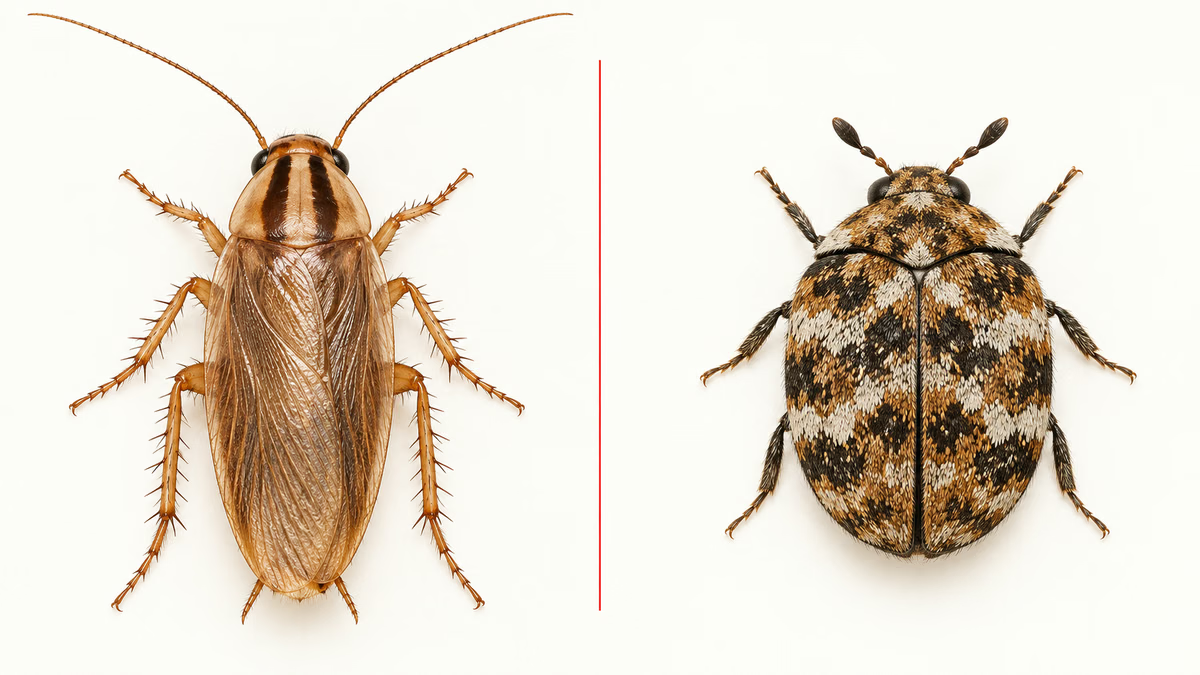
To distinguish cockroaches or beetles, compare several features: cockroaches typically have flattened bodies, long, thread-like antennae and spiny legs; beetles have hardened forewings called elytra. Wing structure is especially useful, but a line down the back is not conclusive. Wingless stages, hidden heads and overlapping body shapes can complicate identification.
A clear photograph and the place you found the insect are more useful than a quick impression. This guide explains what to examine, what other evidence matters, and when a Vancouver homeowner or renter should seek an assessment.
On this page7 sections
Cockroach vs. Beetle: Key Differences at a Glance
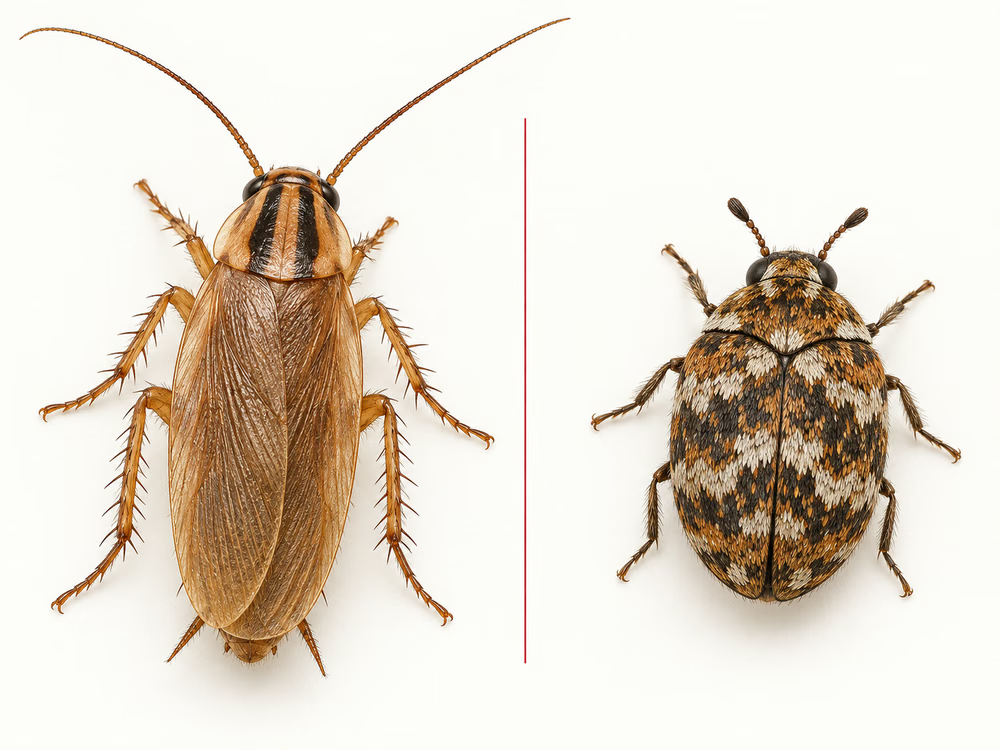
Use this table as a starting point. A combination of compatible features supports a likely identification; a blurred image or a single characteristic may leave the answer uncertain.
| Feature | Typical Cockroach Clue | Typical Beetle Clue | Important Limitation |
|---|---|---|---|
| Body profile | Broad, oval and flattened | Often firm-looking and more rounded or elongated | Ground beetles and some pantry beetles are also flattened. |
| Forewings | Leathery, often visibly veined and overlapping when developed | Hardened elytra, usually meeting edge to edge | Some cockroaches lack developed wings; some beetles have shortened elytra. |
| Antennae | Usually long and thread-like | Variable: thread-like, clubbed or other shapes | Some beetles also have long antennae. |
| Head and legs | Head often concealed from above; conspicuously spiny legs | Head often more exposed; leg form varies | Some beetles conceal their heads, and some have spiny legs. |
Body Shape, Wing Covers, and the Seam Down the Back
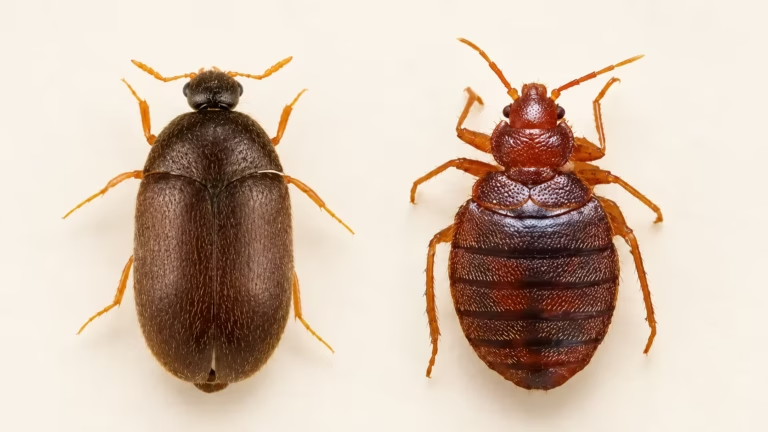
Beetle elytra are modified front wings that form protective covers over the back. In many familiar adult beetles, their inner edges meet along a straight central seam. They are not a separate shell added over ordinary forewings.
Winged cockroaches have front wings called tegmina. These are thickened or leathery rather than the beetle’s rigid covers, and commonly overlap over the abdomen. Their edges, veins or overlap can also create lines down the back. A seam alone therefore does not prove that an insect is a beetle.
Take a photograph from directly above to examine this arrangement. A side view helps show whether the body is flattened or domed. Keep the insect intact: do not lift or pull apart a live insect’s wings. Nymphs and adults with reduced wings need other clues.
Antennae, Legs, and Head Position
Look at the antennae’s shape as well as their length. Cockroach antennae are generally slender and thread-like. Beetle antennae are much more varied; a clubbed tip can be helpful, but long, slender antennae also occur among beetles.
The pronotum is the plate immediately behind the head. In cockroaches it often acts like a shield, obscuring the head in an overhead view. However, certain beetles also tuck their heads underneath this plate. Cockroach legs commonly show obvious spines, while beetle legs vary with their habits.
Posture, shadow and reflections can hide all these structures. A photograph taken at floor level may show a head that disappears in a top view, so compare angles before drawing conclusions.
Why Colour, Size, and Movement Alone Can Be Misleading
Brown or black colouring occurs in both groups. Cockroach nymphs may look different from adults, and freshly moulted cockroaches can be pale before their outer covering darkens. Carpet beetles can lose the scales that create their adult pattern.
Size overlaps too. A small adult beetle is not necessarily an immature insect. Both cockroaches and ground beetles can run for cover, so speed and hiding behaviour do not settle the comparison. Describe what you saw without treating a fast movement as a diagnosis.
Common Beetles Mistaken for Cockroaches
The following groups illustrate different sources of confusion. They are not a ranking of Vancouver’s most common indoor beetles. Regional records establish relevance, but cannot identify the insect in your home.
Ground Beetles and Click Beetles
Many ground beetles are dark, relatively flat and equipped with long running legs. That combination can look cockroach-like at a glance. A distinct head and hardened, sometimes grooved wing covers help separate them from cockroaches. Ground beetles generally live outdoors; an individual near an exterior door may be an incidental visitor.
Click beetles are typically elongated, with the rear corners of the pronotum projecting backwards. Their dark bodies can cause similar confusion. Some can flip with an audible click when overturned, but do not provoke this behaviour to identify one. Their larvae, called wireworms, usually develop outdoors in soil or other habitats, depending on species.
June Beetles
“June beetle” or “June bug” is a common name, often applied to May/June scarab beetles, rather than a precise species identification. Many are stout, brown insects with domed bodies and hardened wing covers. Their shape and clubbed antennae help distinguish them from typical cockroaches.
For local context, the City of Vancouver documents European chafer beetles, which resemble June beetles. Their grubs feed on plant roots outdoors. This does not make every brown beetle a European chafer or indicate an indoor infestation. A beetle appearing near a light or open window may have entered from outside.
Pantry Beetles and Carpet Beetles
Pantry beetles can be small, brown and elongated or oval. Red flour beetles, for example, are reddish-brown adults associated with dried foods. Their elytra and a connection to an affected food package are more useful clues than colour. Different species use different foods; finding a beetle on a kitchen wall does not establish its source.
Adult varied carpet beetles (Anthrenus verbasci) are compact and rounded, with mottled light and dark scales. Their hairy larvae look very different. The larvae, rather than the adults, can feed on susceptible animal-derived materials, including wool and feathers. Carpet beetles and pantry beetles should not be treated as interchangeable: identify the insect before assuming which belongings are affected.
Baby Cockroach or Small Beetle? Identifying Wingless Insects
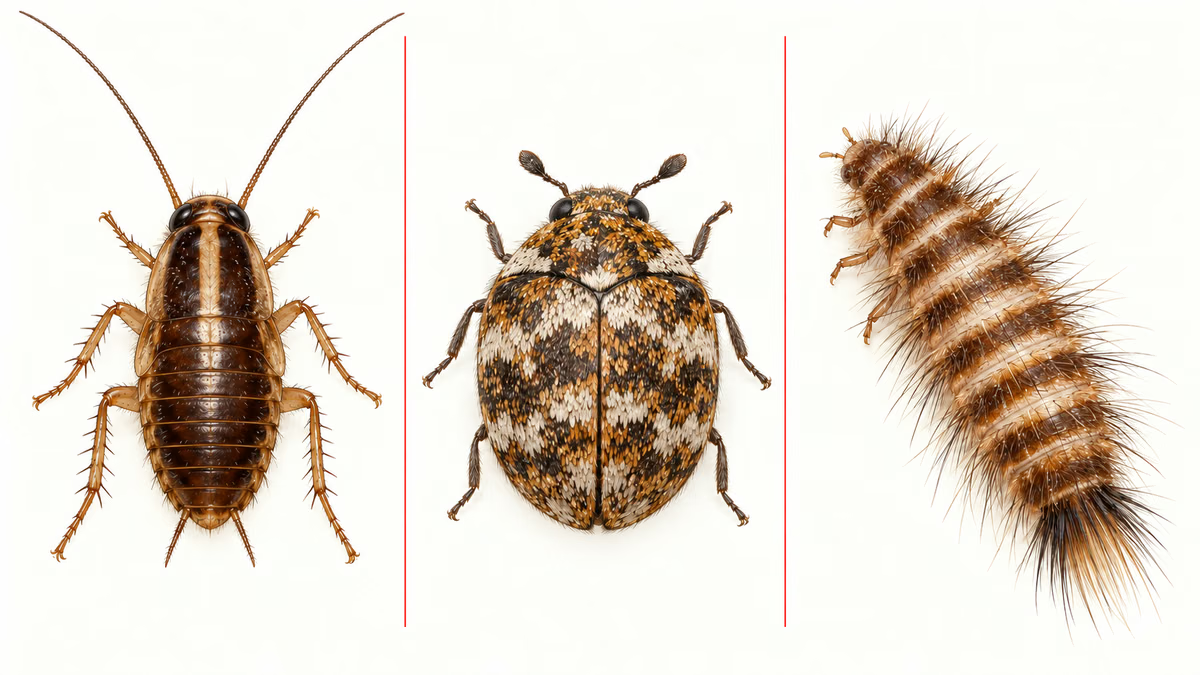
A cockroach nymph generally resembles a smaller, wingless adult, with long antennae, six legs and a recognizably cockroach-shaped body. Older nymphs may develop wing pads, but they do not have fully developed adult wings.
German cockroach nymphs (Blattella germanica) are darker than adults and commonly show a pale lengthwise marking. Adults have two dark lengthwise stripes on the pronotum. UBC’s E-Fauna BC documents this species as established in British Columbia; this supports regional relevance, not identification from a marking alone.
Beetles develop through egg, larva, pupa and adult stages. A small adult beetle already has its adult body form, including elytra, although its flight wings may be hidden or reduced. Beetle larvae have a different form: examples include hairy carpet beetle larvae, slender flour beetle larvae and curved scarab grubs. Some beetle larvae lack legs. None should be labelled a baby cockroach simply because it is small.
Signs of Cockroaches or Beetles in Your Home
Look for evidence near the sighting, without dismantling appliances or opening inaccessible spaces. An insect’s location and associated materials can help narrow the possibilities, but neither establishes the species by itself.
Cockroach Droppings, Egg Cases, and Shed Skins
Cockroach activity may leave dark droppings, cast skins and egg cases. An egg case, called an ootheca, is a capsule containing multiple eggs; its appearance and how the female carries or deposits it vary by species.
Photograph suspected evidence where you find it. Dark specks can have other explanations, and beetles also shed skins as they grow. Droppings alone cannot reliably identify a cockroach species or reveal a hidden population’s size. A recognizable insect alongside additional signs is much more useful than an isolated mark.
Beetle Larvae and Damage to Food, Fabrics, or Wood
Live beetles or larvae within dried goods suggest a stored-food source. Examine the affected product and nearby susceptible packages, including pet food or birdseed where relevant. Phantom’s pantry pest control services address this separate type of problem.
Hairy larvae and cast skins beside damaged wool or feathers can support a carpet beetle investigation. Susceptibility varies with species and material; damage to one item does not mean every fabric is affected.
Particular wood-associated beetles can leave exit holes and powdery debris as larvae develop in wood. This is not a trait of beetles generally. Holes may be old, and some insects emerging from firewood do not attack building timber. An assessment is needed before attributing structural damage or active infestation to a few holes.
What to Do After Finding a Cockroach or Beetle
Photograph or Collect the Insect for Identification
Take a sharp overhead photograph, then a side view if practical. Use even lighting and place a ruler nearby, preferably in the same plane as the insect. Keep an original image as well as any crop so useful detail is preserved.
If safe and straightforward, contain the insect using a clear container and a stiff card, then secure the lid. Avoid bare-hand handling, crushing it or reaching behind electrical equipment. Keep the container away from children and pets. Ask the intended identifier how to retain the specimen.
Compare actual specimen photographs in the UC IPM cockroach identification guide. A professional may still need additional angles or the specimen itself; an unclear photograph cannot provide certainty.
Check for Repeated Activity and Identify the Source
Record the date, room, exact location and number seen. Note whether insects appear near a doorway, within food packaging or beside damaged materials. Include any different life stages and photograph associated evidence separately.
Appropriately placed insect monitors can help document repeated activity; follow their instructions and keep them inaccessible to children and pets. A capture location helps direct inspection, but does not necessarily locate a breeding site. Several sightings in one area, or larvae and adults associated with a food source, warrant closer attention than an isolated outdoor visitor.
Prevent Further Entry and Know When to Call Pest Control
Match your response to the evidence. Inspect relevant stored foods or susceptible materials, remove confirmed infested food and clean the affected storage area. Address leaks, repair screens and seal suitable entry gaps without blocking required ventilation. Avoid indiscriminate spraying or discarding unaffected belongings.
For a fuller prevention discussion, see what attracts cockroaches. Finding an insect does not prove poor hygiene. Renters should document recurring activity and inform their landlord or property manager so inspection can be coordinated.
Seek assessment for suspected cockroaches, repeated activity, multiple life stages, unexplained damage or unresolved identification. Phantom Pest Control provides cockroach control in Vancouver and beetle control services, including inspection and species-directed management. An incidental beetle does not automatically require treatment.
Conclusion
When comparing cockroaches or beetles, combine wing structure, body profile, antennae and head position with the insect’s life stage and surrounding evidence. Photograph first, seek identification when uncertain and choose a response that fits the findings.
For recurring or unclear activity in Vancouver, contact Phantom Pest Control to discuss an inspection. Provide your location, photographs, sighting frequency and any associated signs.
FAQs
Are Cockroaches a Type of Beetle?
No. Cockroaches belong to the insect order Blattodea, while beetles belong to Coleoptera. Both groups have six legs and antennae, but differ in wing structure and development. Cockroach nymphs resemble smaller adults; beetles pass through a distinct larval stage and then a pupal stage before becoming adults.
Can Cockroaches and Beetles Both Fly?
Some can, but flight ability varies. Many beetles fly using hindwings beneath their elytra, while others have reduced flight wings. Cockroach flight depends on species, sex and conditions; some winged adults rarely or never fly. Cockroach nymphs cannot fly. Visible wings alone do not establish flight ability or identify the insect.
Does Finding One Cockroach or Beetle Mean an Infestation?
One sighting does not automatically confirm an infestation. An outdoor beetle may enter accidentally, while a suspected indoor cockroach deserves prompt identification. Consider the species, room, repeated sightings, immature stages and associated evidence. Document the insect and investigate proportionately instead of estimating a hidden population from a single encounter.