Attic & Basement Pest Control in Vancouver & Fraser Valley
Phantom Pest Control deals with pests in attics, crawl spaces and basements across Vancouver, BC and the Fraser Valley. We find out what is living there, from roof rats in the insulation to silverfish in a damp basement, then remove or treat it and seal the gaps it used to get in.
Spaces
Attics, crawl spaces & basements
Common pests
Where they get in
Service area
Why Pests Move Into Attics, Crawl Spaces and Basements
Attics, crawl spaces and basements are the quietest parts of a house: warm or damp, visited only now and then, and full of places to hide.
Rats and mice look for food, shelter and warmth indoors, especially in the colder and wetter months, and they nest in attics, basements, crawl spaces and wall cavities. Raccoons and squirrels reach attics and roof voids through gaps in the roofline and soffits. Below grade, damp air suits silverfish, earwigs and dampwood termites. Our guide to termite signs and prevention covers the leaks and poor crawl-space ventilation they depend on.
Because nobody goes up or down there often, the first sign is usually indirect: scratching in the ceiling, droppings on a storage box, or shredded insulation. Pipes, wires and vents run between the floors, so a problem that starts in the attic or crawl space can reach the rooms in between. For the rest of the house, see our page for single-family & laneway homes.
Weeks can pass without anyone opening the attic hatch or the crawl-space cover.
Rodents and wildlife shred it for nesting and damage it, along with vapour barriers and wiring.
Basements and crawl spaces hold the moisture that silverfish and dampwood termites need.
Cardboard, paper and fabric give cover and nesting material close to the walls.
Roof vents, soffits, foundation cracks and crawl-space vents are the usual ways in.
Gaps where they pass through walls and floors link the attic and basement to the rooms between.
Pests We Find in Vancouver Attics and Basements
The usual culprits behind noises, droppings and damage above and below the living space, each linked to its full service.

Roof rats climb into attics and rafters, while Norway rats stay low in basements and crawl spaces. Both leave droppings and chew wiring.

Get in through gaps at the roofline and nest in the attic, damaging insulation, vapour barriers and wiring.

Starlings, sparrows and pigeons nest in roof voids and vent openings, and their nesting material can block the vents.

Build hidden nests in attics, eaves and wall voids, and can chew through drywall into living spaces.

Thrive in damp basements and crawl spaces, and damage stored paper, books and wallpaper.

Settle in basements, garages and crawl spaces, in the corners and storage that nobody disturbs.

The termite found most often in the region, living in wet or decaying wood in crawl spaces and basement framing.
Describe the noise and when you hear it, or send a photo of the droppings, with your estimate request.
When Pests Move Into Attics & Basements
Wildlife and wasps follow the seasons, rodents move in when the weather turns cold and wet, and moisture pests stay active as long as the space stays damp. For what to check before the cold sets in, see our winter pest control tips.
The months follow the timing each Phantom pest page gives for the Lower Mainland.
Raccoons have litters of two to five young in spring, and squirrels raise two litters annually, so an attic can be used as a nursery more than once.
Nesting peaks in spring and early summer, but in mild weather pigeons can breed in any month, so an open vent can be taken over at any time.
Most active from late spring through early fall. Colonies usually start in early spring, so sealing entry gaps before then is one of the most effective steps against nests in the attic and walls.
Cold, wet weather drives them indoors in search of food and shelter. Once they nest in an attic or crawl space, they can stay active whatever the season.
Follows moisture, not the season
Active wherever moisture stays, which in a basement or crawl space can mean activity in any month.
They need direct contact with moisture, so the risk follows leaks, poor drainage and poor ventilation rather than the month.
A moisture pest of damp crawl spaces and foundations, so treatment comes with advice on the dampness behind it.
How Pests Get Into Attics & Basements
Attic and basement problems usually start at a handful of openings, from the roofline down to the foundation. These are the places an inspection checks first.
- ARoof vents, soffits & eaves
Damaged vents and soffits are the usual way in for squirrels, raccoons and birds.
- BAttic insulation
Droppings, nests and damaged insulation show where rodents or wildlife have been.
- CPlumbing stack & wall cavities
Rodents and wasps travel and nest in wall cavities, out of sight between floors.
- DPipe, cable & dryer-vent openings
Gaps where utilities pass through the walls let mice and insects in.
- EFoundation cracks & basement windows
Cracks and gaps around window frames let rodents and insects in at ground level.
- FStorage room & laundry
Damp corners and stored boxes suit silverfish, spiders and mice.
- GCrawl-space vents & cover
Broken vent screens and loose covers let rodents and wildlife under the house.
- HDamp wood & framing
Wet or decaying wood in a poorly ventilated crawl space is where dampwood termites settle.
- IBranches, woodpiles & bins
Overhanging trees, wood stacked against the walls and open bins give pests cover and a way in.
What You Can Do, and When to Call a Technician
A few habits make an attic, crawl space or basement less inviting. Work at height, in tight spaces and with live animals is where a technician comes in.
You can
Keep stored items in sealed plastic bins rather than cardboard, off the floor and away from the walls, so pests have less cover and nothing to shred for a nest.
Run a dehumidifier, improve the airflow and fix leaking or sweating pipes. Lower humidity in the basement and laundry works against silverfish and the other moisture pests.
Sweeping or vacuuming droppings puts dust into the air. Spray them with disinfectant, wait, then wipe them up with paper towels.
Needs a technician
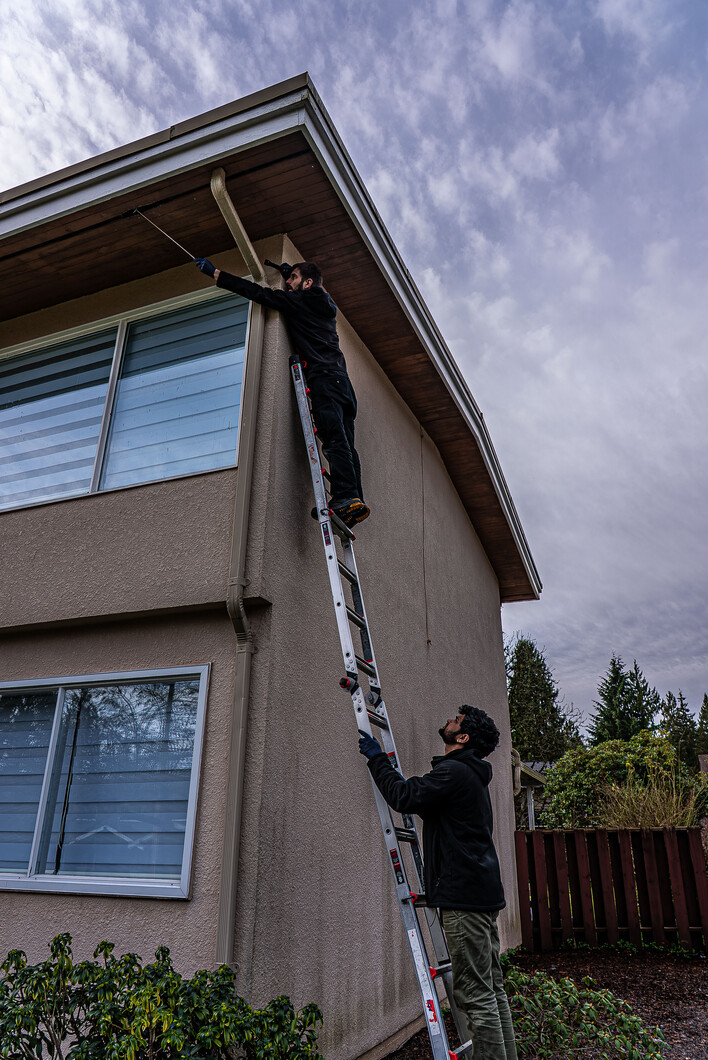
Soffits, roof vents and the gaps around them are ladder work. We check the whole roofline, and the openings we find go on your list for sealing.
Roof rats and Norway rats leave different droppings, and squirrels are busy by day while raccoons and rats move at night. The answer decides the method.
Second-generation rodenticides can’t be used in homes in B.C., and animals in an attic need the right traps at the right time, especially in spring.
Gaps up to the size of a toonie are sealed during a rodent program. Larger openings need exclusion work with steel mesh and metal flashing.
How Our Attic and Basement Pest Control Works
Five steps, from the first look through the attic hatch to the last follow-up visit.
We check the attic through the hatch, the crawl space, the basement and the outside from the roofline to the foundation. Adding the attic or crawl space costs $50, waived if you book the service the same day.
Droppings, gnaw marks, nesting and the time of day you hear the noise tell us what is there. The species decides the treatment, the trapping and what gets sealed.
Rodents get the three-visit rodent program, with traps placed where they travel. Squirrels and other wildlife get our wildlife removal program, and insects such as silverfish a treatment, with an attic fogging add-on available.
Gaps up to the size of a toonie are sealed during the rodent program, and larger openings through exclusion work, quoted after a visit. For wildlife, an opening should be closed only once no animals, young included, are left inside.
The rodent program’s later visits follow up on the traps and the sealing, and the traps are taken away at the end. After an insect treatment, a follow-up may be scheduled if activity continues.
Want visits on a schedule? See our rodent, exclusion and other maintenance programs.
Before Your Attic or Crawl Space Inspection
Each service has its own preparation sheet on our client forms page. For attics, crawl spaces and basements, it comes down to access and a clear start, so new activity shows.
For rats, the attic opening has to be reachable and the closet under it cleared, so the technician can set up a ladder.
If the crawl space is part of the visit, make sure its hatch or cover can be opened and the way to it is clear.
Move boxes away from the basement walls and clear the floor where you have seen activity.
Clearing old droppings from boxes and floors you can reach shows the technician what is new. Wear gloves, wet them with disinfectant, wait 10 minutes, then wipe them up with paper towels; never sweep or vacuum them.
The rodent program sheet asks for access during business hours, 9 a.m. to 5 p.m., Monday to Friday. If the preparation isn’t done and the treatment can’t go ahead, a $78 fee applies.
Write down when and where you hear scratching or find droppings. Activity by day or by night helps tell squirrels from rats.
After the Visit: What to Expect
What happens next depends on the service. These timings come from Phantom’s rodent, silverfish, spider and crawling-insect sheets, and your technician will confirm them.
Treatment day
Stay out for the time on your treatment’s sheet, then air the home out: 15 to 30 minutes after a silverfish treatment, 30 minutes to an hour after a crawling-insect treatment.
First 72 hours
After a spider or crawling-insect treatment, expect a clear drop in activity. Silverfish can be more visible at first, as the treatment disturbs them.
First 4 weeks
No vacuuming, sweeping, mopping or cleaning within 6 inches of the treated baseboards and surfaces.
Within 90 days
The three visits of a rodent program are completed within 90 days of the first service.
Up to 3 months
The insect treatment keeps working for up to 3 months, as long as the aftercare is followed.
Store-bought sprays and household cleaners on treated areas stop the treatment from working, so keep them away for the full four weeks.
Openings larger than a toonie need pest-proofing at additional cost, through our exclusion work. Your technician can arrange the quote.
How to Clean Up Attic Droppings Safely
Rodent droppings, urine and nests can carry hantavirus, and sweeping or vacuuming them puts the particles into the air you breathe. The Public Health Agency of Canada says to wet them first.
Rubber or plastic gloves, and an N95 respirator in a confined space like an attic or crawl space.
Soak the droppings, nesting and the area around them with a Health Canada-approved disinfectant or 1 part bleach to 9 parts water.
Pick up the wet droppings with paper towels or a wet mop.
Seal everything in two plastic bags for the garbage, then wash your hands well with soap and water.
A full clean-up of the attic or crawl space waits until the animals are out and the gaps are closed, or it has to be done twice. Getting them out and closing the gaps is the part we handle, and the Public Health Agency of Canada lists blocking the openings rodents use among the ways to prevent hantavirus.
Of the five North American rodents known to carry hantaviruses, the deer mouse, the white-footed mouse and the red-backed vole are widespread in parts of Canada, so droppings you can’t identify get the same care. The virus can also be picked up by touching surfaces or eating food contaminated by rodents, so keep stored food sealed in metal or glass containers. The Public Health Agency of Canada’s hantavirus prevention guidance has the full steps.
Why Homeowners Choose Phantom Pest Control
The short version: who does the work, and how.
Experience
15+ years of pest control in Vancouver
Credentials
Fully licensed, insured and certified
Estimates
Estimates over the phone are free
Preparation sheets
Sealing
Larger gaps closed with heavy-gauge steel mesh and metal flashing
EXCELLENTTrustindex verifies that the original source of the review is Google. Just wanted to say that we're very happy to have Darcey Walker as our pest control technician as he's always personable, knowledgeable about taking care of our past pest control issues and does a great job!Posted on GoogleTrustindex verifies that the original source of the review is Google. JC from Phantom was very professional and friendly to work with. He came prepared for the first inspection and carefully reviewed our problem and clearly explained the treatment options and timelines. Then we scheduled the follow-on work on the spot for him to come back. In between the two appointments, I found a wasp nest and was able to communicate that to Phantom to add as additional work. All works were completed without issue and the areas tidied to remove any debris. Thank you for taking care of everything so efficiently! Would definitely go back to JC and the team for future needs.Posted on GoogleTrustindex verifies that the original source of the review is Google. Joy and Yash have been great to work with, very prompt and thorough.Posted on GoogleTrustindex verifies that the original source of the review is Google. June was fantastic!! I was concerned that having a termite inspection done by a pest control company would just lead to an aggressive sales pitch for their services, so I specifically chose a company like Pantone who don’t do free inspections. June did a thorough inspection, checked everything available nook and cranny explained everything he was seeing and allayed my worries. Not once did he try to upsell a service or push for some needless preventative measure. I was very happy with the service.Posted on GoogleTrustindex verifies that the original source of the review is Google. The technicians that came to our building to try and exterminate a wasp nest did a great job. Darcy and June we're very capable of removing the Wasps from the eaves in our roof. I can highly recommend them.Posted on GoogleTrustindex verifies that the original source of the review is Google. Exceptional service from Darcy! Always professional, and knowledgeable. He has a knack for attention to detail, and really takes the time to explain the issues with a resolve. Reliable and very friendly A+ Highly recommend!Posted on GoogleTrustindex verifies that the original source of the review is Google. June was so kind and tremendously helpful!Posted on GoogleTrustindex verifies that the original source of the review is Google. Phantom pest did a great job with our mouse and cockroach problem. JC was a wonder to work with and we will be using them in the future if need be. Thanks!Posted on GoogleTrustindex verifies that the original source of the review is Google. This is a very good company. The technician Mark is so nice and very professional.Posted on GoogleTrustindex verifies that the original source of the review is Google. Had a rodent problem, Darcey came over and took care of it. Appreciate the quick response and great job! Thank you!
Attic and Basement Pest Control Across Vancouver & Fraser Valley
We work in houses, townhouses and suites with attics, crawl spaces or basements across Metro Vancouver and the Fraser Valley.
Vancouver & North Shore
Burnaby & Tri-Cities
Richmond & Delta
Fraser Valley
More Services for Your Home
Related services for the rest of your home.
Sealing larger openings at the roofline, vents and foundation.
Scheduled programs, including rodent and exclusion programs.
Pest control for the whole house, inside and out.
All our home services, by property type.
Attic and Basement Pest Control FAQs
Straight answers to the questions people ask about noises, droppings and pests above and below the living space.
Prefer to talk?
How much does an attic or crawl space inspection cost?
A house inspection is $150 + GST, plus $50 for the attic or crawl space unless you book the service the same day. The other common prices:
- Inspection of a condo, apartment or townhouse: $125 + GST
- Rodent program, three visits: $495–$650 + GST for a house
- Wildlife trapping, two traps and two visits over a week: $350 + GST, with no guarantees for catching the animal
Prices can change with the size of the property and the severity, and each service page lists its current range.
What’s making noise in my attic?
The time of day is a strong clue. Squirrels are active during the day, while raccoons and opossums are mostly nocturnal, and rats and mice are mostly active at night. Scratching or scurrying inside walls and ceilings is a common sign of rodents, and birds nesting in a roof void or vent can be heard too. Note when and where you hear it, check for droppings, and book an inspection: the species decides the method.
Does Phantom do attic clean-up or replace insulation?
No. Our part is removing the rodents or wildlife, treating where it’s needed and sealing the way in; clean-up and insulation work are separate jobs. Insulation that is soaked or heavily soiled over a large area is a job for an insulation contractor, and it’s worth replacing only after the inspection and sealing, so the new layer isn’t nested in again. For a few droppings on a shelf or a box, follow the steps in our clean-up guide.
Can you put rat poison in my attic?
Not second-generation rodenticides. Since January 21, 2023, B.C. has restricted these products (SGARs) to essential services such as hospitals and food production, so licensed companies can’t use them in homes. Health Canada notes that snap traps are very effective when they are well placed and set properly, and that in places children or pets can reach, poisoned bait must be in a tamper-proof bait station. Your technician chooses the method for the space.
Why do I keep finding silverfish in my basement?
Usually because the basement is damp. Silverfish favour warm, humid and dark places, and basements and crawl spaces are among their usual spots. A dehumidifier, better airflow and fixing leaks take away the humidity they need. Treatment for a house is $325–$425 + GST, and an attic fogging add-on is $195–$250 + GST. More on keeping them away: how to get rid of silverfish.
Are those mouse or rat droppings?
Size and shape tell them apart. Where you find them helps too:
- Mouse: ⅛ to ¼ inch long (3 to 6 mm)
- Norway rat: blunt and capsule-shaped, around ¾ inch (about 2 cm), usually at ground level in basements and crawl spaces
- Roof rat: pointed and spindle-shaped, around ½ inch, usually in attics and rafters
Our guide to mouse vs rat droppings has more on telling them apart.
Can you get squirrels or raccoons out of the attic in spring?
Yes, though a raccoon family may have to wait until the young can leave with their mother. Raccoons have their young in spring, and the B.C. government notes that a mother and her babies can’t be removed from the nest until the young can leave with her, at about 12 weeks. Squirrels raise two litters annually, so young can be inside at other times too. The BC SPCA advises checking that no young animals are inside before an opening is repaired; an adult trying hard to get back in is a sign of a mother trying to reach her young.
Who arranges pest control for a basement suite?
Usually the landlord for insects; for rodents, it depends on the local bylaw. B.C.’s Residential Tenancy Branch says landlords are generally responsible for controlling insect infestations such as bed bugs, and that local standards of maintenance bylaws decide whether the landlord manages other pests, such as rodents. To enter a rented suite for a treatment, the landlord needs the tenant’s permission or must give at least 24 hours’ written notice, with an entry time between 8 a.m. and 9 p.m., under section 29 of the Residential Tenancy Act.
Do I need to leave home during the treatment?
It depends on the service. The rodent program sheet sets no vacancy time. For silverfish, spider and crawling-insect treatments, our preparation sheets ask everyone to stay out for at least 6 to 8 hours, and 24 hours for children under 2, pregnant or nursing mothers, people with respiratory conditions, and pets. Your booked service’s preparation sheet lists the exact time and who it applies to.
How long does it take to get rid of rats in the attic?
Plan on three visits, completed within 90 days of the first one. A rodent program starts with an inspection inside and out, puts traps where the rats travel, and closes gaps up to toonie size along the way; bigger openings are a separate exclusion job. How soon the scratching stops depends on the size of the infestation and how the rats get in, and a severe infestation can need extra visits. Once the program ends, the traps are all taken away.
Attic or Basement Pests?
Tell us what you’re hearing or finding, where and when, and we’ll recommend the next step. A photo of the droppings helps.
Estimates over the phone are free. Describe what you’re hearing and where, and we’ll tell you whether it needs an inspection.