Home Buyer & Seller Pest Inspections in Vancouver & Fraser Valley
Phantom Pest Control provides pest inspections for home buyers and sellers in Vancouver, BC and the Fraser Valley. We check the home from the roofline to the crawl space and sort live activity from old signs. You get a written report with photos showing what we found and where pests get in.

Who it’s for
Home buyers, sellers & their agents
Pests we look for
Where we look
Service area
Why Buyers and Sellers Book a Pest Inspection
A home sale packs big decisions into a few days, and the signs of pests tend to be out of sight: attics, crawl spaces, wall voids and the base of the outside walls.
Sellers meet the question on paper. BCREA’s residential Property Disclosure Statement (form BC1002, revised July 2025) asks: “Are you aware of any infestation or unrepaired damage by insects, rodents, or bats?” An inspection before you list shows what is there on the day, so your answer rests on facts, and any treatment can be done before buyers walk through.
Buyers meet it on the clock. In B.C., buyers of most residential property can rescind within three business days after the offer is accepted, for a fee of 0.25% of the purchase price. Your deadline is the subject removal date in your offer, or the end of those three business days if you’re relying on the rescission period, so book early and tell us the date. Already settled in? Our pages for single-family & laneway homes, townhouses and condos & apartments cover life after the sale.
Subject removal dates and the three-day rescission period leave little time to find a problem.
On the residential form, question 3.F asks about infestation or unrepaired damage by insects, rodents or bats.
A home inspection looks at accessible areas; it usually isn’t a dedicated pest search.
Droppings, nests and flattened insulation sit where few buyers climb. More on attic and basement pest control.
With nobody sleeping there, bed bugs can go quiet and leave few signs to see.
Pests can travel between units, and council minutes can record building-wide treatments.
What a Pest Inspection Looks For in Vancouver Homes
The pests a technician looks for when a home changes hands, each linked to its full service page.

Droppings, gnawing and holes by the foundation. Norway rats favour damp crawl spaces; roof rats take to attics.

Loose shavings in the attic or crawl space and rustling in the walls point to a nest in damp wood.

Dampwood termites, the main species here, live inside wet or decaying timber rather than in soil.

Powderpost beetles tunnel through timber, floors and beams; small exit holes may be the only sign.

Get in through gaps in rooflines, soffits and vents, then nest in attics and wall cavities.

Drawn to people, not dirt. They travel in furniture and hide in mattresses and small cracks.

Shelter in warm, damp spots behind the fridge and stove and in the cabinets under sinks.
Tell us where you saw it, and add a photo to your estimate request.
Seasonal Pest Signs in Homes for Sale
A showing catches one season. Ants and wasps peak in the warmer months, rats and mice push indoors when it turns cold and wet, and subterranean termites swarm in spring. To read what you find, see mouse vs rat droppings.
Ant, wasp and rodent months come from Phantom’s pest pages for the Lower Mainland; the subterranean termite flight comes from the B.C. Ministry of Agriculture.
Ant activity runs through spring and summer. B.C.’s carpenter ant guidance says more than 10 to 12 ants inside in an evening is worth checking for a nest indoors.
Subterranean termites swarm in April and May. The B.C. Ministry of Agriculture says winged adults appear only once a colony is 3 or 4 years old. Phantom’s termite page puts dampwood swarmers in late summer and early fall.
Active from late spring through early fall. A nest under the eaves or inside a wall can hold thousands of wasps by late summer.
They move indoors for food and shelter in the colder, wet months. A fall or winter showing is the time to look under sinks and along the garage walls.
Not seasonal
They follow people and furniture, not the weather, and an empty home can hide them.
Indoors whatever the season, wherever warmth and moisture meet near food.
Driven by moisture rather than season, and a sign that a basement or bathroom stays damp.
Where Pests Hide in a Home for Sale
Nine places a technician checks in a typical Vancouver house, from the roofline to the back fence. Several of them are places a showing walks straight past.
- AEaves, soffits & roof vents
Gaps here let in squirrels, raccoons and roof rats, and wasps build under the eaves.
- BAttic & insulation
Droppings and flattened insulation point to rodents; piles of shavings point to carpenter ants.
- CUnder sinks & behind appliances
Where pipes pass through the wall, look for droppings, gnawing and cockroaches.
- DBathroom & laundry
Damp rooms draw silverfish, and slow leaks soften wood for carpenter ants and termites.
- EBedrooms & closets
Furniture left in the home can carry bed bugs; check seams, frames and headboards.
- FGarage & storage
Boxes, birdseed and pet food stored here draw mice and rats toward the house.
- GBasement or crawl space
Moisture, soft wood, nests and droppings stay out of sight down here.
- HFoundation & siding at grade
Look for gaps around pipes, siding touching soil and earthen tubes on concrete.
- IYard, decks & wood piles
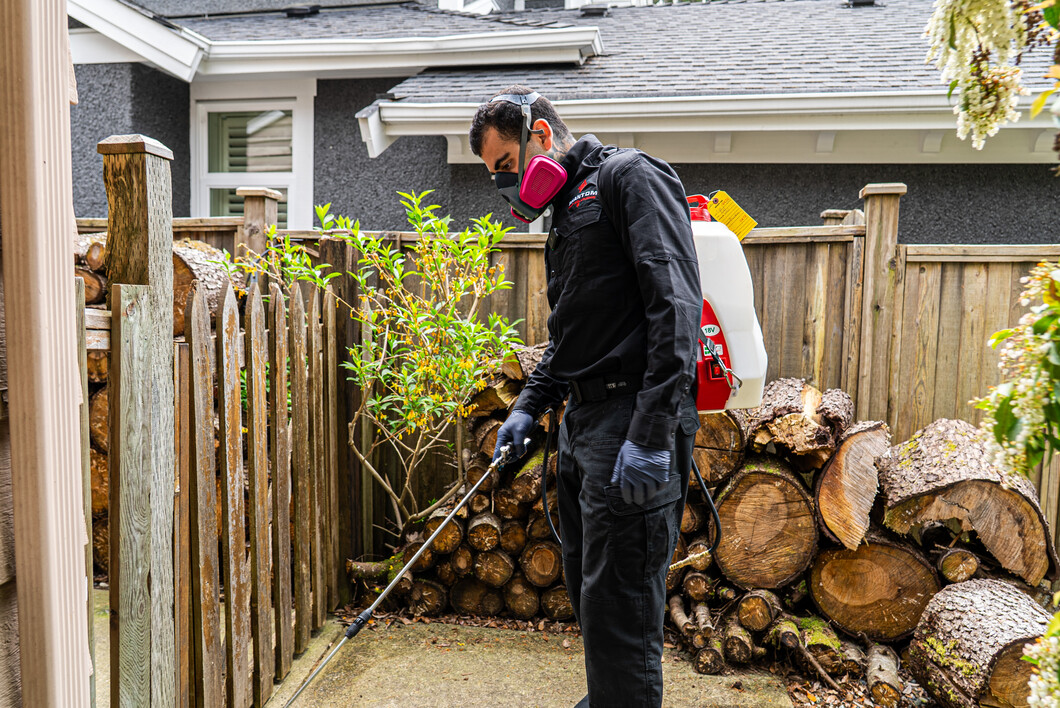
Firewood on the wall and shrubs against the siding give pests a bridge inside.
What You Can Check at a Showing, and What Needs a Technician
A showing is short, but a flashlight and a few minutes tell you a lot. Look, take photos and ask questions, and leave anything you find where it is.
You can
Open the cabinets under the kitchen and bathroom sinks, and look along the garage walls. Health Canada lists droppings, gnawing, tracks on dusty surfaces and holes by the foundation as signs of rodents. Don’t sweep or vacuum droppings: Health Canada warns the dust raised can cause illness.
Bait stations along the walls, traps in the garage or patched holes show that someone dealt with a problem. They don’t prove one now, so ask the seller what was treated, when and by whom.
On the residential form, check questions 3.F (infestation or unrepaired damage) and 3.K (moisture in the walls, basement or crawl space). Damp and pests travel together, so a “yes” to either deserves a closer look.
Needs a technician
A technician goes in where access allows, with the light and the time to read what is there. Adding the attic or crawl space costs $50, waived if you book service the same day.
Our K9 teams detect bed bugs and eggs in mattresses, furniture, baseboards and wall voids. Phantom requires a K9 detection before any bed bug treatment.
Shavings, exit holes and soft wood can be old. Telling carpenter ants from termites, and past damage from live activity, decides whether anything needs treating. More on carpenter ants in walls.
The report shows what we found, how active it is, where pests get in and what we recommend, so you can share it with your agent.
How Our Pest Inspection for Home Buyers and Sellers Works
Five steps, from the first call to the written report, planned around your subject or listing dates.
Tell us the address, the type of home, who arranges access and the date you must decide by. We book visits Monday to Friday, between 9 a.m. and 5 p.m., so call early to find a time that suits both agents.
We walk the rooms, the garage and the yard, then the attic and crawl space where access allows. The roofline, the foundation and the spots where pipes and wires pass through get a close look.
We confirm which pest it is, whether the activity is current or old, and how it gets in. If bed bugs are suspected, a K9 inspection comes next.
You receive a written report with photos showing what we found, where we found it and what we recommend.
If you go ahead, treatment targets what we found. Our rodent program seals gaps up to the size of a toonie, and larger openings are closed through exclusion work.
Once the home is yours, scheduled visits keep watch for rodents and insects.
Before the Inspection: Access and Paperwork
An inspection needs little preparation, but access decides how much can be checked. Here is what helps, from both sides of the sale.
The buyer’s agent books the time with the listing agent. Tell us about lockboxes, alarms, parking and any strata storage locker.
Clear the hatch, the closet below it and the crawl space entry, so a ladder and a light can get in.
They show where activity was and who treated it, so don’t clear them away before the visit.
Pets should be out of the rooms being checked, or away from the home for the visit.
The disclosure statement, any pest control invoices and, in a strata, recent council minutes.
Write down what caught your eye at the showing and where, and attach photos to your estimate request.
After the Inspection: Treating Before Closing or Move-In
What happens next depends on the report and on what buyer and seller agree. The timings below come from our treatment sheets.
Inspection day
The technician checks the home, and the written report with photos follows.
Before subjects come off
Buyer and seller decide with their agents whether to treat, adjust the deal or carry on.
Treatment day
Bed bug and cockroach treatments both need 6 to 8 hours out of the home. Children under 2, nursing mothers, people with breathing conditions and pets stay away for 24 hours, and your sheet lists the full rules.
First 4 to 7 days
After a cockroach treatment, numbers drop sharply within 4 to 7 days, and some may wander out for up to 2 to 3 weeks.
Up to 3 months
Bed bug treatments keep working for up to 3 months. For the first 4 weeks, no mopping or vacuuming within 6 inches of the baseboards.
Treating before you list means buyers walk through a home where the work is done. Keep the invoice and our report with your sale documents for when questions come up.
Keep our report with your closing documents. It records what was found before you took over, which helps if something turns up after you move in.
Reading a Home’s Pest History
The base of the outside walls is where a home’s pest history shows. Rodents get in here, carpenter ants and termites find damp wood here, and past pest control leaves its marks.
Proof of a past program: ask whether it is still running and what it found.
Steel wool or fresh caulk around a pipe marks an old way in; an open gap is a current one.
Firewood stacked against the wall and siding at soil level invite carpenter ants and termites.
Earthen tubes on concrete are a termite sign; soft, damp wood can host carpenter ants or dampwood termites.
Ask the seller what each sign means: who set the bait stations, and is the contract still running? Our own exterior baiting is billed per visit, needs 30 days’ notice to cancel and charges the final visit, so agree with the seller on who cancels it or keeps it. At the end of a rodent program we take our devices away, because devices left in place can draw crawling insects.
A sign is a lead, not a verdict. A bait station shows someone managed rodents, not that they are there now, and a gap shows a way in, not who used it. Even carpenter ants seen outside aren’t proof of a nest: B.C.’s guidance says their presence doesn’t necessarily mean an infestation. The inspection looks for fresh activity before anything is called a problem.
Why Buyers and Sellers Choose Phantom Pest Control
Who does the inspection, what you receive and what it costs, in six lines.
Experience
15+ years of pest control in Vancouver
Credentials
Fully licensed, insured and certified
What you get
A written report with photos of what we found
K9 detection
What it costs
$150 + GST for a house inspection, or $125 + GST for a condo, apartment or townhouse
EXCELLENTTrustindex verifies that the original source of the review is Google. Just wanted to say that we're very happy to have Darcey Walker as our pest control technician as he's always personable, knowledgeable about taking care of our past pest control issues and does a great job!Posted on GoogleTrustindex verifies that the original source of the review is Google. JC from Phantom was very professional and friendly to work with. He came prepared for the first inspection and carefully reviewed our problem and clearly explained the treatment options and timelines. Then we scheduled the follow-on work on the spot for him to come back. In between the two appointments, I found a wasp nest and was able to communicate that to Phantom to add as additional work. All works were completed without issue and the areas tidied to remove any debris. Thank you for taking care of everything so efficiently! Would definitely go back to JC and the team for future needs.Posted on GoogleTrustindex verifies that the original source of the review is Google. Joy and Yash have been great to work with, very prompt and thorough.Posted on GoogleTrustindex verifies that the original source of the review is Google. June was fantastic!! I was concerned that having a termite inspection done by a pest control company would just lead to an aggressive sales pitch for their services, so I specifically chose a company like Pantone who don’t do free inspections. June did a thorough inspection, checked everything available nook and cranny explained everything he was seeing and allayed my worries. Not once did he try to upsell a service or push for some needless preventative measure. I was very happy with the service.Posted on GoogleTrustindex verifies that the original source of the review is Google. The technicians that came to our building to try and exterminate a wasp nest did a great job. Darcy and June we're very capable of removing the Wasps from the eaves in our roof. I can highly recommend them.Posted on GoogleTrustindex verifies that the original source of the review is Google. Exceptional service from Darcy! Always professional, and knowledgeable. He has a knack for attention to detail, and really takes the time to explain the issues with a resolve. Reliable and very friendly A+ Highly recommend!Posted on GoogleTrustindex verifies that the original source of the review is Google. June was so kind and tremendously helpful!Posted on GoogleTrustindex verifies that the original source of the review is Google. Phantom pest did a great job with our mouse and cockroach problem. JC was a wonder to work with and we will be using them in the future if need be. Thanks!Posted on GoogleTrustindex verifies that the original source of the review is Google. This is a very good company. The technician Mark is so nice and very professional.Posted on GoogleTrustindex verifies that the original source of the review is Google. Had a rodent problem, Darcey came over and took care of it. Appreciate the quick response and great job! Thank you!
Pest Inspections for Home Sales Across Vancouver & Fraser Valley
We inspect houses, townhouses and condos for buyers, sellers and their agents across Metro Vancouver, the North Shore and the Fraser Valley.
Vancouver & North Shore
Burnaby & Tri-Cities
Richmond & Delta
Fraser Valley
More Services for Your New Home
Where to go next, once the report is in.
A dog-led check of a home or unit before your furniture moves in.
Sealing the larger gaps an inspection finds, from a detailed exclusion plan.
Scheduled visits for rodents and insects once the home is yours.
Our home services, plus a page for each type of home.
Home Buyer and Seller Pest Inspection FAQs
Straight answers to what buyers, sellers and agents ask before a home changes hands.
Prefer to talk?
Do home inspectors check for pests in B.C.?
Usually not as a dedicated pest search. Consumer Protection BC describes B.C. home inspections as visual, non-invasive assessments of accessible areas of a home, and the contract sets out what is and isn’t covered. The inspector’s report must point out anything they recommend getting expert advice on. A pest inspection is that expert check: a technician looks for live activity, old damage and the gaps pests use, including the attic and crawl space where access allows. Read your home inspection contract to see what it includes.
Do you need a pest inspection when buying a house?
It’s your choice, and some homes give more reason than others. The disclosure form itself reminds buyers to make their own inquiries, because a seller’s knowledge of the home may be incomplete. Book one if you saw droppings, shavings or bait stations at a showing, if the disclosure answers mention infestation or moisture, or if the home is older or has stood empty. B.C.’s carpenter ant guidance also flags homes surrounded by forest, on earthen crawl spaces or with decaying timbers in the foundation. More on older Vancouver homes.
Who pays for a pest inspection, the buyer or the seller?
Whoever orders it, and our fee doesn’t change with the side that pays. A seller can order one before listing and hand the report to interested buyers; a buyer can still order their own. Splitting the cost of any treatment is part of the negotiation between buyer and seller, with their agents.
Do sellers have to disclose pests in B.C.?
Known material latent defects must be disclosed. Whether a pest problem counts depends on the facts, so ask your lawyer, notary or real estate agent. BCFSA, the province’s real estate regulator, describes these as defects a reasonable inspection would not reveal that make a home potentially dangerous or costly to repair. The residential disclosure statement also asks directly about infestation and unrepaired pest damage, and BCREA’s notes remind sellers that they are legally responsible for the accuracy of their answers.
How much does a pest inspection cost?
A house is $150 + GST to inspect, and a condo, apartment or townhouse is $125 + GST. The other prices that can come up in a sale:
- Attic or crawl space: $50 more, waived if you book service the same day
- K9 bed bug inspection: $195–$275 + GST for one home or unit
- K9 in a building: $250 + GST for the first unit and the common area, then $35 + GST per additional unit
Estimates over the phone are free. Prices can change with the size of the property, and each service page shows its current range.
Are there termites in Vancouver?
Yes. Phantom’s termite page names the dampwood termite as the primary species in Vancouver and the Lower Mainland; it lives inside wet or decaying timber. The B.C. Ministry of Agriculture also records subterranean termites in the City of Vancouver, with winged swarmers in April and May. Carpenter ants are easily mistaken for them: ants have a narrow waist and elbowed antennae, termites a broad waist and straight antennae. An inspection tells you which you have, and whether it is active.
Do condos and townhouses need a pest inspection?
It’s often worth it, and look beyond the unit, because pests can move between homes in a building. Phantom’s K9 page notes that bed bugs spread between units through wall voids, electrical conduits and shared spaces. Pair the unit inspection with the strata’s records: ask the seller for recent council minutes, which under the Strata Property Act the strata must provide to an owner, or to someone the owner authorizes in writing, within 2 weeks. Minutes can show building-wide pest treatments.
Can a K9 check a vacant condo for bed bugs?
Yes, and it’s worth doing in an empty unit. University of Kentucky entomologists note that when apartments are vacant, bed bugs often spread to nearby units or reduce their activity until the unit is reoccupied, so a unit can look clean and still have them. The dog checks places people can’t see into, from mattresses to wall voids. Before the visit, the K9 sheet rules out household cleaners and disinfectants for 24 hours and cooking for 2 hours, with fans off and no pets in the unit.
Should you get pest control before moving in?
Only if the inspection found something, and then it’s the easiest time. Bare rooms already meet our bed bug sheet’s rule of furniture 2 feet from the walls, and nobody has to leave a lived-in home for the 6 to 8 hours after a bed bug or cockroach treatment. Gaps are also easier to seal before boxes fill the garage. If nothing turned up, skip treatment and consider regular maintenance once you’re settled.
What happens if the inspection finds pests?
You get the facts to decide with. The written report shows what we found, how active it is and how pests get in, and we can quote the treatment and any sealing. Buyer and seller then agree, with their agents, whether the seller treats before completion, the price changes, or the buyer handles it after possession. We don’t advise on contract terms, but we can book treatment around either side’s dates.
Check Before You Close
Tell us the address, your deadline and anything you noticed. A photo helps.
Inspections start at $125 + GST for a condo, apartment or townhouse and $150 + GST for a house, with a written report and photos.